







Question: 26. Why does the birthday problem apply to cryptographic hashes? a. Because they work in binary. b. Because they are iterative. c. Because the apply
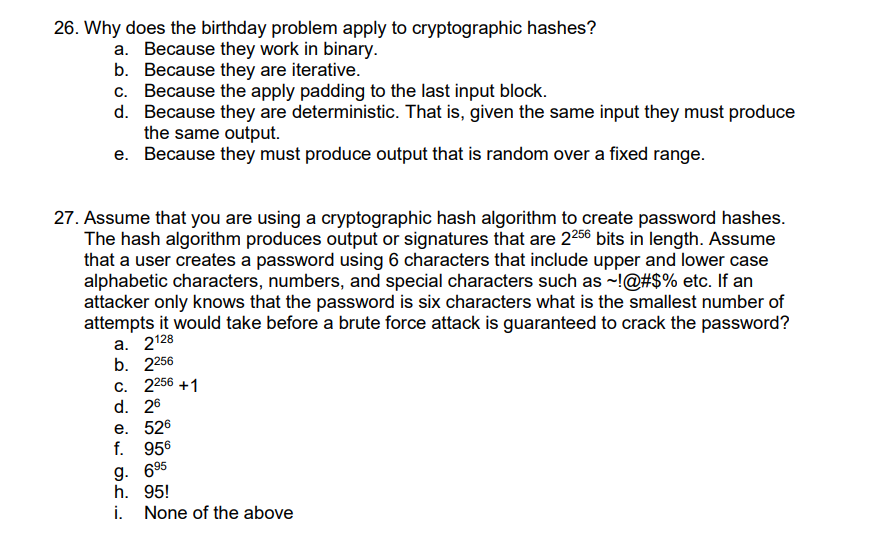
26. Why does the birthday problem apply to cryptographic hashes? a. Because they work in binary. b. Because they are iterative. c. Because the apply padding to the last input block. d. Because they are deterministic. That is, given the same input they must produce the same output. e. Because they must produce output that is random over a fixed range. 27. Assume that you are using a cryptographic hash algorithm to create password hashes. The hash algorithm produces output or signatures that are 2256 bits in length. Assume that a user creates a password using 6 characters that include upper and lower case alphabetic characters, numbers, and special characters such as @@#$% etc. If an attacker only knows that the password is six characters what is the smallest number of attempts it would take before a brute force attack is guaranteed to crack the password? a. 2128 b. 2256 c. 2256+1 d. 26 e. 526 f. 956 g. 695 h. 95! i. None of the above
Step by Step Solution
There are 3 Steps involved in it

Get step-by-step solutions from verified subject matter experts
 Study Help