







Question: 3. (20 points total) The continuous timing method in direct time study was used to obtain the times for a worker-machine task as indicated in
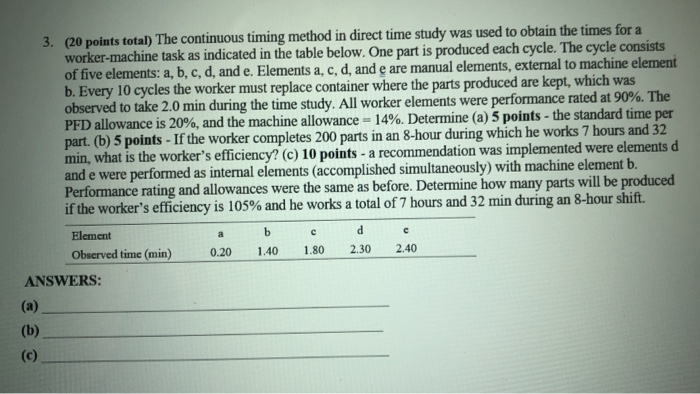
3. (20 points total) The continuous timing method in direct time study was used to obtain the times for a worker-machine task as indicated in the table below. One part is produced each cycle. The cycle consists of five elements: a, b, c, d, and e. Elements a, c, d, and e are manual elements, external to machine element b. Every 10 cycles the worker must replace container where the parts produced are kept, which was observed to take 2.0 min during the time study. All worker elements were performance rated at 90%. The PFD allowance is 20%, and the machine allowance = 14%. Determine (a) 5 points - the standard time per part. (b) 5 points - If the worker completes 200 parts in an 8-hour during which he works 7 hours and 32 min, what is the worker's efficiency? (c) 10 points - a recommendation was implemented were elements d and e were performed as internal elements (accomplished simultaneously) with machine element b. Performance rating and allowances were the same as before. Determine how many parts will be produced if the worker's efficiency is 105% and he works a total of 7 hours and 32 min during an 8-hour shift. Element Observed time (min) ANSWERS: 0.20 1.40 1.80 2.30 2.40 (b) (c)
Step by Step Solution
There are 3 Steps involved in it

Get step-by-step solutions from verified subject matter experts
 Study Help