



Question: 3. (3 points) Recycle streams can increase the complexity of a process. Shown below is a well-mixed tank with a heater. In this process, a
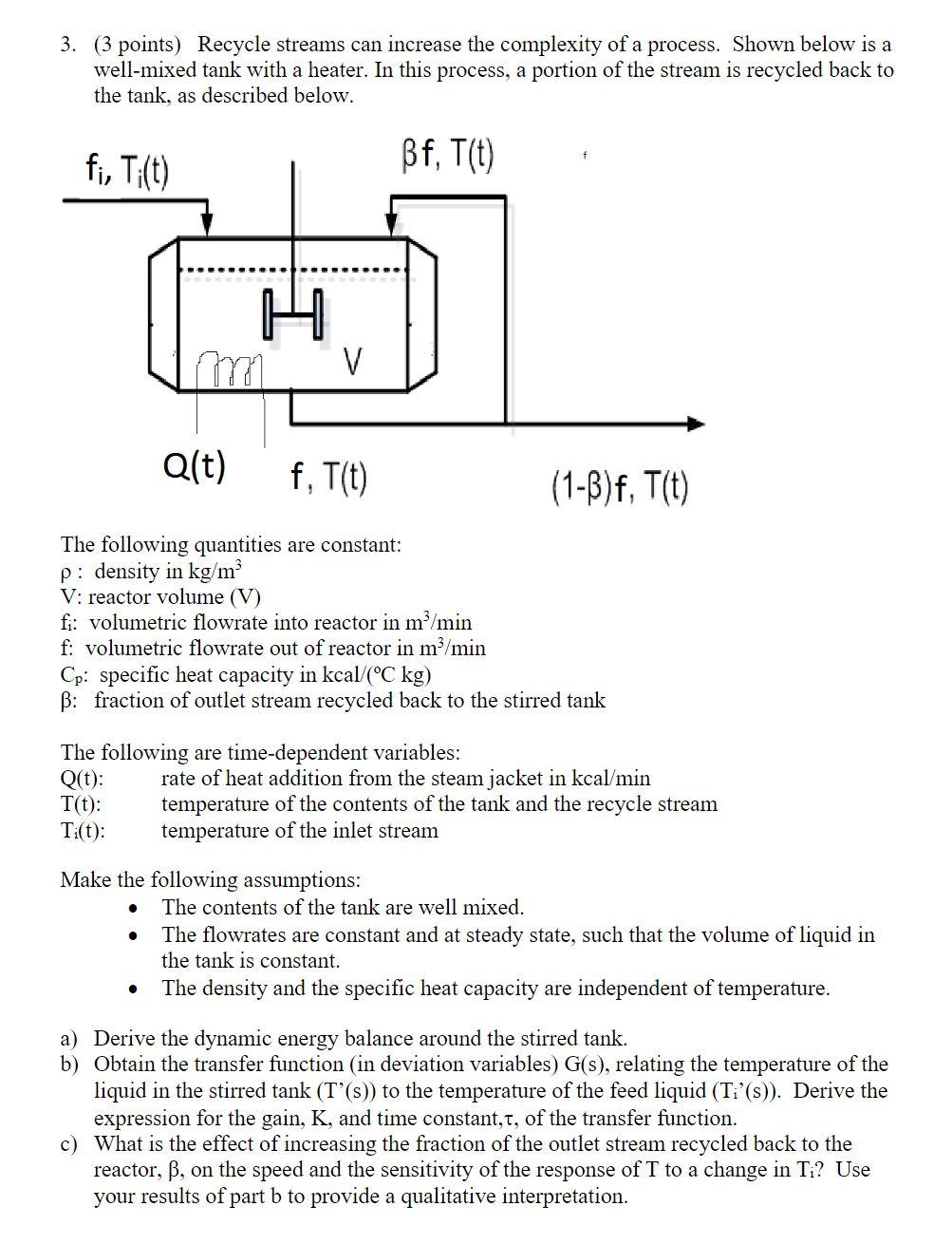
3. (3 points) Recycle streams can increase the complexity of a process. Shown below is a well-mixed tank with a heater. In this process, a portion of the stream is recycled back to the tank, as described below. fi, Tit) Bf, T(t) I m V Q(t) f, T(t) (1-B)f, T(t) The following quantities are constant: p: density in kg/m V: reactor volume (V) fi volumetric flowrate into reactor in m?/min f: volumetric flowrate out of reactor in m/min Cp: specific heat capacity in kcal/(C kg) B: fraction of outlet stream recycled back to the stirred tank The following are time-dependent variables: Q(t): rate of heat addition from the steam jacket in kcal/min T(t): temperature of the contents of the tank and the recycle stream Ti(t): temperature of the inlet stream Make the following assumptions: The contents of the tank are well mixed. The flowrates are constant and at steady state, such that the volume of liquid in the tank is constant. The density and the specific heat capacity are independent of temperature. a) Derive the dynamic energy balance around the stirred tank. b) Obtain the transfer function (in deviation variables) G(s), relating the temperature of the liquid in the stirred tank (T(s)) to the temperature of the feed liquid (Ti(s)). Derive the expression for the gain, K, and time constant,t, of the transfer function. c) What is the effect of increasing the fraction of the outlet stream recycled back to the reactor, , on the speed and the sensitivity of the response of T to a change in T;? Use your results of part b to provide a qualitative interpretation. 3. (3 points) Recycle streams can increase the complexity of a process. Shown below is a well-mixed tank with a heater. In this process, a portion of the stream is recycled back to the tank, as described below. fi, Tit) Bf, T(t) I m V Q(t) f, T(t) (1-B)f, T(t) The following quantities are constant: p: density in kg/m V: reactor volume (V) fi volumetric flowrate into reactor in m?/min f: volumetric flowrate out of reactor in m/min Cp: specific heat capacity in kcal/(C kg) B: fraction of outlet stream recycled back to the stirred tank The following are time-dependent variables: Q(t): rate of heat addition from the steam jacket in kcal/min T(t): temperature of the contents of the tank and the recycle stream Ti(t): temperature of the inlet stream Make the following assumptions: The contents of the tank are well mixed. The flowrates are constant and at steady state, such that the volume of liquid in the tank is constant. The density and the specific heat capacity are independent of temperature. a) Derive the dynamic energy balance around the stirred tank. b) Obtain the transfer function (in deviation variables) G(s), relating the temperature of the liquid in the stirred tank (T(s)) to the temperature of the feed liquid (Ti(s)). Derive the expression for the gain, K, and time constant,t, of the transfer function. c) What is the effect of increasing the fraction of the outlet stream recycled back to the reactor, , on the speed and the sensitivity of the response of T to a change in T;? Use your results of part b to provide a qualitative interpretation
Step by Step Solution
There are 3 Steps involved in it

Get step-by-step solutions from verified subject matter experts