



Question: 3. According to Equation (1.1), The p-p process produces a pair of positrons. A positron is an antielectron; when a slow-moving positron encounters an electron,
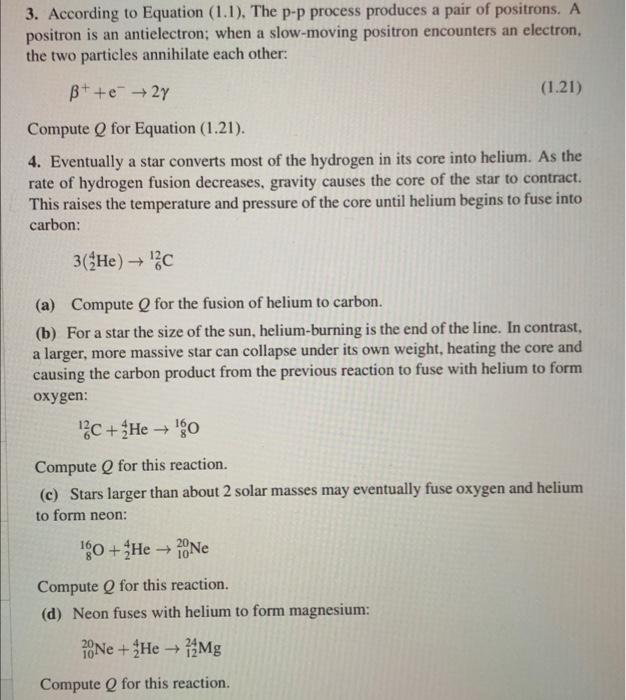
3. According to Equation (1.1), The p-p process produces a pair of positrons. A positron is an antielectron; when a slow-moving positron encounters an electron, the two particles annihilate each other: ++e2 Compute Q for Equation (1.21). 4. Eventually a star converts most of the hydrogen in its core into helium. As the rate of hydrogen fusion decreases, gravity causes the core of the star to contract. This raises the temperature and pressure of the core until helium begins to fuse into carbon: 3(24He)612C (a) Compute Q for the fusion of helium to carbon. (b) For a star the size of the sun, helium-burning is the end of the line. In contrast, a larger, more massive star can collapse under its own weight, heating the core and causing the carbon product from the previous reaction to fuse with helium to form oxygen: 612C+24He816O Compute Q for this reaction. (c) Stars larger than about 2 solar masses may eventually fuse oxygen and helium to form neon: 816O+24He1020Ne Compute Q for this reaction. (d) Neon fuses with helium to form magnesium: 1020Ne+24He1224Mg Compute Q for this reaction
Step by Step Solution
There are 3 Steps involved in it

Get step-by-step solutions from verified subject matter experts