







Question: 3. Go-Back-N and selective repeat Assuming a source has sent 10 packets (marked by sequence number #1 to #10) and received the acknowledgments for these
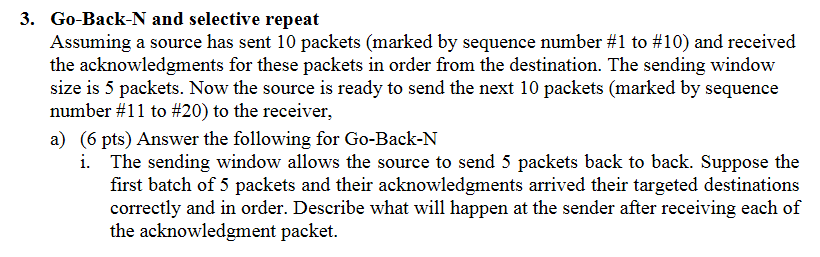
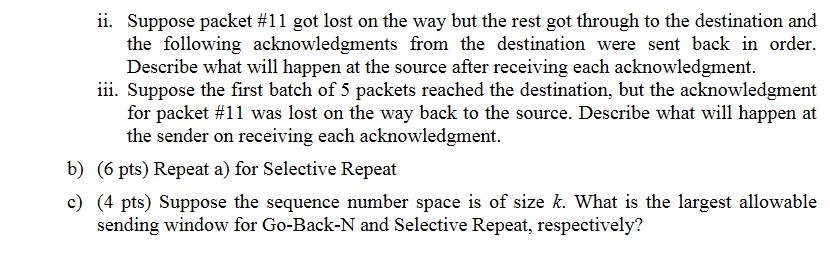
3. Go-Back-N and selective repeat Assuming a source has sent 10 packets (marked by sequence number #1 to #10) and received the acknowledgments for these packets in order from the destination. The sending window size is 5 packets. Now the source is ready to send the next 10 packets (marked by sequence number #11 to #20) to the receiver, a) (6 pts) Answer the following for Go-Back-N i. The sending window allows the source to send 5 packets back to back. Suppose the first batch of 5 packets and their acknowledgments arrived their targeted destinations correctly and in order. Describe what will happen at the sender after receiving each of the acknowledgment packet. ii. Suppose packet #11 got lost on the way but the rest got through to the destination and the following acknowledgments from the destination were sent back in order. Describe what will happen at the source after receiving each acknowledgment. iii. Suppose the first batch of 5 packets reached the destination, but the acknowledgment for packet #11 was lost on the way back to the source. Describe what will happen at the sender on receiving each acknowledgment. b) (6 pts) Repeat a) for Selective Repeat c) (4 pts) Suppose the sequence number space is of size k. What is the largest allowable sending window for Go-Back-N and Selective Repeat, respectively
Step by Step Solution
There are 3 Steps involved in it

Get step-by-step solutions from verified subject matter experts
 Study Help