







Question: 3. In this question, let's consider a domain of objects that are dinner meals: 1. Appetizer: {salad(s),soup(s)} 2. Entree: {beef(f), fish (f)} 3. Drink: {beer(w),
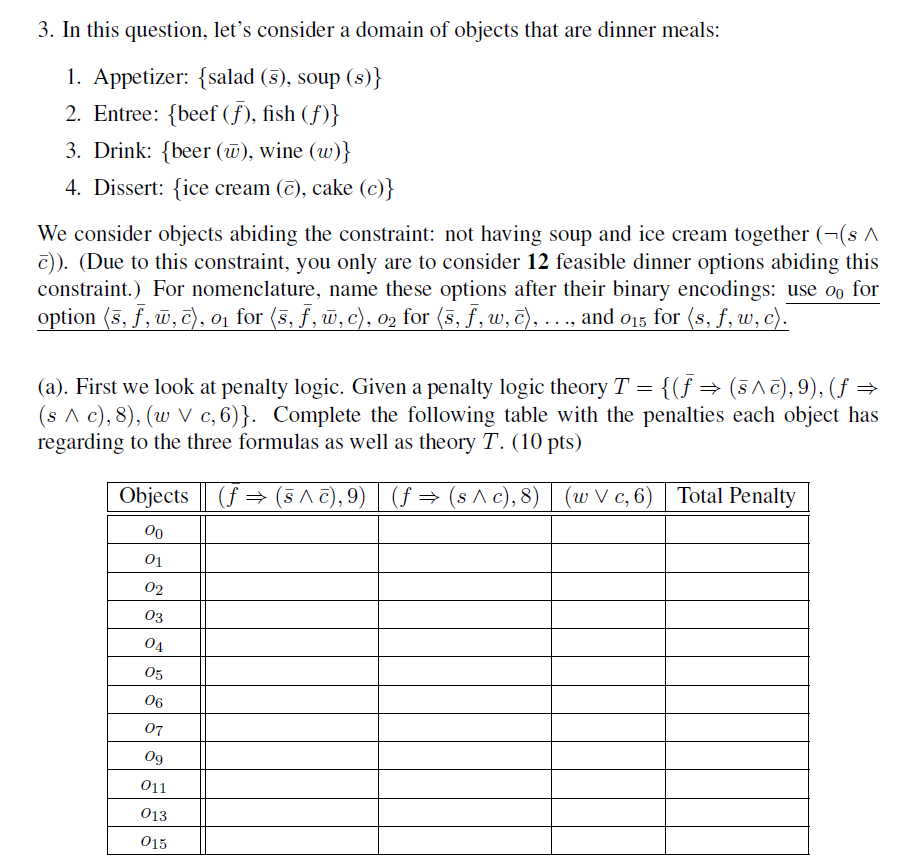
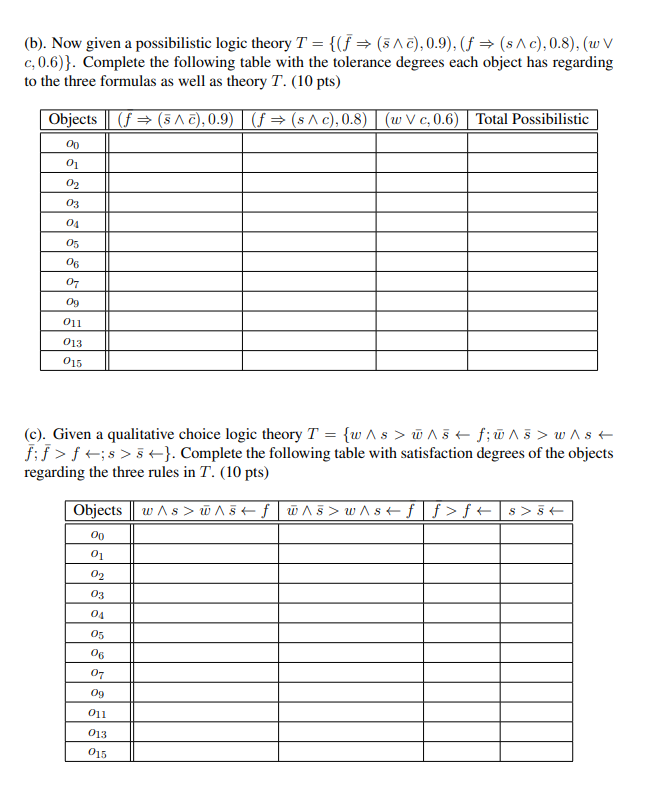
3. In this question, let's consider a domain of objects that are dinner meals: 1. Appetizer: {salad(s),soup(s)} 2. Entree: {beef(f), fish (f)} 3. Drink: {beer(w), wine (w)} 4. Dissert: { ice cream (c), cake (c)} We consider objects abiding the constraint: not having soup and ice cream together ((s c) ). (Due to this constraint, you only are to consider 12 feasible dinner options abiding this constraint.) For nomenclature, name these options after their binary encodings: useo0for option s,f,w,c,o1 for s,f,w,c,o2 for s,f,w,c,, and o15 for s,f,w,c. (a). First we look at penalty logic. Given a penalty logic theory T={(f(sc),9),(f (sc),8),(wc,6)}. Complete the following table with the penalties each object has regarding to the three formulas as well as theory T. (10 pts) (b). Now given a possibilistic logic theory T={(f(sc),0.9),(f(sc),0.8),(w c,0.6)}. Complete the following table with the tolerance degrees each object has regarding to the three formulas as well as theory T.(10pts) (c). Given a qualitative choice logic theory T={ws>wsf;ws>ws f;f>f;s>s}. Complete the following table with satisfaction degrees of the objects regarding the three rules in T.(10pts)
Step by Step Solution
There are 3 Steps involved in it

Get step-by-step solutions from verified subject matter experts
 Study Help