







Question: 3. k-Nearest Neighbors Given the same training data in question 1 (Buy_Computer dataset example), use k Nearest Neighbor algorithm (k=3) to predict the class for
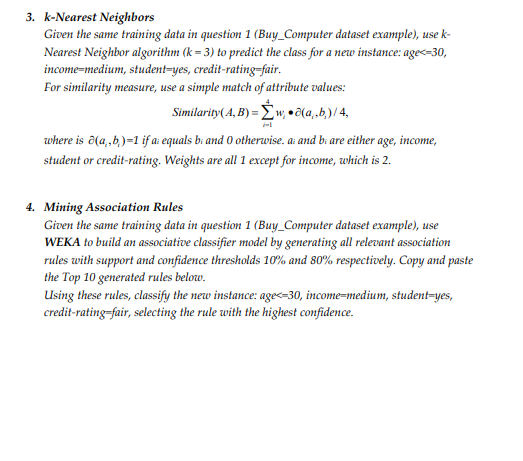
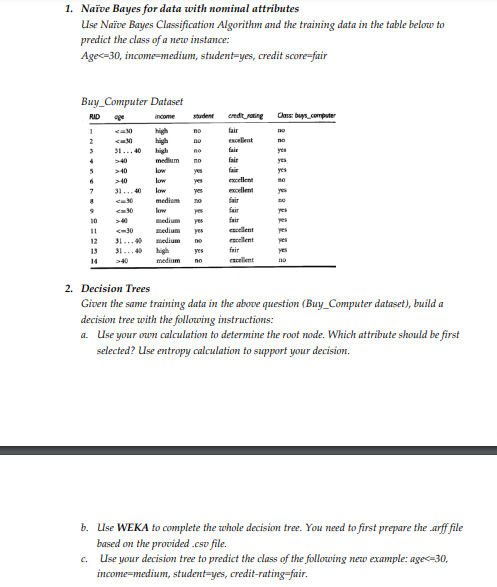
3. k-Nearest Neighbors Given the same training data in question 1 (Buy_Computer dataset example), use k Nearest Neighbor algorithm (k=3) to predict the class for a new instance: age= yes, credit-rating = fair. For similarity measure, use a simple match of attribute values: Similarity(A,B)=i=14wi(ai,bi)/4, where is (ai,bi)=1 if ai equals bi and 0 otherwise. ai and bi are either age, income, student or credit-rating. Weights are all 1 except for income, which is 2. 4. Mining Association Rules Given the same training data in question 1 (Buy_Computer dataset example), use WEKA to build an associative classifier model by generating all relevant association rules with support and confidence thresholds 10% and 80% respectively. Copy and paste the Top 10 generated rules below. Using these rules, classify the new instance: age=30, income = medium, student =y yes, credit-rating=fair, selecting the rule with the highest confidence. 1. Nave Bayes for data with nominal attributes Use Nve Bayes Classification Algorithm and the training data in the table below to predict the dass of a new instance: Age
Step by Step Solution
There are 3 Steps involved in it

Get step-by-step solutions from verified subject matter experts
 Study Help