





Question: 3. Three models A, B and C are to be assembled on a mixed model line, Hourly production rates for the three models are: A,
3. Three models A, B and C are to be assembled on3. Three models A, B and C are to be assembled on

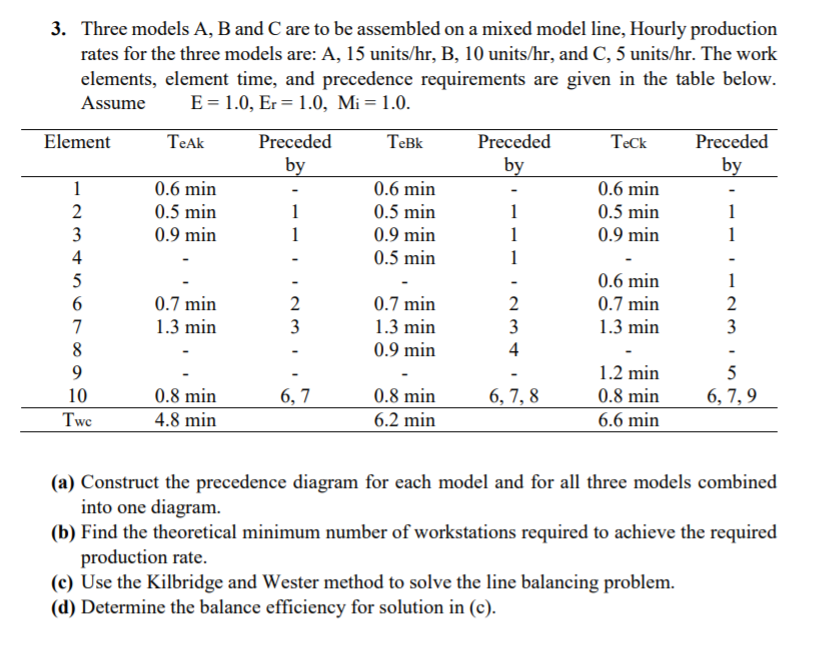
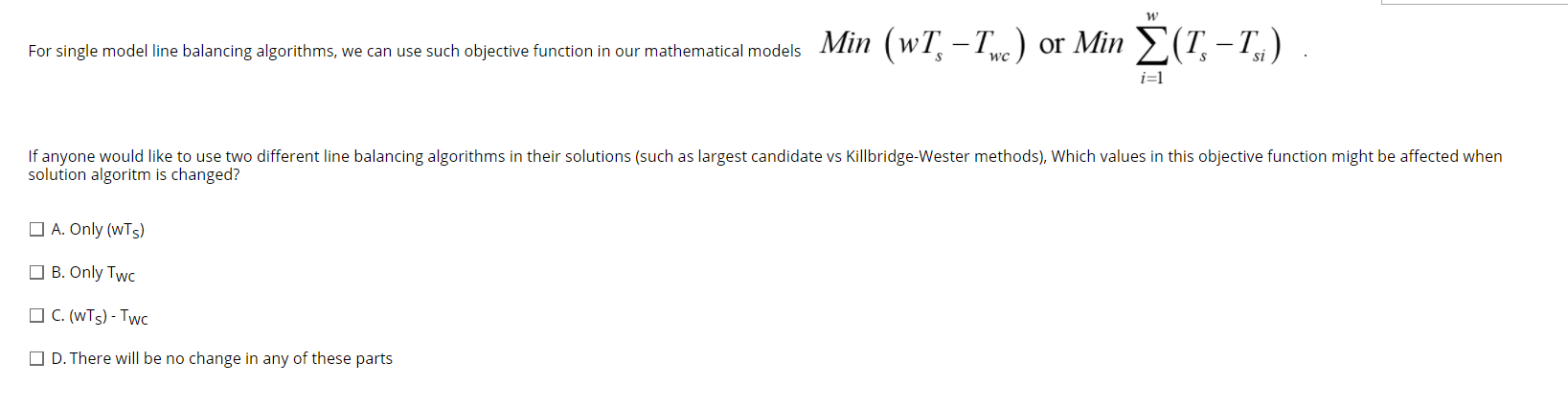
3. Three models A, B and C are to be assembled on a mixed model line, Hourly production rates for the three models are: A, 15 units/hr, B, 10 units/hr, and C, 5 units/hr. The work elements, element time, and precedence requirements are given in the table below. Assume E= 1.0, Er = 1.0, Mi = 1.0. Element Teak TeBk Teck Preceded by Preceded by Preceded by 0.6 min 0.5 min 0.9 min 1 1 0.6 min 0.5 min 0.9 min 0.5 min 1 1 1 0.6 min 0.5 min 0.9 min 1 1 1 2 3 4 5 6 7 8 9 10 Twe 0.7 min 1.3 min 2 3 0.7 min 1.3 min 0.9 min 2 3 4 0.6 min 0.7 min 1.3 min 1 2 3 5 6, 7,9 0.8 min 4.8 min 6, 7 6, 7,8 1.2 min 0.8 min 6.6 min 0.8 min 6.2 min (a) Construct the precedence diagram for each model and for all three models combined into one diagram. (b) Find the theoretical minimum number of workstations required to achieve the required production rate. (c) Use the Kilbridge and Wester method to solve the line balancing problem. (d) Determine the balance efficiency for solution in (c). W For single model line balancing algorithms, we can use such objective function in our mathematical models Min (wT, -Twe) or Min (T. -T:) i=1 If anyone would like to use two different line balancing algorithms in their solutions (such as largest candidate vs Killbridge-Wester methods), Which values in this objective function might be affected when solution algoritm is changed? A. Only (wts) B. Only Twc C. (WTS) - Twc D. There will be no change in any of these parts

Step by Step Solution

There are 3 Steps involved in it

1 Expert Approved Answer
Step: 1 Unlock blur-text-image

Question Has Been Solved by an Expert!

Get step-by-step solutions from verified subject matter experts

Step: 2 Unlock
Step: 3 Unlock

Students Have Also Explored These Related General Management Questions!