







Question: 4. Calculate the molar extinction coefficient for a 95.3mq/L solution of [Cu(NH3)4]2+ if a percent transmittance of 56.12% was measured with a cell path length
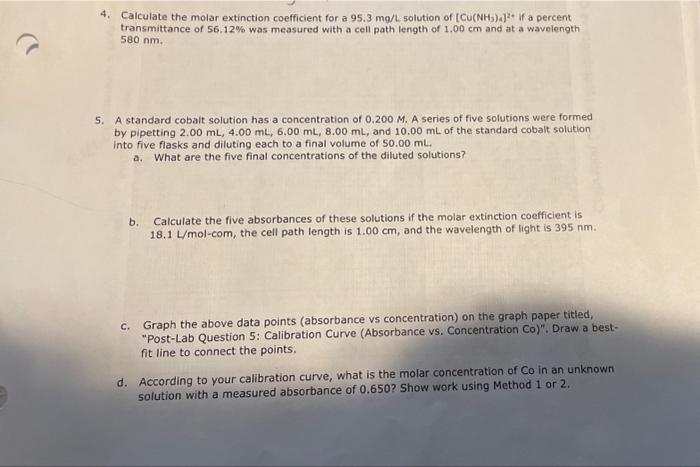
4. Calculate the molar extinction coefficient for a 95.3mq/L solution of [Cu(NH3)4]2+ if a percent transmittance of 56.12% was measured with a cell path length of 1.00cm and at a wavelength 580nm. 5. A standard cobalt solution has a concentration of 0.200M. A series of five solutions were formed by pipetting 2.00mL,4.00mL,6.00mL,8.00mL, and 10.00mL of the standard cobalt solution into five flasks and diluting each to a final volume of 50.00mL. a. What are the five final concentrations of the diluted solutions? b. Calculate the five absorbances of these solutions if the molar extinction coefficient is 18.1L/mol-com, the cell path length is 1.00cm, and the wavelength of light is 395nm. c. Graph the above data points (absorbance vs concentration) on the graph paper titled, "Post-Lab Question 5: Calibration Curve (Absorbance vs. Concentration Co)". Draw a bestfit line to connect the points. d. According to your calibration curve, what is the molar concentration of Co in an unknown solution with a measured absorbance of 0.650 ? Show work using Method 1 or 2
Step by Step Solution
There are 3 Steps involved in it

Get step-by-step solutions from verified subject matter experts
 Study Help