





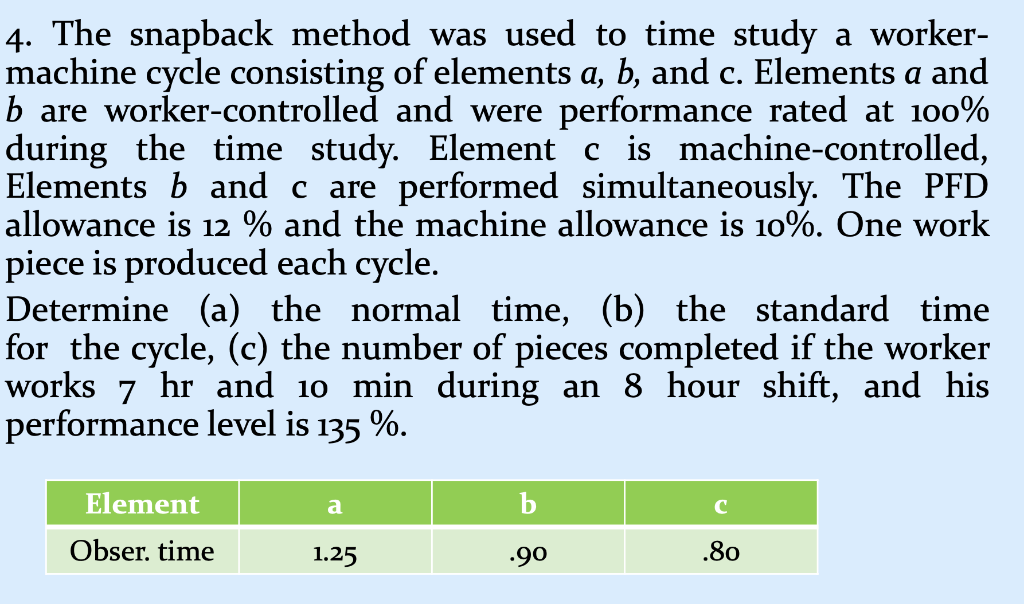
Question: 4. The snapback method was used to time study a worker- machine cycle consisting of elements a, b, and c. Elements a and b are
4. The snapback method was used to time study a4. The snapback method was used to time study a

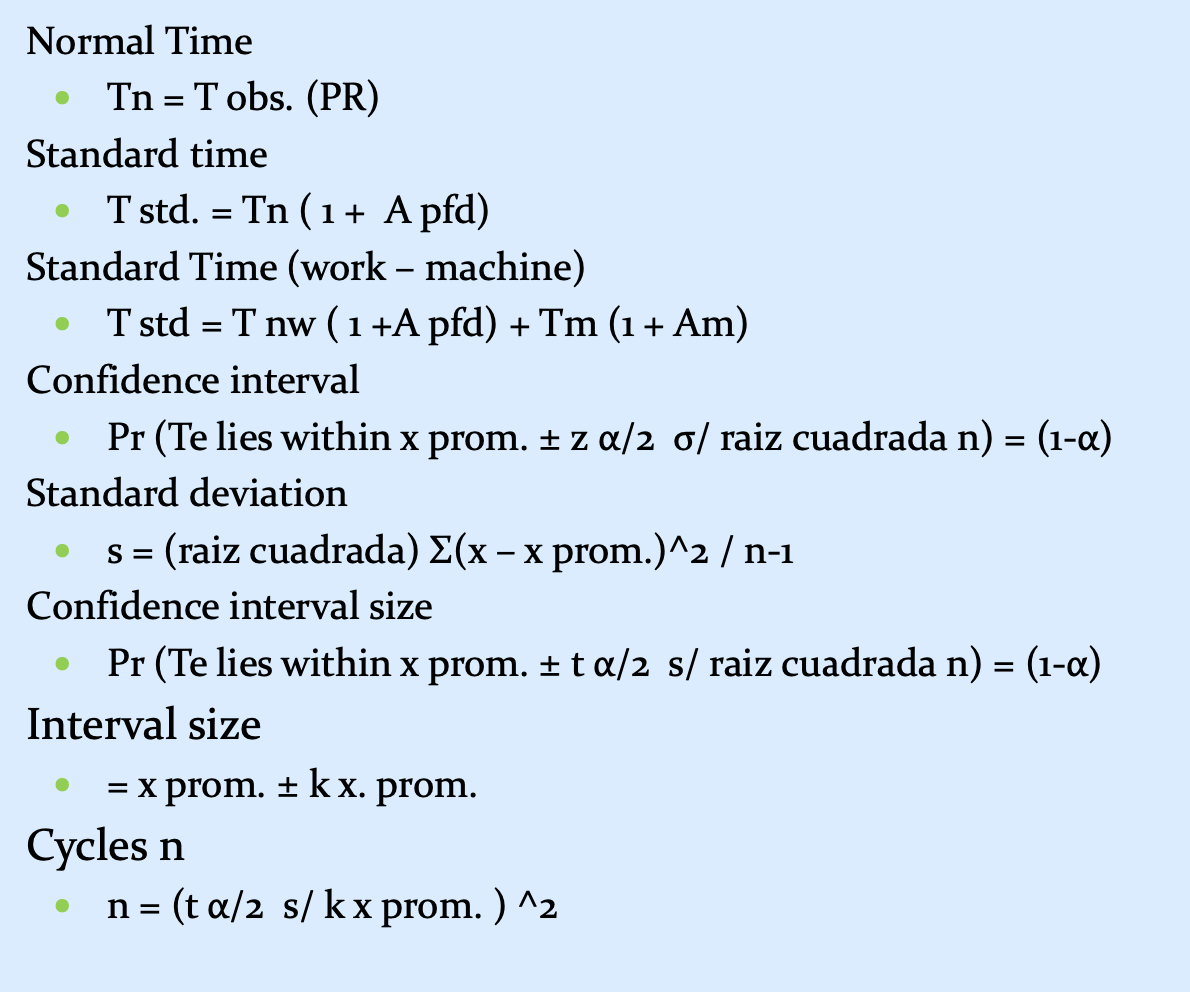
4. The snapback method was used to time study a worker- machine cycle consisting of elements a, b, and c. Elements a and b are worker-controlled and were performance rated at 100% during the time study. Element c is machine-controlled, Elements b and c are performed simultaneously. The PFD allowance is 12 % and the machine allowance is 10%. One work piece is produced each cycle. Determine (a) the normal time, (b) the standard time for the cycle, (c) the number of pieces completed if the worker works 7 hr and 10 min during an 8 hour shift, and his performance level is 135 %. Element a b Obser. time 1.25 .90 .80 Normal Time Tn = T obs. (PR) Standard time T std. = Tn (1+ A pfd) Standard Time (work - machine) T std = T nw ( 1 +A pfd) + Tm (1 + Am) Confidence interval Pr (Te lies within x prom. z a/2 o/ raiz cuadrada n) = (1-a) Standard deviation S = (raiz cuadrada) (x - x prom.)^2 / n-1 Confidence interval size Pr (Te lies within x prom. Ita/2 s/ raiz cuadrada n) = (1-x) Interval size x prom. = kx. prom. Cycles n n= (t a/2 s/kx prom.) ^2 =

Step by Step Solution

There are 3 Steps involved in it

1 Expert Approved Answer
Step: 1 Unlock blur-text-image

Question Has Been Solved by an Expert!

Get step-by-step solutions from verified subject matter experts

Step: 2 Unlock
Step: 3 Unlock

Students Have Also Explored These Related General Management Questions!