



Question: 5 . 1 1 This exercise examines the effect of different cache designs, specifically comparing associative caches to the direct - mapped caches from Section
This exercise examines the effect of different cache designs, specifically comparing associative caches to the directmapped caches from Section For these exercises, refer to the sequence of word address shown below.
xbe,
xce
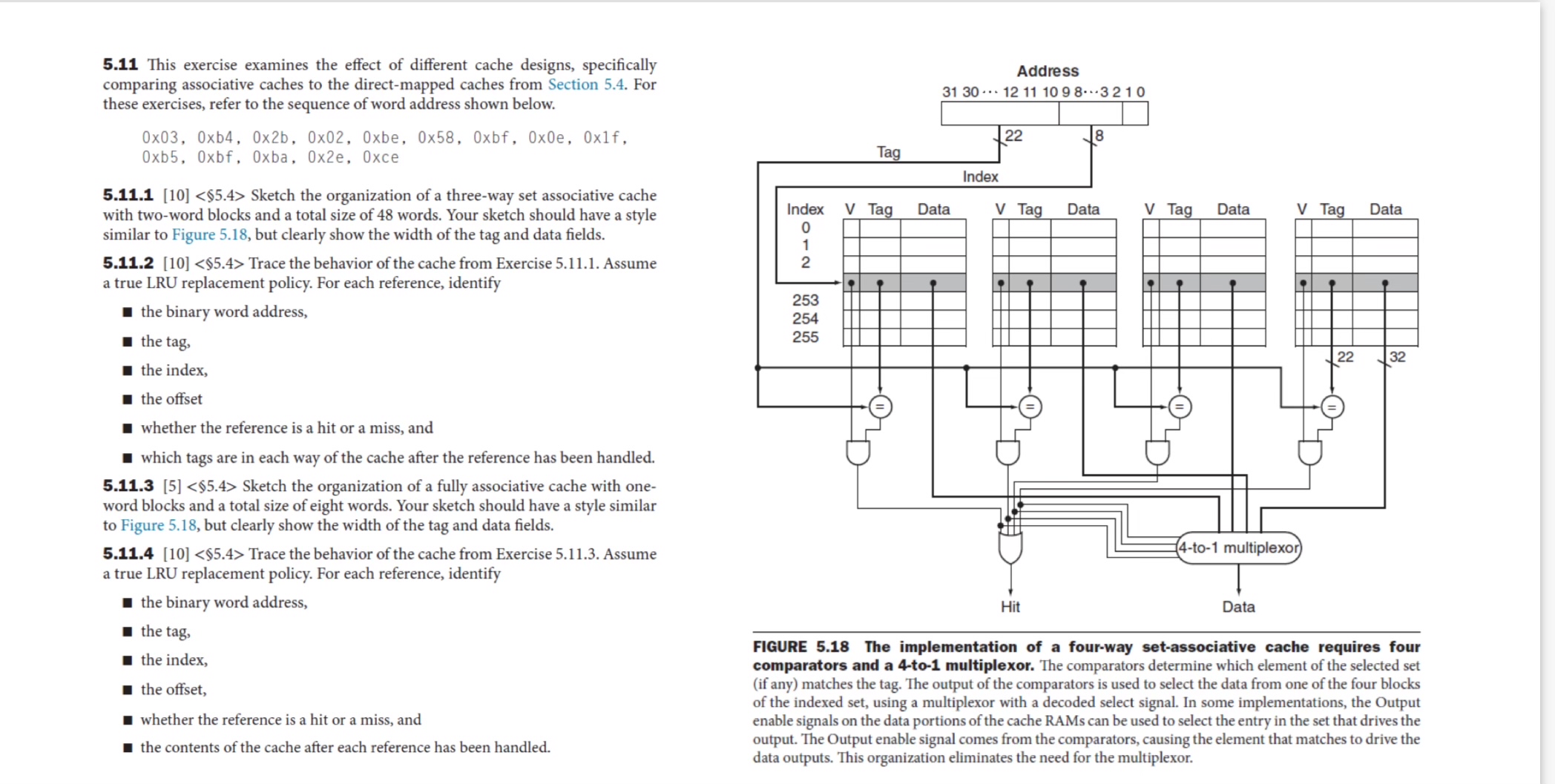
$ Sketch the organization of a threeway set associative cache with twoword blocks and a total size of words. Your sketch should have a style similar to Figure but clearly show the width of the tag and data fields.
$ Trace the behavior of the cache from Exercise Assume a true LRU replacement policy. For each reference, identify
the binary word address,
the tag,
the index,
the offset
whether the reference is a hit or a miss, and
which tags are in each way of the cache after the reference has been handled.
Sketch the organization of a fully associative cache with oneword blocks and a total size of eight words. Your sketch should have a style similar to Figure but clearly show the width of the tag and data fields.
$ Trace the behavior of the cache from Exercise Assume a true LRU replacement policy. For each reference, identify
the binary word address,
the tag,
the index,
the offset,
whether the reference is a hit or a miss, and
the contents of the cache after each reference has been handled.
Address
FIGURE The implementation of a fourway setassociative cache requires four comparators and a to multiplexor. The comparators determine which element of the selected set if any matches the tag. The output of the comparators is used to select the data from one of the four blocks of the indexed set, using a multiplexor with a decoded select signal. In some implementations, the Output enable signals on the data portions of the cache RAMs can be used to select the entry in the set that drives the output. The Output enable signal comes from the comparators, causing the element that matches to drive the data outputs. This organization eliminates the need for the multiplexor.
Step by Step Solution
There are 3 Steps involved in it
1 Expert Approved Answer
Step: 1 Unlock

Question Has Been Solved by an Expert!
Get step-by-step solutions from verified subject matter experts
Step: 2 Unlock
Step: 3 Unlock