





Question: 5. A consumer preference study compares the effects of three different bottle designs (A, B, and C) on sales of a popular fabric softener. A
5. A consumer preference study compares the
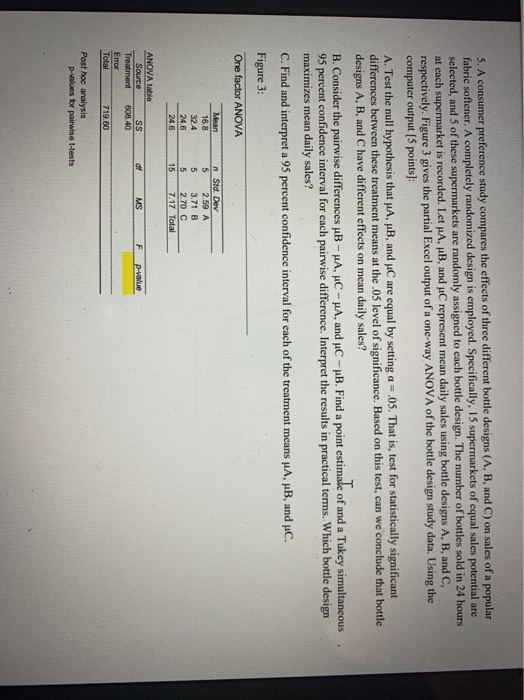
5. A consumer preference study compares the effects of three different bottle designs (A, B, and C) on sales of a popular fabric softener. A completely randomized design is employed. Specifically, 15 supermarkets of equal sales potential are selected, and 5 of these supermarkets are randomly assigned to each bottle design. The number of bottles sold in 24 hours at each supermarket is recorded. Let A, B, and C represent mean daily sales using bottle designs A, B, and C. respectively. Figure 3 gives the partial Excel output of a one-way ANOVA of the bottle design study data. Using the computer output [5 points): A. Test the null hypothesis that A, B, and Care equal by setting a - .05. That is, test for statistically significant differences between these treatment means at the .05 level of significance. Based on this test, can we conclude that bottle designs A, B, and C have different effects on mean daily sales? B. Consider the pairwise differences uB - A. HC-A, and uC - ul. Find a point estimale of and a Tukey simultaneous 95 percent confidence interval for each pairwise difference. Interpret the results in practical terms. Which bottle design maximizes mean daily sales? C. Find and interpret a 95 percent confidence interval for each of the treatment means A, B, and uC. Figure 3: One factor ANOVA Mean 16.8 n 5 6 32.4 6 24. 24.6 Std. Der 2.59 A 3.71 B 2.70 C 7.17 Total 5 15 of MS F p-value ANOVA table Source SS Treatment 608,40 Error Total 719.60 Post hoc analysis P-values for pairwise t-tests

Step by Step Solution

There are 3 Steps involved in it

1 Expert Approved Answer
Step: 1 Unlock blur-text-image

Question Has Been Solved by an Expert!

Get step-by-step solutions from verified subject matter experts

Step: 2 Unlock
Step: 3 Unlock

Students Have Also Explored These Related General Management Questions!