


Question: 6. If activities on the critical path are delayed or the critical path has negative slack which activities should you focus on to get back
6. If activities on the critical path are delayed
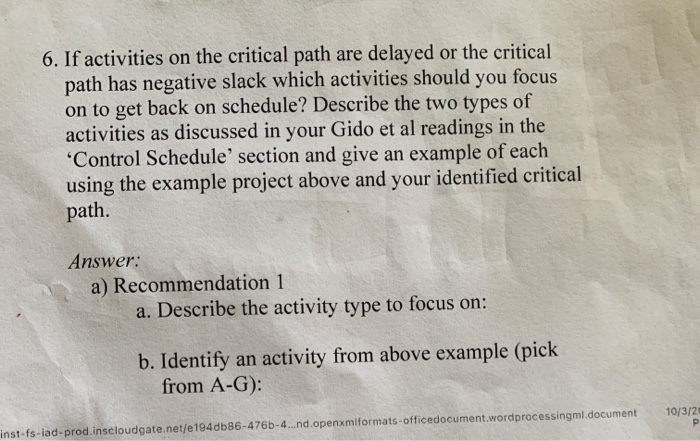
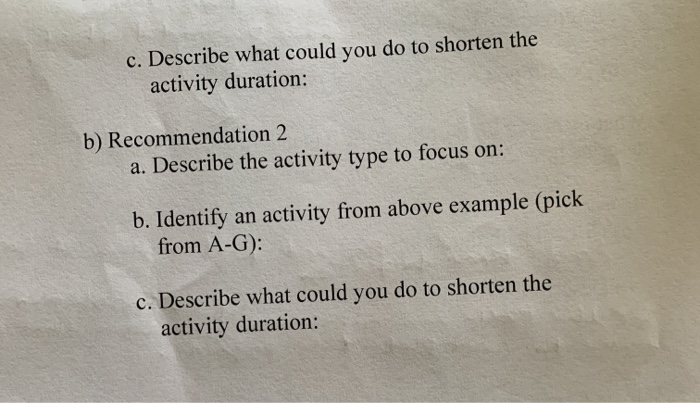
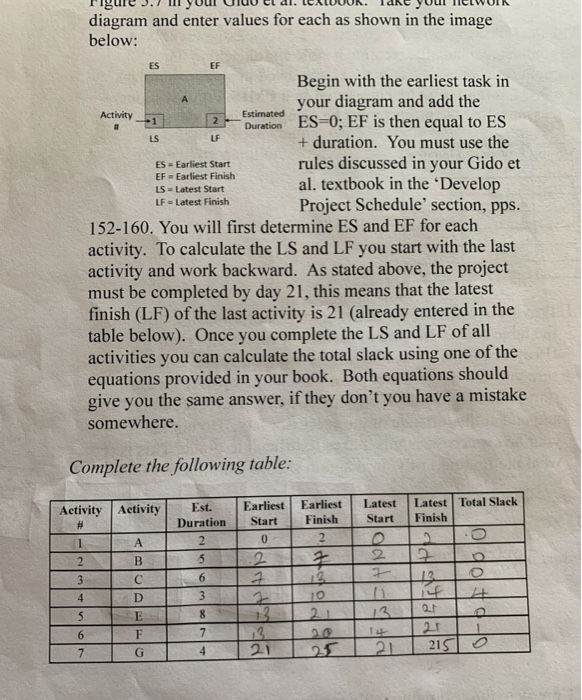
6. If activities on the critical path are delayed or the critical path has negative slack which activities should you focus on to get back on schedule? Describe the two types of activities as discussed in your Gido et al readings in the "Control Schedule' section and give an example of each using the example project above and your identified critical path. Answer: a) Recommendation 1 a. Describe the activity type to focus on: b. Identify an activity from above example (pick from A-G): 10/3/26 P inst-fs-lad-prod. inscloudgate.net/e194db86-476b-4...nd.openxmlformats-officedocument.wordprocessingml.document c. Describe what could you do to shorten the activity duration: b) Recommendation 2 a. Describe the activity type to focus on: b. Identify an activity from above example (pick from A-G): c. Describe what could you do to shorten the activity duration: diagram and enter values for each as shown in the image below: ES EF A Estimated 2 Activity - 1 # LS LF ES = Earliest Start EF - Earliest Finish LS=Latest Start LF = Latest Finish Begin with the earliest task in your diagram and add the Duration ES=0; EF is then equal to ES + duration. You must use the rules discussed in your Gido et al. textbook in the 'Develop Project Schedule' section, pps. 152-160. You will first determine ES and EF for each activity. To calculate the LS and LF you start with the last activity and work backward. As stated above, the project must be completed by day 21, this means that the latest finish (LF) of the last activity is 21 (already entered in the table below). Once you complete the LS and LF of all activities you can calculate the total slack using one of the equations provided in your book. Both equations should give you the same answer, if they don't you have a mistake somewhere. Complete the following table: Activity Activity # Earliest Finish 2 Latest Start Est. Duration 2 5 Latest Total Slack Finish A Earliest Start 0 2 7 2 1 2 3 4 B 7 2 7 6 12 12 OFPOOL 3 13 1 5 6 D E F G 8 7 4 21 13 21 7 215 21 6. If activities on the critical path are delayed or the critical path has negative slack which activities should you focus on to get back on schedule? Describe the two types of activities as discussed in your Gido et al readings in the "Control Schedule' section and give an example of each using the example project above and your identified critical path. Answer: a) Recommendation 1 a. Describe the activity type to focus on: b. Identify an activity from above example (pick from A-G): 10/3/26 P inst-fs-lad-prod. inscloudgate.net/e194db86-476b-4...nd.openxmlformats-officedocument.wordprocessingml.document c. Describe what could you do to shorten the activity duration: b) Recommendation 2 a. Describe the activity type to focus on: b. Identify an activity from above example (pick from A-G): c. Describe what could you do to shorten the activity duration: diagram and enter values for each as shown in the image below: ES EF A Estimated 2 Activity - 1 # LS LF ES = Earliest Start EF - Earliest Finish LS=Latest Start LF = Latest Finish Begin with the earliest task in your diagram and add the Duration ES=0; EF is then equal to ES + duration. You must use the rules discussed in your Gido et al. textbook in the 'Develop Project Schedule' section, pps. 152-160. You will first determine ES and EF for each activity. To calculate the LS and LF you start with the last activity and work backward. As stated above, the project must be completed by day 21, this means that the latest finish (LF) of the last activity is 21 (already entered in the table below). Once you complete the LS and LF of all activities you can calculate the total slack using one of the equations provided in your book. Both equations should give you the same answer, if they don't you have a mistake somewhere. Complete the following table: Activity Activity # Earliest Finish 2 Latest Start Est. Duration 2 5 Latest Total Slack Finish A Earliest Start 0 2 7 2 1 2 3 4 B 7 2 7 6 12 12 OFPOOL 3 13 1 5 6 D E F G 8 7 4 21 13 21 7 215 21
Step by Step Solution

There are 3 Steps involved in it

1 Expert Approved Answer
Step: 1 Unlock blur-text-image

Question Has Been Solved by an Expert!

Get step-by-step solutions from verified subject matter experts

Step: 2 Unlock
Step: 3 Unlock

Students Have Also Explored These Related General Management Questions!