







Question: 7. A small, omnidirectional sound source at the position (x, y, z) = (0, 0, 0.01 mm) radiates with a wavelength 2 mm. The
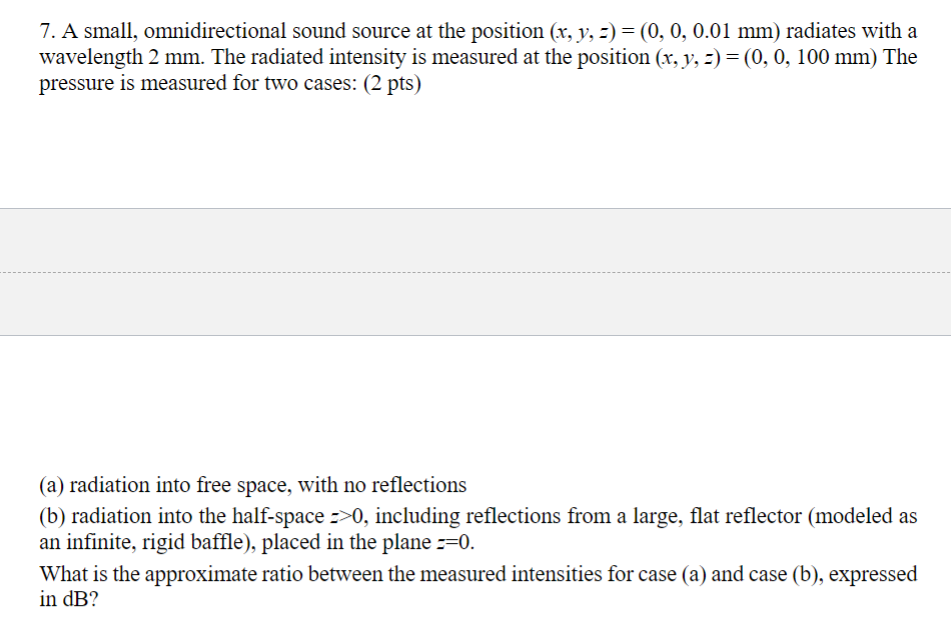
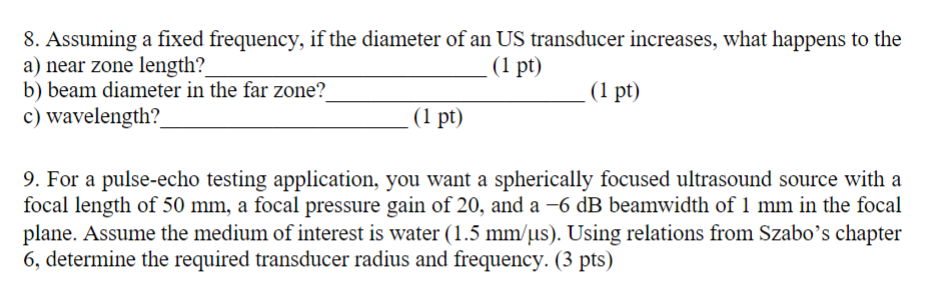
7. A small, omnidirectional sound source at the position (x, y, z) = (0, 0, 0.01 mm) radiates with a wavelength 2 mm. The radiated intensity is measured at the position (x, y, z) = (0, 0, 100 mm) The pressure is measured for two cases: (2 pts) (a) radiation into free space, with no reflections (b) radiation into the half-space =>0, including reflections from a large, flat reflector (modeled as an infinite, rigid baffle), placed in the plane ==0. What is the approximate ratio between the measured intensities for case (a) and case (b), expressed in dB? 8. Assuming a fixed frequency, if the diameter of an US transducer increases, what happens to the a) near zone length? (1 pt) b) beam diameter in the far zone? (1 pt) c) wavelength? (1 pt) 9. For a pulse-echo testing application, you want a spherically focused ultrasound source with a focal length of 50 mm, a focal pressure gain of 20, and a -6 dB beamwidth of 1 mm in the focal plane. Assume the medium of interest is water (1.5 mm/us). Using relations from Szabo's chapter 6, determine the required transducer radius and frequency. (3 pts)
Step by Step Solution
There are 3 Steps involved in it

Get step-by-step solutions from verified subject matter experts
 Study Help