







Question: 8.12 A bending member with a rectangular cross section is made of ABS plastic and has dimensions, as defined in Fig. 8.13(a), of b
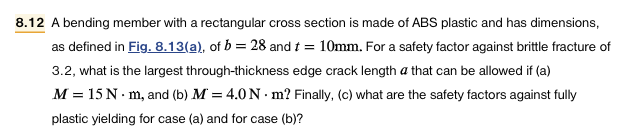
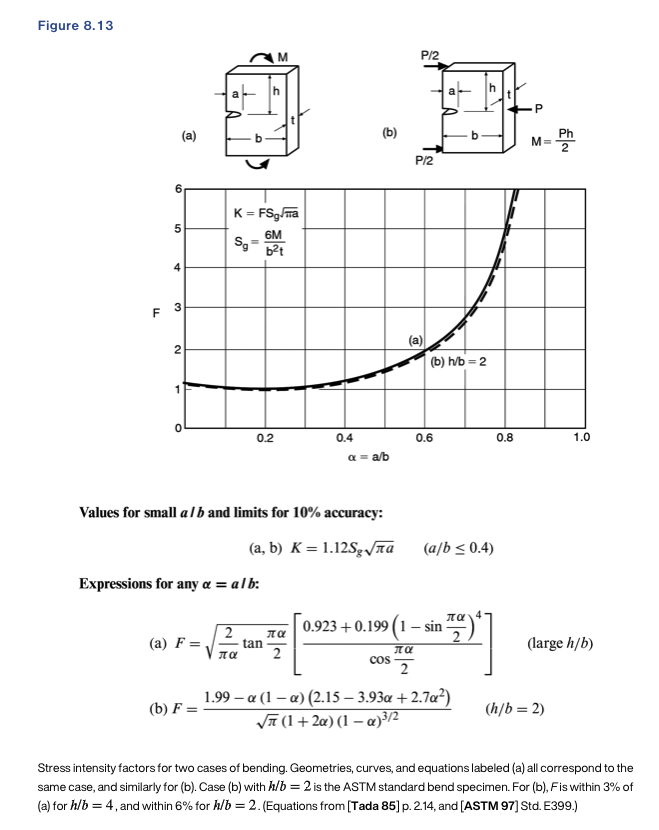
8.12 A bending member with a rectangular cross section is made of ABS plastic and has dimensions, as defined in Fig. 8.13(a), of b = 28 and t = 10mm. For a safety factor against brittle fracture of 3.2, what is the largest through-thickness edge crack length a that can be allowed if (a) M = 15 N. m, and (b) M = 4.0 Nm? Finally, (c) what are the safety factors against fully plastic yielding for case (a) and for case (b)? Figure 8.13 F (a) 6 5 4 3 2 1 0 (a) F= K = FSgJma 6M Sg bt (b) F= 0.2 Expressions for any a = alb: M Values for small alb and limits for 10% accuracy: tan 0.4 (b) 2 a = a/b P/2 P/2 Cos (a) (a, b) K = 1.12S (a/b 0.4) (b) h/b=2 0.6 [0.923 +0.199 (1 sin 2 b 2 1.99 - (1 - ) (2.15 - 3.93a+2.7) (1+2) (1-) /2 0.8 - Ph 2 M= 1.0 (large h/b) (h/b = 2) Stress intensity factors for two cases of bending. Geometries, curves, and equations labeled (a) all correspond to the same case, and similarly for (b). Case (b) with h/b = 2 is the ASTM standard bend specimen. For (b), Fis within 3% of (a) for h/b = 4, and within 6% for h/b = 2. (Equations from [Tada 85] p. 2.14, and [ASTM 97] Std. E399.)
Step by Step Solution
There are 3 Steps involved in it

Get step-by-step solutions from verified subject matter experts
 Study Help