





Question: 8.3 Understanding Hypothesis Testing 1. If all else is equal, the larger the sample size, the LARGER / SMALLER the MEAN / SAMPLE STANDARD DEVIATION
8.3 Understanding Hypothesis Testing 1. If all
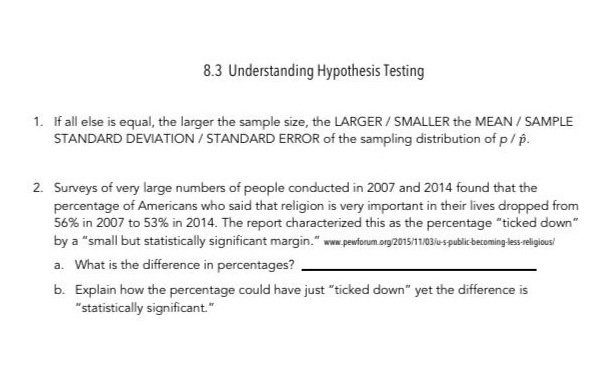
8.3 Understanding Hypothesis Testing 1. If all else is equal, the larger the sample size, the LARGER / SMALLER the MEAN / SAMPLE STANDARD DEVIATION / STANDARD ERROR of the sampling distribution of p/. 2. Surveys of very large numbers of people conducted in 2007 and 2014 found that the percentage of Americans who said that religion is very important in their lives dropped from 56% in 2007 to 53% in 2014. The report characterized this as the percentage "ticked down" by a "small but statistically significant margin." www.pewforum.ng/2015/11/03ius public becoming-less-religious! a. What is the difference in percentages? b. Explain how the percentage could have just "ticked down" yet the difference is "statistically significant." 8.3 Understanding Hypothesis Testing 1. If all else is equal, the larger the sample size, the LARGER / SMALLER the MEAN / SAMPLE STANDARD DEVIATION / STANDARD ERROR of the sampling distribution of p/. 2. Surveys of very large numbers of people conducted in 2007 and 2014 found that the percentage of Americans who said that religion is very important in their lives dropped from 56% in 2007 to 53% in 2014. The report characterized this as the percentage "ticked down" by a "small but statistically significant margin." www.pewforum.ng/2015/11/03ius public becoming-less-religious! a. What is the difference in percentages? b. Explain how the percentage could have just "ticked down" yet the difference is "statistically significant

Step by Step Solution

There are 3 Steps involved in it

1 Expert Approved Answer
Step: 1 Unlock blur-text-image

Question Has Been Solved by an Expert!

Get step-by-step solutions from verified subject matter experts

Step: 2 Unlock
Step: 3 Unlock

Students Have Also Explored These Related General Management Questions!