







Question: 9. Black-Scholes/puts/strike Problem 9. Consider a Black-Scholes model with r = 6%, o = 0.25, S(0) = 50 and 8 = 0. Suppose you sold
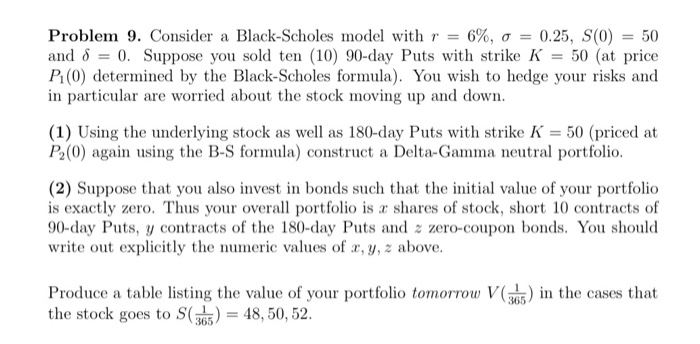
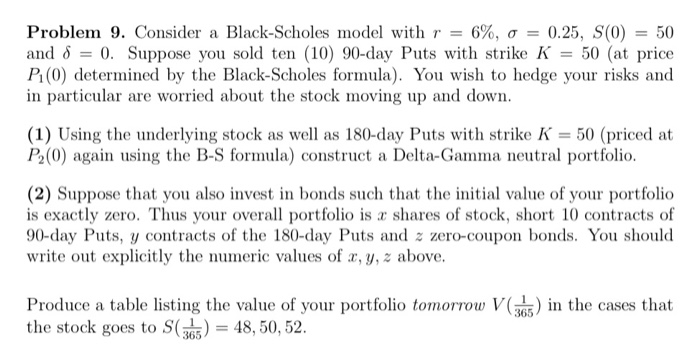
Problem 9. Consider a Black-Scholes model with r = 6%, o = 0.25, S(0) = 50 and 8 = 0. Suppose you sold ten (10) 90-day Puts with strike K = 50 (at price P1(0) determined by the Black-Scholes formula). You wish to hedge your risks and in particular are worried about the stock moving up and down. (1) Using the underlying stock as well as 180-day Puts with strike K = 50 (priced at P2(0) again using the B-S formula) construct a Delta-Gamma neutral portfolio. (2) Suppose that you also invest in bonds such that the initial value of your portfolio is exactly zero. Thus your overall portfolio is x shares of stock, short 10 contracts of 90-day Puts, y contracts of the 180-day Puts and z zero-coupon bonds. You should write out explicitly the numeric values of x,y,z above. Produce a table listing the value of your portfolio tomorrow V(365) in the cases that the stock goes to S(365) = 48, 50, 52. Problem 9. Consider a Black-Scholes model with r = 6%, o = 0.25, S(0) = 50 and 8 = 0. Suppose you sold ten (10) 90-day Puts with strike K 50 (at price Pi (0) determined by the Black-Scholes formula). You wish to hedge your risks and in particular are worried about the stock moving up and down. (1) Using the underlying stock as well as 180-day Puts with strike K = 50 (priced at P2(0) again using the B-S formula) construct a Delta-Gamma neutral portfolio. (2) Suppose that you also invest in bonds such that the initial value of your portfolio is exactly zero. Thus your overall portfolio is x shares of stock, short 10 contracts of 90-day Puts, y contracts of the 180-day Puts and z zero-coupon bonds. You should write out explicitly the numeric values of x,y,z above. Produce a table listing the value of your portfolio tomorrow V(365) in the cases that the stock goes to S(365) = 48, 50, 52. Problem 9. Consider a Black-Scholes model with r = 6%, o = 0.25, S(0) = 50 and 8 = 0. Suppose you sold ten (10) 90-day Puts with strike K = 50 (at price P1(0) determined by the Black-Scholes formula). You wish to hedge your risks and in particular are worried about the stock moving up and down. (1) Using the underlying stock as well as 180-day Puts with strike K = 50 (priced at P2(0) again using the B-S formula) construct a Delta-Gamma neutral portfolio. (2) Suppose that you also invest in bonds such that the initial value of your portfolio is exactly zero. Thus your overall portfolio is x shares of stock, short 10 contracts of 90-day Puts, y contracts of the 180-day Puts and z zero-coupon bonds. You should write out explicitly the numeric values of x,y,z above. Produce a table listing the value of your portfolio tomorrow V(365) in the cases that the stock goes to S(365) = 48, 50, 52. Problem 9. Consider a Black-Scholes model with r = 6%, o = 0.25, S(0) = 50 and 8 = 0. Suppose you sold ten (10) 90-day Puts with strike K 50 (at price Pi (0) determined by the Black-Scholes formula). You wish to hedge your risks and in particular are worried about the stock moving up and down. (1) Using the underlying stock as well as 180-day Puts with strike K = 50 (priced at P2(0) again using the B-S formula) construct a Delta-Gamma neutral portfolio. (2) Suppose that you also invest in bonds such that the initial value of your portfolio is exactly zero. Thus your overall portfolio is x shares of stock, short 10 contracts of 90-day Puts, y contracts of the 180-day Puts and z zero-coupon bonds. You should write out explicitly the numeric values of x,y,z above. Produce a table listing the value of your portfolio tomorrow V(365) in the cases that the stock goes to S(365) = 48, 50, 52
Step by Step Solution
There are 3 Steps involved in it

Get step-by-step solutions from verified subject matter experts
 Study Help