







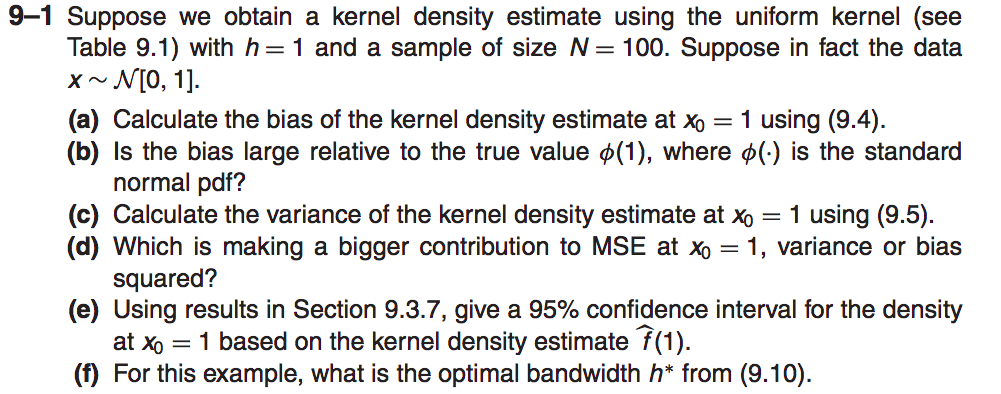
Question: 91 Suppose we obtain a kernel density estimate using the uniform kernel (see Table 9.1) with h=1 and a sample of size N= 100. Suppose

![100. Suppose in fact the data x~N[0, 1]. (a) Calculate the bias](https://dsd5zvtm8ll6.cloudfront.net/si.experts.images/questions/2024/09/66ea0d927f969_93066ea0d922be02.jpg)



91 Suppose we obtain a kernel density estimate using the uniform kernel (see Table 9.1) with h=1 and a sample of size N= 100. Suppose in fact the data x~N[0, 1]. (a) Calculate the bias of the kernel density estimate at Xo = 1 using (9.4). (b) is the bias large relative to the true value 0(1), where 0 () is the standard normal pdf? (c) Calculate the variance of the kernel density estimate at Xo 1 using (9.5). (d) Which is making a bigger contribution to MSE at Xo = 1, variance or bias squared? (e) Using results in Section 9.3.7, give a 95% confidence interval for the density at xo = 1 based on the kernel density estimate 7(1). (1) For this example, what is the optimal bandwidth h* from (9.10). Table 9.1. Kernel Functions: Commonly Used Examplesa Kernel Kernel Function K(z) 6 Uniform (or box or rectangular) x 1(z)
Step by Step Solution
There are 3 Steps involved in it

Get step-by-step solutions from verified subject matter experts
 Study Help