



Question: (a) A liquid-phase isomerization A B is carried out in a 1000-gal CSTR that has a single impeller located halfway down the reactor. The liquid
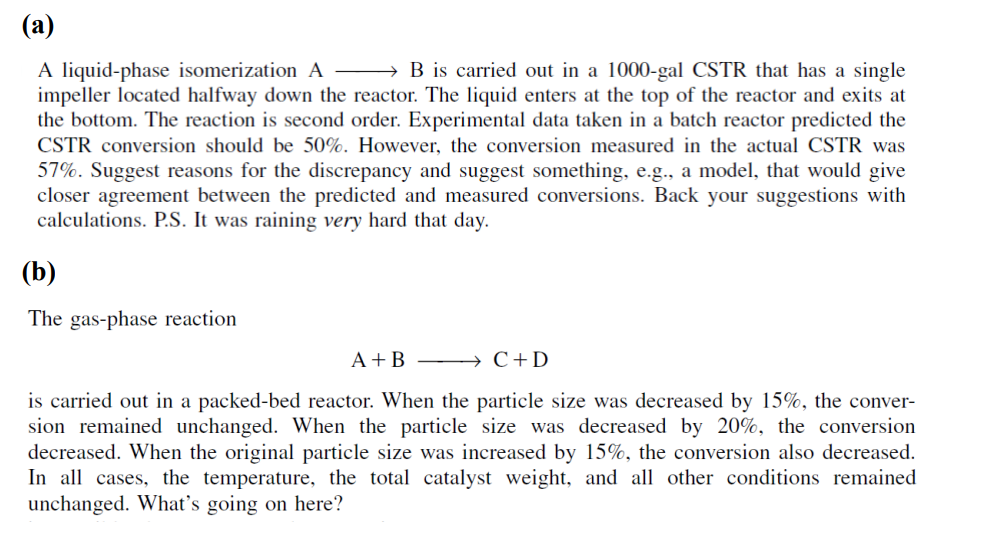
(a) A liquid-phase isomerization A B is carried out in a 1000-gal CSTR that has a single impeller located halfway down the reactor. The liquid enters at the top of the reactor and exits at the bottom. The reaction is second order. Experimental data taken in a batch reactor predicted the CSTR conversion should be 50%. However, the conversion measured in the actual CSTR was 57%. Suggest reasons for the discrepancy and suggest something, e.g., a model, that would give closer agreement between the predicted and measured conversions. Back your suggestions with calculations. P.S. It was raining very hard that day. (b) The gas-phase reaction A+B C+D is carried out in a packed-bed reactor. When the particle size was decreased by 15%, the conver- sion remained unchanged. When the particle size was decreased by 20%, the conversion decreased. When the original particle size was increased by 15%, the conversion also decreased. In all cases, the temperature, the total catalyst weight, and all other conditions remained unchanged. What's going on here
Step by Step Solution
There are 3 Steps involved in it

Get step-by-step solutions from verified subject matter experts