







Question: ( a ) A square plate, of side a = 6 m and thickness 4 8 mm , is clamped on three edges and free
a A square plate, of side and thickness mm is clamped on three edges and free on the fourth edge. It carries a uniform pressure load of and its material properties are: Young's modulus, GPa; Poison ratio, Using the appropriate Plate Data Sheet, determine the plate's maximum deflection and maximum bending moment and show where these occur. Indicate whether the maximum moment is sagging or hogging. Hence, determine the maximum stress and state whether it is tensile or compressive on the top surface of the plate.
marks
b The maximum deflection calculated in part a above was found to be unacceptable and two options are being considered:
i To increase the thickness of the plate from mm to mm
ii To use a different material with a Young's modulus, GPa
Which of the two options results in the greatest reduction to the value of the maximum deflection? Justify your answer with appropriate calculations.
marks
c What is the effect of the two options considered in part b on the maximum stress in the plate? Compare changes, if any, to the maximum stress value computed in part a
marks
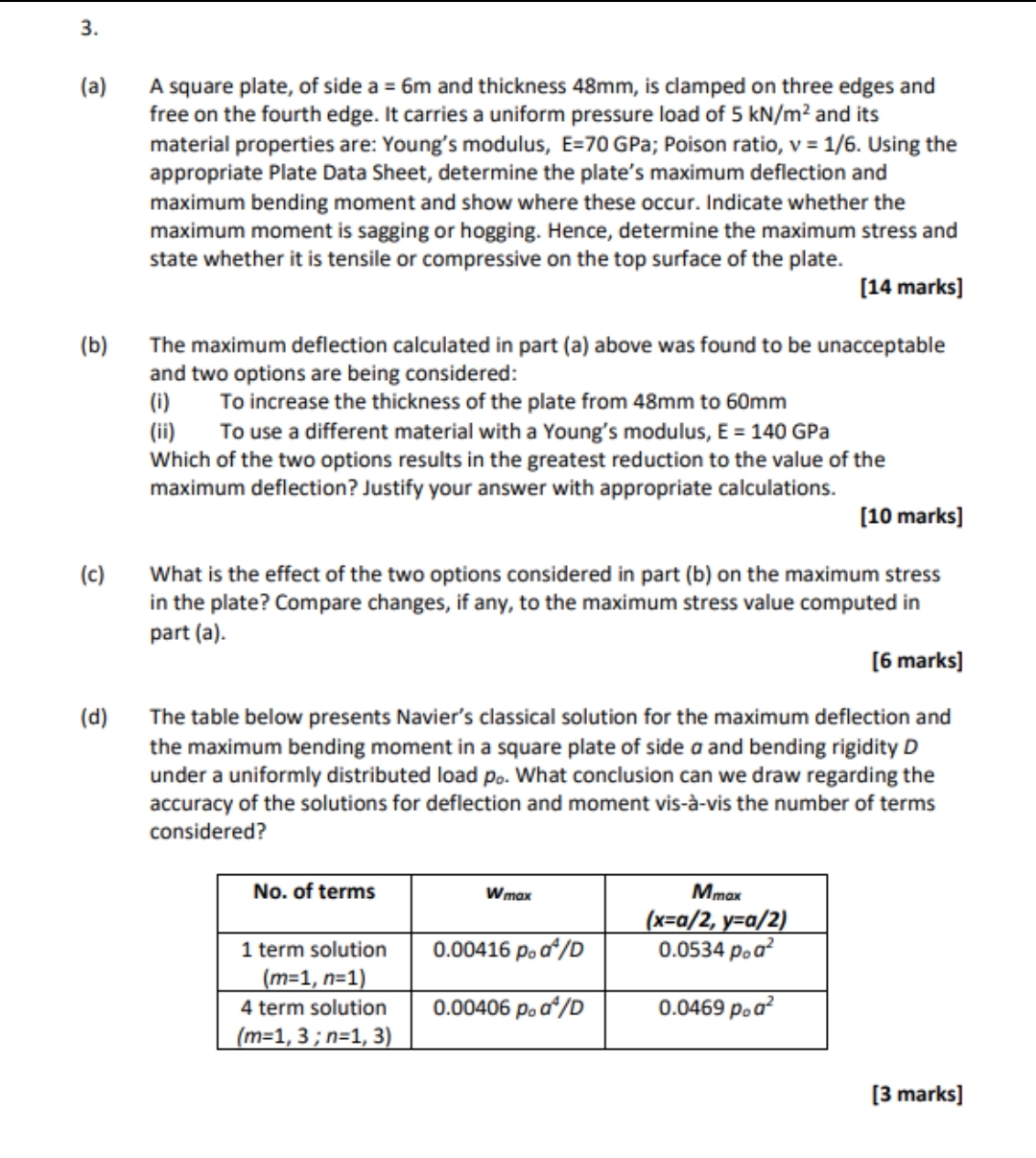
d The table below presents Navier's classical solution for the maximum deflection and the maximum bending moment in a square plate of side a and bending rigidity under a uniformly distributed load What conclusion can we draw regarding the accuracy of the solutions for deflection and moment visvis the number of terms considered?
tableNo of terms,table
Step by Step Solution
There are 3 Steps involved in it
1 Expert Approved Answer
Step: 1 Unlock

Question Has Been Solved by an Expert!
Get step-by-step solutions from verified subject matter experts
Step: 2 Unlock
Step: 3 Unlock
 Study Help