







Question: a) An annular plate ( 2 mathrm{~m} ) external diameter and ( 1 mathrm{~m} ) internal diameter with its greatest and least depths below the
a) An annular plate \( 2 \mathrm{~m} \) external diameter and \( 1 \mathrm{~m} \) internal diameter with its greatest and least depths below the surface being \( 1.5 \mathrm{~m} \) and \( 0.75 \mathrm{~m} \) respectively. Calculate the magnitude, direction and location of the force acting upon one side of the plate due to water pressure. b) Determine the rate of flow of water through a pipe of \( 300 \mathrm{~mm} \) diameter placed in an inclined position where a venturimeter is inserted, having a throat diameter of \( 150 \mathrm{~mm} \) (See diagram below). The difference of pressure between the main and throat is measured by a liquid of sp. gravity 0.7 in an inverted U- tube which gives a reading of \( 260 \mathrm{~mm} \). The loss of head between the main and throat is 0.3 times the kinetic head of the nine.
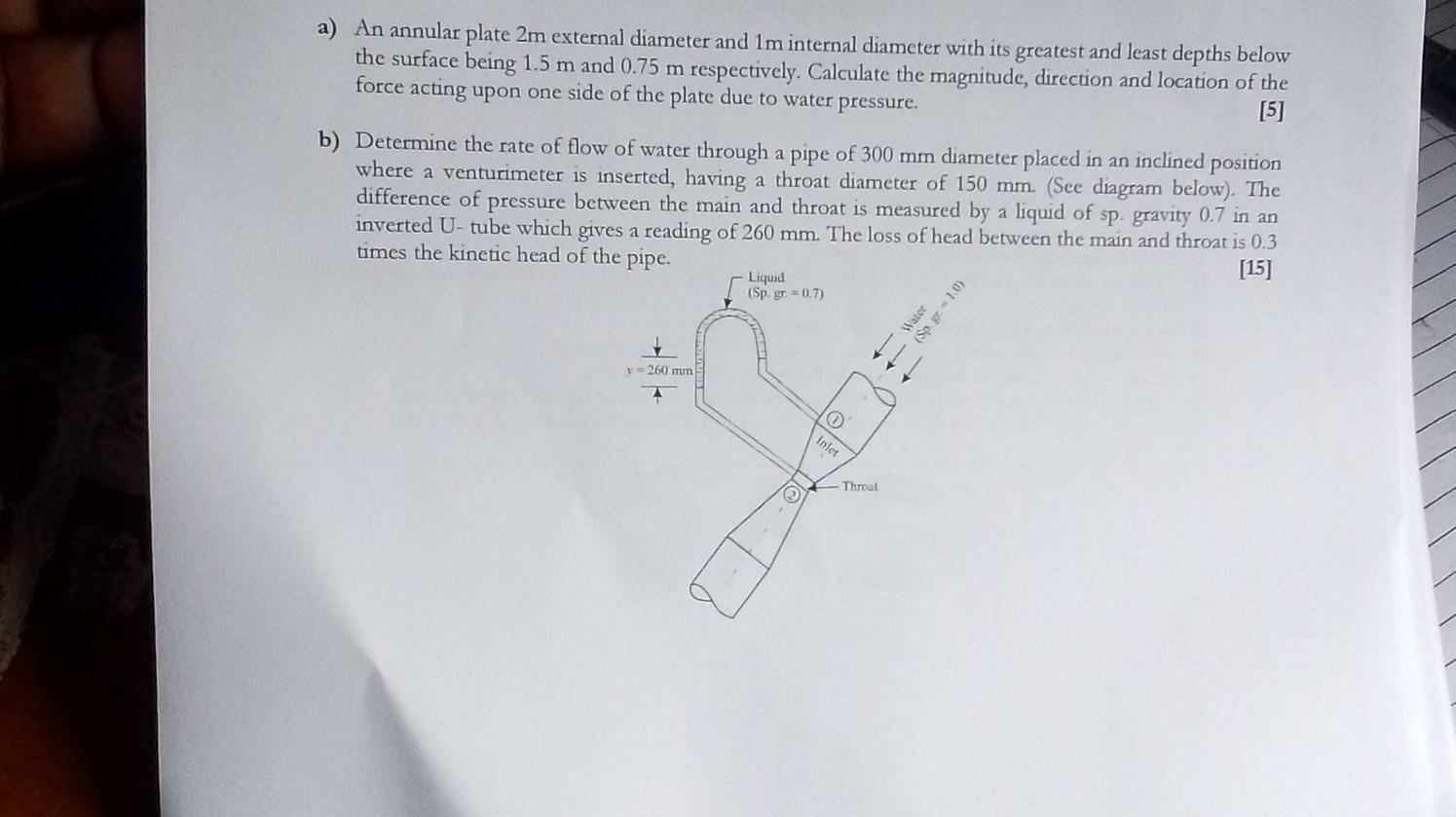
a) An annular plate 2m external diameter and 1m internal diameter with its greatest and least depths below the surface being 1.5m and 0.75m respectively. Calculate the magnitude, direction and location of the force acting upon one side of the plate due to water pressure. [5] b) Determine the rate of flow of water through a pipe of 300mm diameter placed in an inclined position where a venturimeter is inserted, having a throat diameter of 150mm. (See diagram below). The difference of pressure between the main and throat is measured by a liquid of sp. gravity 0.7 in an inverted U- tube which gives a reading of 260mm. The loss of head between the main and throat is 0.3 times the kinetic head of the pipe. [15]
Step by Step Solution
There are 3 Steps involved in it

Get step-by-step solutions from verified subject matter experts
 Study Help