







Question: A and B are binary ( can take values 0 and 1 ) , while X can take values 0 , 1 , and 2
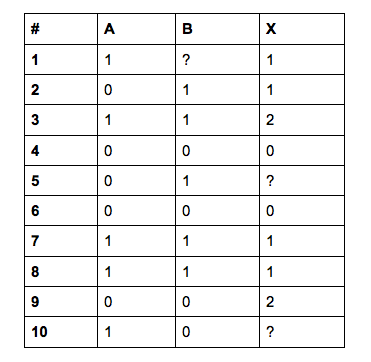
A and B are binary can take values and while X can take values and We have the following training examples. The missing values are denoted by We need to estimate PA PX A PX A PB A and PB A table#xWe are doing soft EM on this data. In the initial step, say we initialize unknown probabilities as
PX A PX A
PX A PX A
PB A PB A What is the P P where i indicates in the ith row, after the st Estep. round up to decimal places
Step by Step Solution
There are 3 Steps involved in it
1 Expert Approved Answer
Step: 1 Unlock

Question Has Been Solved by an Expert!
Get step-by-step solutions from verified subject matter experts
Step: 2 Unlock
Step: 3 Unlock
 Study Help