







Question: A CNC machine must position its axes rapidly and precisely so that high - quality cutting can be done efficiently. A CNC mill with three
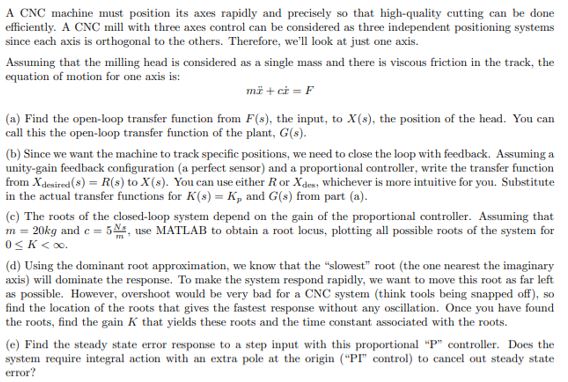
A CNC machine must position its axes rapidly and precisely so that highquality cutting can be done efficiently. A CNC mill with three axes control can be considered as three independent positioning systems since each axis is orthogonal to the others. Therefore, we'll look at just one axis.
Assuming that the milling head is considered as a single mass and there is viscous friction in the track, the equation of motion for one axis is:
m ddotxc dotxF
a Find the openloop transfer function from Fs the input, to Xs the position of the head. You can call this the openloop transfer function of the plant, Gs
b Since we want the machine to track specific positions, we need to close the loop with feedback. Assuming a unitygain feedback configuration a perfect sensor and a proportional controller, write the transfer function from Xtext desired sRs to Xs You can use either R or Xtext des whichever is more intuitive for you. Substitute in the actual transfer functions for KsKp and Gs from part a
c The roots of the closedloop system depend on the gain of the proportional controller. Assuming that mmathrm~kg and cfracNpimathrmm use MATLAB to obtain a root locus, plotting all possible roots of the system for leq Kinfty
d Using the dominant root approximation, we know that the "slowest" root the one nearest the imaginary axis will dominate the response. To make the system respond rapidly, we want to move this root as far left as possible. However, overshoot would be very bad for a CNC system think tools being snapped off so find the location of the roots that gives the fastest response without any oscillation. Once you have found the roots, find the gain K that yields these roots and the time constant associated with the roots.
c Find the steady state error response to a step input with this proportional P controller. Does the system require integral action with an extra pole at the origin PI control to cancel out steady state error?
Step by Step Solution
There are 3 Steps involved in it
1 Expert Approved Answer
Step: 1 Unlock

Question Has Been Solved by an Expert!
Get step-by-step solutions from verified subject matter experts
Step: 2 Unlock
Step: 3 Unlock
 Study Help