







Question: (a) Consider a sequence of random variables X1, X2, X3, X4, X5, X6, X7, . . . which are all independent and uniformly distributed
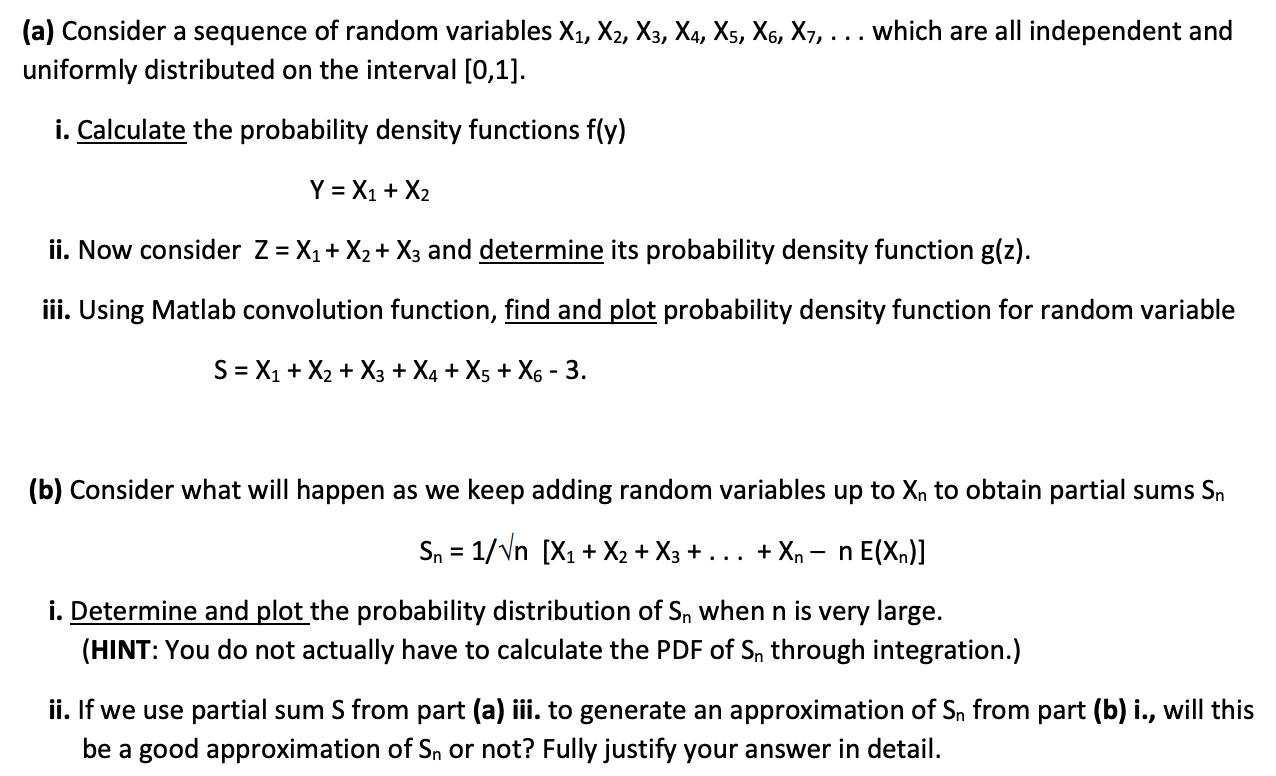
(a) Consider a sequence of random variables X1, X2, X3, X4, X5, X6, X7, . . . which are all independent and uniformly distributed on the interval [0,1]. i. Calculate the probability density functions f(y) Y = X1 + X2 ii. Now consider Z = X+ X+ X3 and determine its probability density function g(z). iii. Using Matlab convolution function, find and plot probability density function for random variable S = X1 + x2 + X3+X4 + X5 + X6 - 3. (b) Consider what will happen as we keep adding random variables up to Xn to obtain partial sums Sn Sn = 1/n [X1 X2 + X3 + ... + Xn- n E(Xn)] i. Determine and plot the probability distribution of S when n is very large. (HINT: You do not actually have to calculate the PDF of Sn through integration.) ii. If we use partial sum S from part (a) iii. to generate an approximation of Sn from part (b) i., will this be a good approximation of Sn or not? Fully justify your answer in detail.
Step by Step Solution
There are 3 Steps involved in it

Get step-by-step solutions from verified subject matter experts
 Study Help