







Question: A contractor is planning to use an elevating scraper for a small cut and fill operation (1,200 BCY). The material to be hauled weighs 3,000
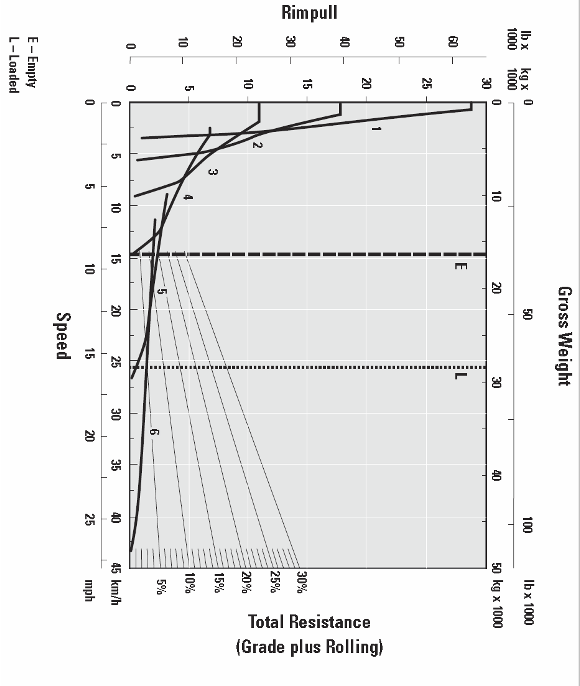
A contractor is planning to use an elevating scraper for a small cut and fill operation (1,200 BCY). The material to be hauled weighs 3,000 lb/bcy with a swell estimated to be 10% and shrinkage 20%. The rated heaped capacity is 11 cubic yards, and the rated maximum load is 28,000 lb. The scraper empty weight is equal to 36,000 lb. Its weight distribution while Empty is: 66% (Drive Axle), and 34% (Rear axle). Its weight distribution at rated max load is: 52% (Drive Axle), 48% (Rear axle).
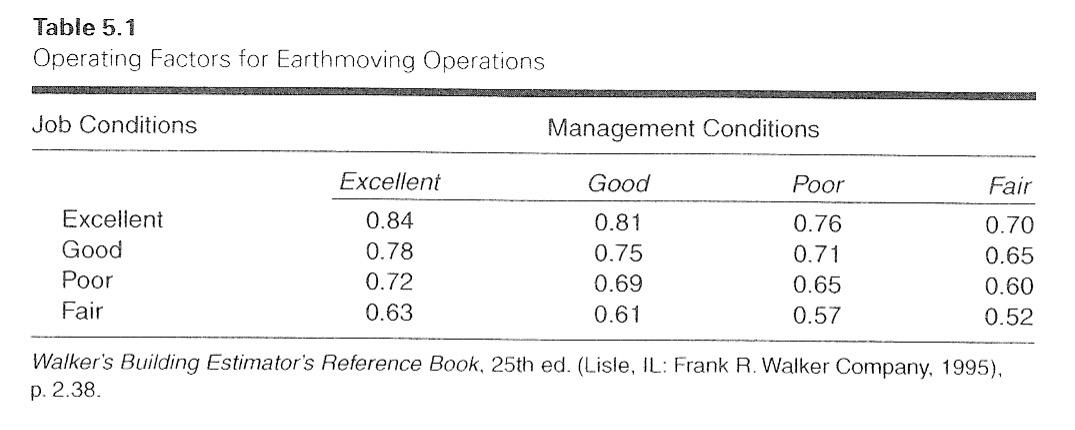
The distance between the cut and fill sites is equal to 1 mile through a linear road in firm earth with rolling resistance equal to 120 lb/ton. The scraper first climbs the road at an average uphill grade of 4% when hauling material then utilizes the same road to return empty. Fixed time is equal to 1.5 minutes. Performance chart for given scraper is attached. Assume that traction and elevation do not affect performance. What is the gross vehicle weight (tons) you will use for this scraper during hauling operations? ] What is the estimated productivity of the scraper under good job and management conditions in bank cubic yard per hour? Use attached table to identify the operating factor, and assume that the operator drive up the hill in 3rd gear and return in 5th gear. What is the estimated unit cost of the cut and fill operation in dollars per bank cubic yard assuming an hourly O&O cost of $125/hour? How many 8-hour days will it take the contractor to complete the cut and fill operation?
Gross Weight Table 5.1 Operating Factors for Earthmoving Operations Walker's Building Estimator's Reference Book, 25th ed. (Lisle, IL: Frank R. Walker Company, 1995), p. 2.38
Step by Step Solution
There are 3 Steps involved in it

Get step-by-step solutions from verified subject matter experts
 Study Help