







Question: A detector receives data packets from two different transmitters, with 50% of the packets originating at the transmitter 1 (T1) and 50% at transmitter
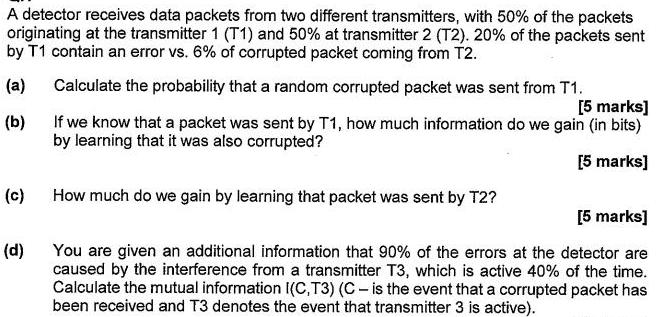
A detector receives data packets from two different transmitters, with 50% of the packets originating at the transmitter 1 (T1) and 50% at transmitter 2 (T2). 20% of the packets sent by T1 contain an error vs. 6% of corrupted packet coming from T2. (a) (b) (c) (d) Calculate the probability that a random corrupted packet was sent from T1. [5 marks] If we know that a packet was sent by T1, how much information do we gain (in bits) by learning that it was also corrupted? [5 marks] How much do we gain by learning that packet was sent by T2? [5 marks] You are given an additional information that 90% of the errors at the detector are caused by the interference from a transmitter T3, which is active 40% of the time. Calculate the mutual information I(C,T3) (C-is the event that a corrupted packet has been received and T3 denotes the event that transmitter 3 is active).
Step by Step Solution
3.39 Rating (149 Votes )
There are 3 Steps involved in it
A detector receives data packets from two different transmitters with 50 of the packets originating ... View full answer

Get step-by-step solutions from verified subject matter experts
 Study Help