







Question: A famous estimation problem is the German Tank problem. In WWII, Germany produced tanks and gave them ordered serial numbers of 1, 2, .. .
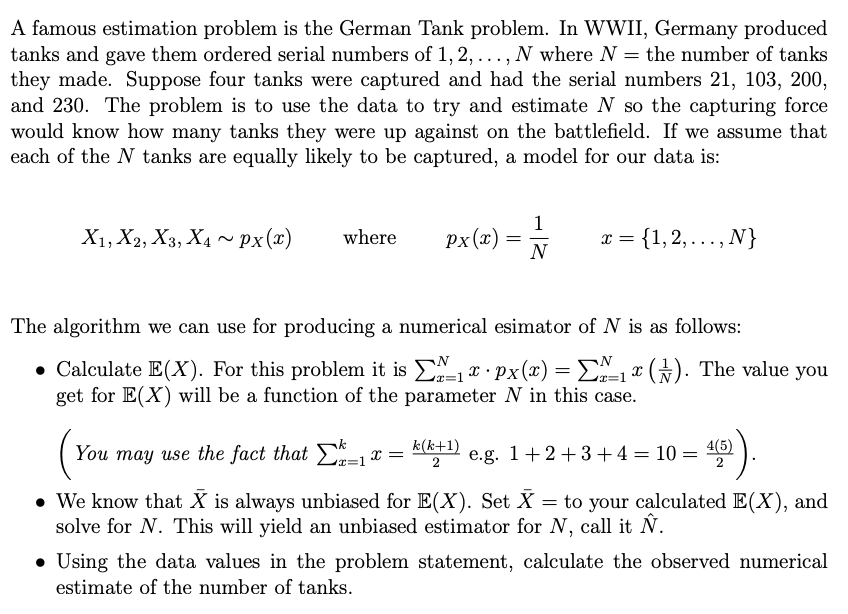
A famous estimation problem is the German Tank problem. In WWII, Germany produced tanks and gave them ordered serial numbers of 1, 2, .. . , N where N = the number of tanks they made. Suppose four tanks were captured and had the serial numbers 21, 103, 200, and 230. The problem is to use the data to try and estimate N so the capturing force would know how many tanks they were up against on the battleeld. If we assume that each of the N tanks are equally likely to be captured, a model for our data is: X11X2,X33X4~PX('T) where PX()=% x={1,2,.._,N} The algorithm we can use for producing a numerical esimator of N is as follows: 0 Calculate lE(X). For this problem it is 22;, r - pX(r) = 22;, m (i). The value you get for lE(X) will be a function of the parameter N in this case. (You may use thefact that ZLlr: w e.g.1+2+3+4= 10: 44:23). 0 We know that X is always unbiased for 1E(X) Set X' = to your calculated ]E(X), and solve for N. This will yield an unbiased estimator for N, call it N. 0 Using the data values in the problem statement, calculate the observed numerical estimate of the number of tanks
Step by Step Solution
There are 3 Steps involved in it

Get step-by-step solutions from verified subject matter experts
 Study Help