







Question: (a) (i) For the finite arithmetic sequence 4, 10, 16, . . ., 70, write down the first term a, the difference d and the
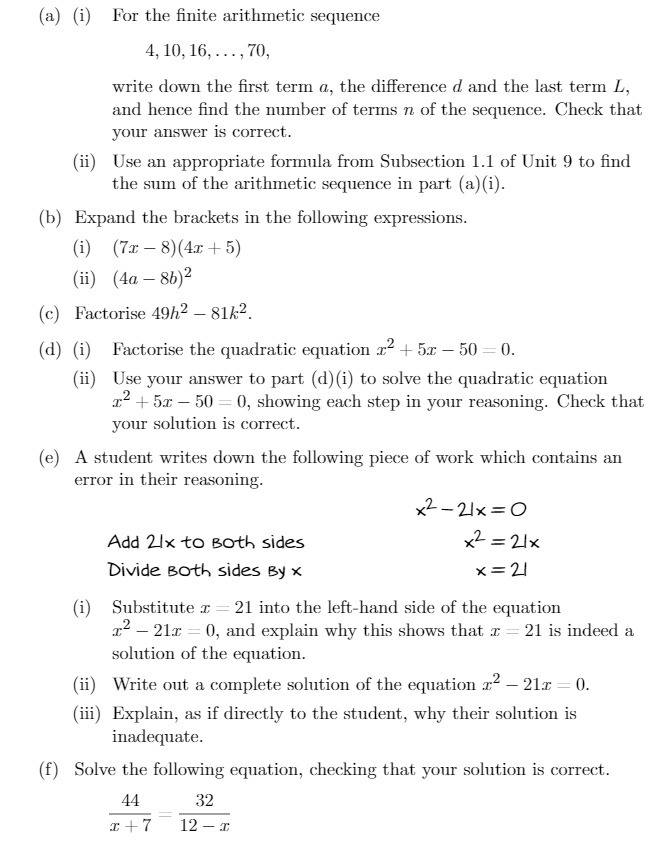
(a) (i) For the finite arithmetic sequence 4, 10, 16, . . ., 70, write down the first term a, the difference d and the last term L, and hence find the number of terms n of the sequence. Check that your answer is correct. (ii) Use an appropriate formula from Subsection 1.1 of Unit 9 to find the sum of the arithmetic sequence in part (a) (i). (b) Expand the brackets in the following expressions. (i) (7: - 8)(4.r + 5) (ii) (4a - 86)2 (c) Factorise 49h2 - 81k2. (d) (i) Factorise the quadratic equation r' + 5x - 50 = 0. (ii) Use your answer to part (d) (i) to solve the quadratic equation x2 + 5x -50 =0, showing each step in your reasoning. Check that your solution is correct. (e) A student writes down the following piece of work which contains an error in their reasoning. x2-21x = 0 Add 21x to Both sides x2 = 21x Divide Both sides By x x = 21 (i) Substitute r = 21 into the left-hand side of the equation x- - 21x =0, and explain why this shows that I = 21 is indeed a solution of the equation. (ii) Write out a complete solution of the equation r- - 21x = 0. 'iii) Explain, as if directly to the student, why their solution is inadequate. (f) Solve the following equation, checking that your solution is correct. 44 32 2
Step by Step Solution
There are 3 Steps involved in it

Get step-by-step solutions from verified subject matter experts
 Study Help