





Question: A load cell is a device which couverts a force or load into a more measureable output, such as voltage. You are required to design
A load cell is a device which couverts a force or

A load cell is a device which couverts a force or
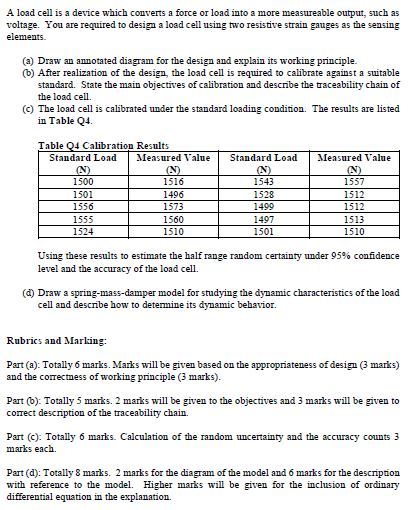
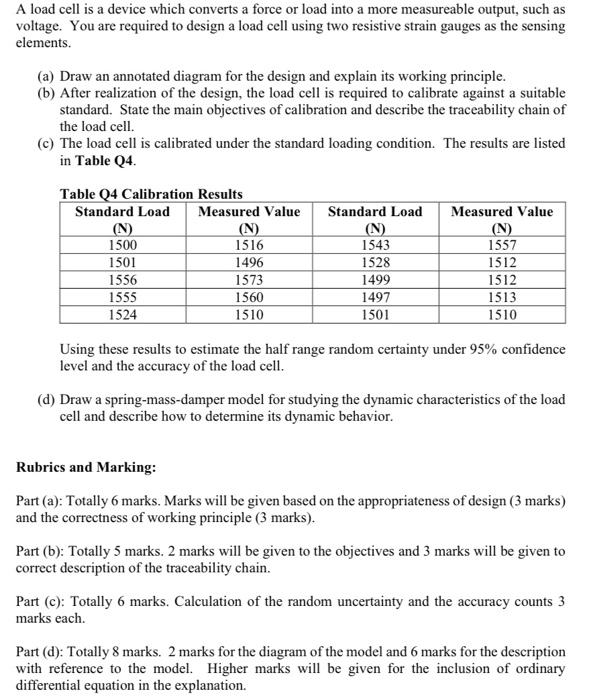
A load cell is a device which couverts a force or load into a more measureable output, such as voltage. You are required to design a load cell using two resistive strain gauges as the seasing elements (a) Draw an annotated diagram for the design and explain its working principle. (1) After realization of the design, the load cell is required to calibrate against a suitable standard. State the main objectives of calibration and describe the traceability chain of the load cell (C) The load cell is calibrated under the standard loading condition. The results are listed in Table Q4. (N) Table Q4 Calibration Results Standard Load Measured Value N 1500 1516 1501 1496 1556 1573 1555 1560 1524 1510 Standard LoadMeasured Value N) IN) 1543 1557 1528 1 512 1499 1512 1407 1513 1501 1510 Using these results to estimate the half range random certainty under 95% confidence level and the accuracy of the load cell. (d) Draw a spring-mass-damper model for studying the dynamic characteristics of the load cell and describe how to determine its dynamic behavior. Rubrics and Marking: Part (a). Totally 6 marks. Marks will be given based on the appropriateness of design (3 marks) and the correctness of working principle (3 marks). Part(): Totally 5 marks. 2 marks will be given to the objectives and 3 marks will be given to correct description of the traceability chain Part (c): Totally 6 marks. Calculation of the random uncertainty and the accuracy counts 3 marks each Part (d): Totally 8 marks. 2 marks for the diagram of the model and 6 marks for the description with reference to the model. Higher marks will be given for the inclusion of ordinary differential equation in the explanation A load cell is a device which converts a force or load into a more measureable output, such as voltage. You are required to design a load cell using two resistive strain gauges as the sensing elements. (a) Draw an annotated diagram for the design and explain its working principle (b) After realization of the design, the load cell is required to calibrate against a suitable standard. State the main objectives of calibration and describe the traceability chain of the load cell. (c) The load cell is calibrated under the standard loading condition. The results are listed in Table Q4. (N) Table Q4 Calibration Results Standard Load Measured Value (N) 1500 1516 1501 1496 1556 1573 1555 1560 1524 1510 Standard Load (N) 1543 1528 1499 1497 1501 Measured Value (N) 1557 1512 1512 1513 1510 Using these results to estimate the half range random certainty under 95% confidence level and the accuracy of the load cell. (d) Draw a spring-mass-damper model for studying the dynamic characteristics of the load cell and describe how to determine its dynamic behavior. Rubrics and Marking: Part (a): Totally 6 marks. Marks will be given based on the appropriateness of design (3 marks) and the correctness of working principle (3 marks). Part (b): Totally 5 marks. 2 marks will be given to the objectives and 3 marks will be given to correct description of the traceability chain. Part (c): Totally 6 marks. Calculation of the random uncertainty and the accuracy counts 3 marks each. Part (d): Totally 8 marks. 2 marks for the diagram of the model and 6 marks for the description with reference to the model. Higher marks will be given for the inclusion of ordinary differential equation in the explanation. A load cell is a device which couverts a force or load into a more measureable output, such as voltage. You are required to design a load cell using two resistive strain gauges as the seasing elements (a) Draw an annotated diagram for the design and explain its working principle. (1) After realization of the design, the load cell is required to calibrate against a suitable standard. State the main objectives of calibration and describe the traceability chain of the load cell (C) The load cell is calibrated under the standard loading condition. The results are listed in Table Q4. (N) Table Q4 Calibration Results Standard Load Measured Value N 1500 1516 1501 1496 1556 1573 1555 1560 1524 1510 Standard LoadMeasured Value N) IN) 1543 1557 1528 1 512 1499 1512 1407 1513 1501 1510 Using these results to estimate the half range random certainty under 95% confidence level and the accuracy of the load cell. (d) Draw a spring-mass-damper model for studying the dynamic characteristics of the load cell and describe how to determine its dynamic behavior. Rubrics and Marking: Part (a). Totally 6 marks. Marks will be given based on the appropriateness of design (3 marks) and the correctness of working principle (3 marks). Part(): Totally 5 marks. 2 marks will be given to the objectives and 3 marks will be given to correct description of the traceability chain Part (c): Totally 6 marks. Calculation of the random uncertainty and the accuracy counts 3 marks each Part (d): Totally 8 marks. 2 marks for the diagram of the model and 6 marks for the description with reference to the model. Higher marks will be given for the inclusion of ordinary differential equation in the explanation A load cell is a device which converts a force or load into a more measureable output, such as voltage. You are required to design a load cell using two resistive strain gauges as the sensing elements. (a) Draw an annotated diagram for the design and explain its working principle (b) After realization of the design, the load cell is required to calibrate against a suitable standard. State the main objectives of calibration and describe the traceability chain of the load cell. (c) The load cell is calibrated under the standard loading condition. The results are listed in Table Q4. (N) Table Q4 Calibration Results Standard Load Measured Value (N) 1500 1516 1501 1496 1556 1573 1555 1560 1524 1510 Standard Load (N) 1543 1528 1499 1497 1501 Measured Value (N) 1557 1512 1512 1513 1510 Using these results to estimate the half range random certainty under 95% confidence level and the accuracy of the load cell. (d) Draw a spring-mass-damper model for studying the dynamic characteristics of the load cell and describe how to determine its dynamic behavior. Rubrics and Marking: Part (a): Totally 6 marks. Marks will be given based on the appropriateness of design (3 marks) and the correctness of working principle (3 marks). Part (b): Totally 5 marks. 2 marks will be given to the objectives and 3 marks will be given to correct description of the traceability chain. Part (c): Totally 6 marks. Calculation of the random uncertainty and the accuracy counts 3 marks each. Part (d): Totally 8 marks. 2 marks for the diagram of the model and 6 marks for the description with reference to the model. Higher marks will be given for the inclusion of ordinary differential equation in the explanation

Step by Step Solution

There are 3 Steps involved in it

1 Expert Approved Answer
Step: 1 Unlock blur-text-image

Question Has Been Solved by an Expert!

Get step-by-step solutions from verified subject matter experts

Step: 2 Unlock
Step: 3 Unlock

Students Have Also Explored These Related General Management Questions!