





Question: A mechanical engineer is studying the thrust force developed by a drill press. He suspected that the depth of cut (factor A), the feed rate
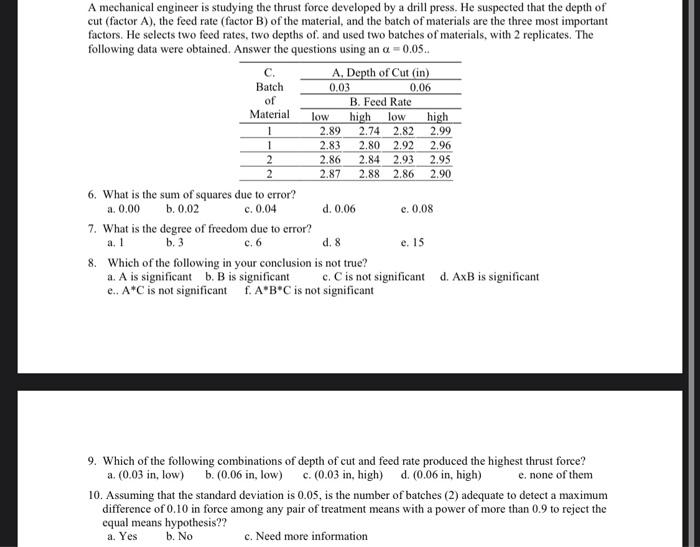
A mechanical engineer is studying the thrust
A mechanical engineer is studying the thrust force developed by a drill press. He suspected that the depth of cut (factor A), the feed rate (factor B) of the material, and the batch of materials are the three most important factors. He selects two feed rates, two depths of and used two batches of materials, with 2 replicates. The following data were obtained. Answer the questions using an a=0.05. c. A. Depth of Out (in) Batch 0.03 0.06 of B. Feed Rate Material low high low high 1 2.89 2.74 2.82 2.99 1 2.83 2.80 2.92 2.96 2 2.86 2.84 2.93 2.95 2.87 2.88 2.86 2.90 6. What is the sum of squares due to error? a. 0.00 b. 0.02 c. 0.04 d. 0.06 7. What is the degree of freedom due to error? a. 1 c. 6 d. 8 8. Which of the following in your conclusion is not true? a. A is significant b. B is significant c. C is not significant d. AxB is significant e.. A*C is not significant f. A*B*C is not significant 2 e. 0.08 b. 3 e. 15 9. Which of the following combinations of depth of cut and feed rate produced the highest thrust force? a. (0.03 in, low) b. (0.06 in, low) c.(0.03 in, high) d. (0.06 in, high) e none of them 10. Assuming that the standard deviation is 0.05, is the number of batches (2) adequate to detect a maximum difference of 0.10 in force among any pair of treatment means with a power of more than 0.9 to reject the equal means hypothesis?? a. Yes b. No c. Need more information

Step by Step Solution

There are 3 Steps involved in it

1 Expert Approved Answer
Step: 1 Unlock blur-text-image

Question Has Been Solved by an Expert!

Get step-by-step solutions from verified subject matter experts

Step: 2 Unlock
Step: 3 Unlock

Students Have Also Explored These Related General Management Questions!