







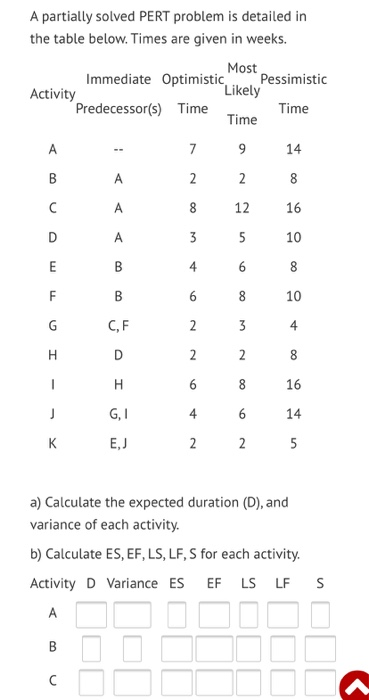
Question: A partially solved PERT problem is detailed in the table below. Times are given in weeks. Activity Immediate Predecessor(s) Optimistic Time Most Likely Time Pessimistic
A partially solved PERT problem is detailed in the table below. Times are given in weeks.
Activity
Immediate
Predecessor(s)
Optimistic
Time
Most Likely
Time
Pessimistic
Time
A
--
7
9
14
B
A
2
2
8
C
A
8
12
16
D
A
3
5
10
E
B
4
6
8
F
B
6
8
10
G
C, F
2
3
4
H
D
2
2
8
I
H
6
8
16
J
G, I
4
6
14
K
E, J
2
2
5
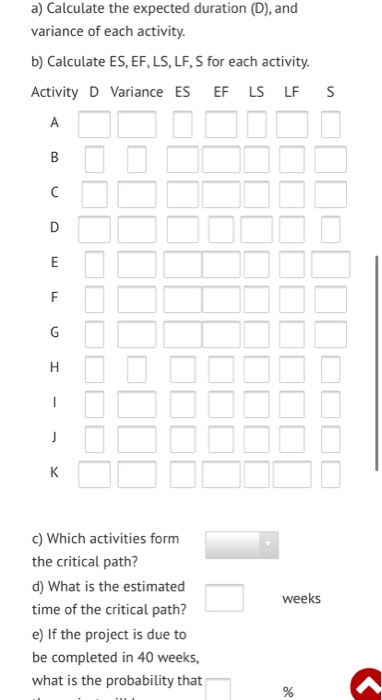
a) Calculate the expected duration (D), and variance of each activity.
b) Calculate ES, EF, LS, LF, S for each activity.
Activity
D
Variance
ES
EF
LS
LF
S
A
Answer
Answer
Answer
Answer
Answer
Answer
Answer
B
Answer
Answer
Answer
Answer
Answer
Answer
Answer
C
Answer
Answer
Answer
Answer
Answer
Answer
Answer
D
Answer
Answer
Answer
Answer
Answer
Answer
Answer
E
Answer
Answer
Answer
Answer
Answer
Answer
Answer
F
Answer
Answer
Answer
Answer
Answer
Answer
Answer
G
Answer
Answer
Answer
Answer
Answer
Answer
Answer
H
Answer
Answer
Answer
Answer
Answer
Answer
Answer
I
Answer
Answer
Answer
Answer
Answer
Answer
Answer
J
Answer
Answer
Answer
Answer
Answer
Answer
Answer
K
Answer
Answer
Answer
Answer
Answer
Answer
Answer
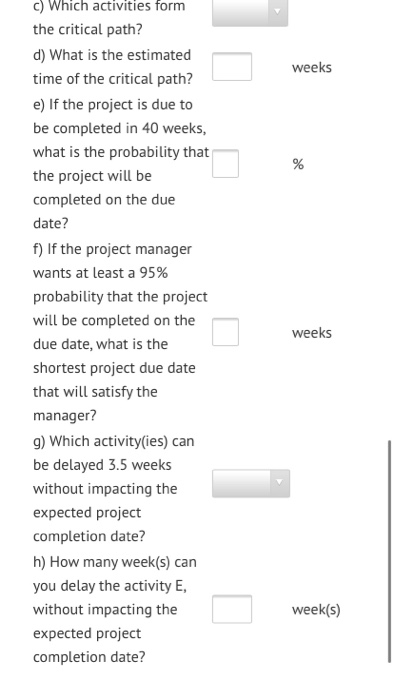
c) Which activities form the critical path? Answer
d) What is the estimated time of the critical path? Answer weeks
e) If the project is due to be completed in 40 weeks, what is the probability that the project will be completed on the due date? Answer %
f) If the project manager wants at least a 95% probability that the project will be completed on the due date, what is the shortest project due date that will satisfy the manager? Answer weeks
g) Which activity(ies) can be delayed 3.5 weeks without impacting the expected project completion date? Answer
h) How many week(s) can you delay the activity E, without impacting the expected project completion date? Answer week(s)
Step by Step Solution
There are 3 Steps involved in it
1 Expert Approved Answer
Step: 1 Unlock

Question Has Been Solved by an Expert!
Get step-by-step solutions from verified subject matter experts
Step: 2 Unlock
Step: 3 Unlock
 Study Help