







Question: a satellite with orbital elements: eccentricity, e = 0.12; semi-major axis, a = 4, 200 km; inclination, i = 25; longitude of ascending node,
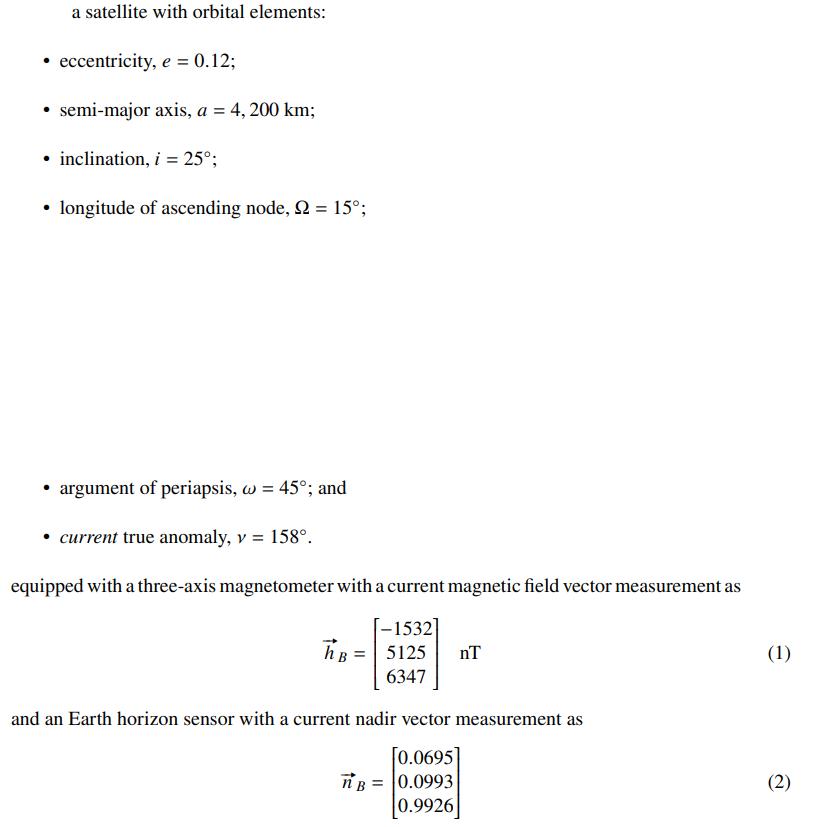
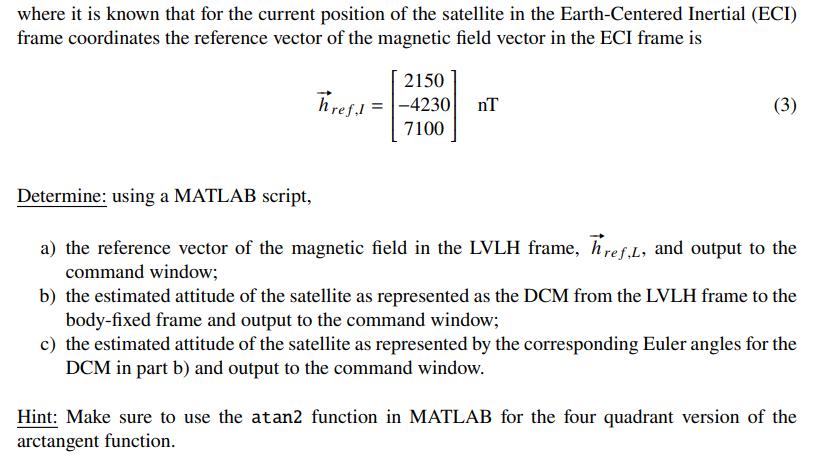
a satellite with orbital elements: eccentricity, e = 0.12; semi-major axis, a = 4, 200 km; inclination, i = 25; longitude of ascending node, 22 = 15; argument of periapsis, w = 45; and current true anomaly, v = 158. equipped with a three-axis magnetometer with a current magnetic field vector measurement as [-1532] hB = 5125 6347 nT and an Earth horizon sensor with a current nadir vector measurement as [0.0695] = 0.0993 0.9926 B (1) (2) where it is known that for the current position of the satellite in the Earth-Centered Inertial (ECI) frame coordinates the reference vector of the magnetic field vector in the ECI frame is href.1= 2150] -4230 nT 7100 (3) Determine: using a MATLAB script, a) the reference vector of the magnetic field in the LVLH frame, href.L, and output to the command window; b) the estimated attitude of the satellite as represented as the DCM from the LVLH frame to the body-fixed frame and output to the command window; c) the estimated attitude of the satellite as represented by the corresponding Euler angles for the DCM in part b) and output to the command window. Hint: Make sure to use the atan2 function in MATLAB for the four quadrant version of the arctangent function.
Step by Step Solution
3.47 Rating (150 Votes )
There are 3 Steps involved in it
Using a MATLAB script Heres how you can approach each part a Reference Vector of the Magnetic Field in the LVLH Frame 1 Convert the current ECI satellite location to the LVLH Local Vertical Local Hori... View full answer

Get step-by-step solutions from verified subject matter experts
 Study Help