







Question: A statement-level dependence graph represents the dependences between statements in a loop nest. Nodes represent Single Statements, and edges dependences between statements. An edge is
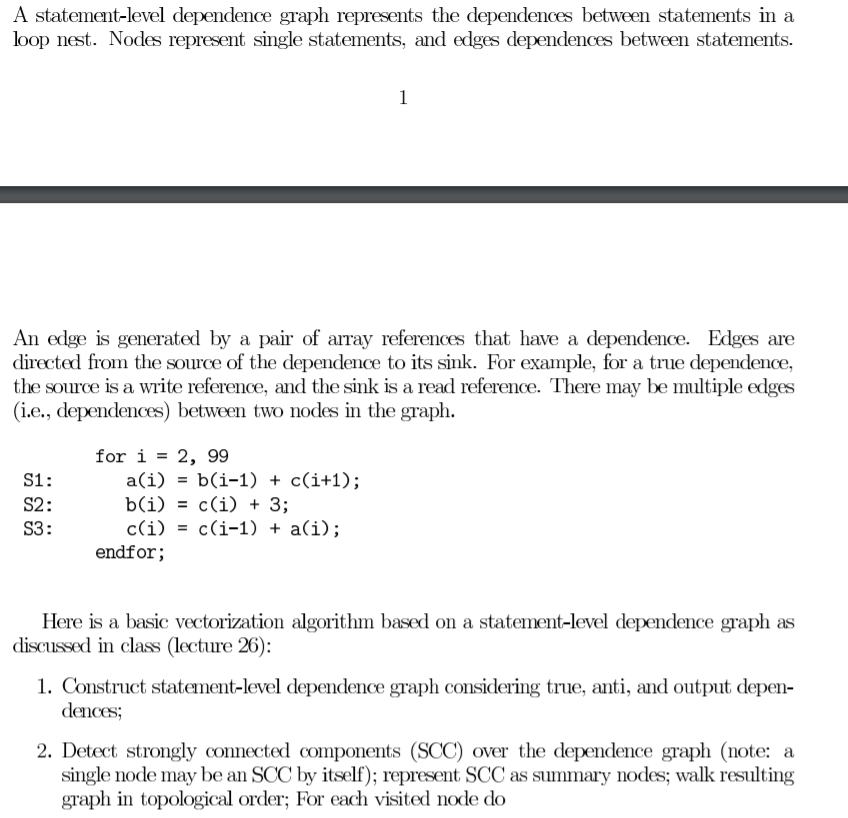
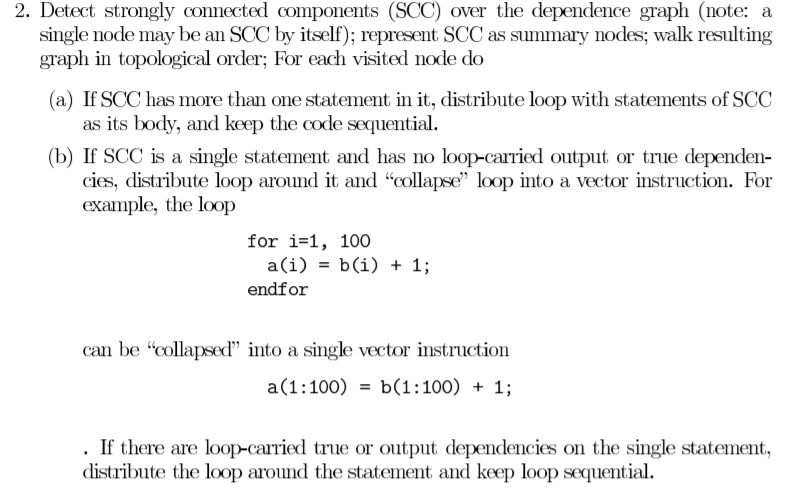
A statement-level dependence graph represents the dependences between statements in a loop nest. Nodes represent Single Statements, and edges dependences between statements. An edge is generated by a pair of array references that have a dependence. Edges are directed from the source of the dependence to its sink. For example, for a true dependence, the source is a write reference, and the sink is a read reference. There may be multiple edges (i.e., dependences between two nodes in the graph. for i 2, 99 a(i) bli-1) c(i+1) S1 b(i) c(i) 3; S2 c(i) c (i-1) a(i) S3: endfor Here is a basic vectorization algorithm based on a statement-level dependence graph as discussed in class (lecture 26 1. Construct statement-level dependence graph considering true, anti, and output depen- dences; 2. Detect strongly connected components (SCC) over the dependence graph (note: a single node may be an SCC by itself); represent SCC as summary nodes; walk resulting graph in topological order; For each visited node do A statement-level dependence graph represents the dependences between statements in a loop nest. Nodes represent Single Statements, and edges dependences between statements. An edge is generated by a pair of array references that have a dependence. Edges are directed from the source of the dependence to its sink. For example, for a true dependence, the source is a write reference, and the sink is a read reference. There may be multiple edges (i.e., dependences between two nodes in the graph. for i 2, 99 a(i) bli-1) c(i+1) S1 b(i) c(i) 3; S2 c(i) c (i-1) a(i) S3: endfor Here is a basic vectorization algorithm based on a statement-level dependence graph as discussed in class (lecture 26 1. Construct statement-level dependence graph considering true, anti, and output depen- dences; 2. Detect strongly connected components (SCC) over the dependence graph (note: a single node may be an SCC by itself); represent SCC as summary nodes; walk resulting graph in topological order; For each visited node do
Step by Step Solution
There are 3 Steps involved in it

Get step-by-step solutions from verified subject matter experts
 Study Help