







Question: abs() Write a function abs(x) that models a limited version of the behavior of the built-in function (it is not necessary to deal with
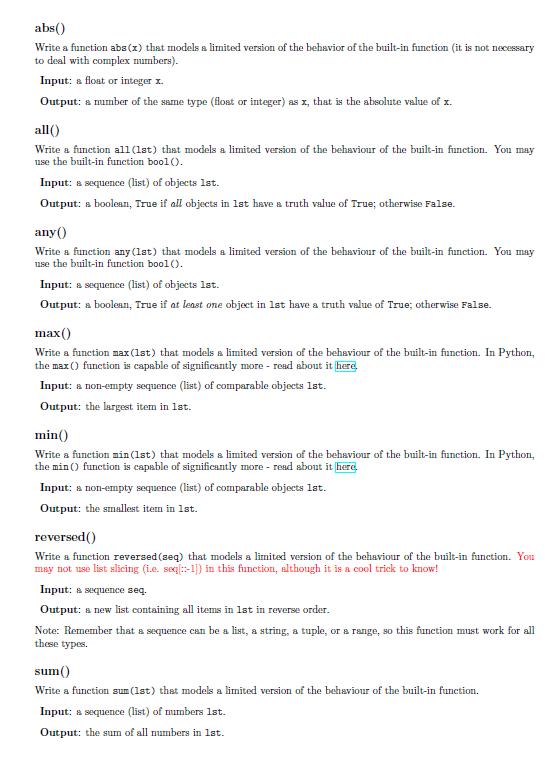
abs() Write a function abs(x) that models a limited version of the behavior of the built-in function (it is not necessary to deal with complex numbers). Input: a float or integer x. Output: a number of the same type (float or integer) as x, that is the absolute value of x. all () Write a function all (1st) that models a limited version of the behaviour of the built-in function. You may use the built-in function bool(). Input: a sequence (list) of objects 1st. Output: a boolean, True if all objects in 1st have a truth value of True; otherwise False. any() Write a function any (lat) that models a limited version of the behaviour of the built-in function. You may use the built-in function bool(). Input: a sequence (list) of objects 1st. Output: a boolean, True if at least one object in 1st have a truth value of True; otherwise False. max() Write a function max (1st) that models a limited version of the behaviour of the built-in function. In Python, the max() function is capable of significantly more - read about it here. Input: a non-empty sequence (list) of comparable objects 1st. Output: the largest item in 1st. min() Write a function min (1st) that models a limited version of the behaviour of the built-in function. In Python, the min () function is capable of significantly more - read about it here Input: a non-empty sequence (list) of comparable objects 1st. Output: the smallest item in 1st. reversed () Write a function reversed (seq) that models a limited version of the behaviour of the built-in function. You may not use list slicing (i.e. seq::-1]) in this function, although it is a cool trick to know! Input: a sequence seq. Output: a new list containing all items in 1st in reverse order. Note: Remember that a sequence can be a list, a string, a tuple, or a range, so this function must work for all these types. sum() Write a function sun (1st) that models a limited version of the behaviour of the built-in function. Input: a sequence (list) of numbers lat. Output: the sum of all numbers in lat.
Step by Step Solution
There are 3 Steps involved in it
To write a function that models a limited version of the behavior of the builtin function abs we can use the following steps 1 Define a function called abs that takes one argument x 2 Check if x is gr... View full answer

Get step-by-step solutions from verified subject matter experts
 Study Help