







Question: After plugging in the constraint, how do you take the derivative of the function with respect to H? H1+1m logEylerl where C denotes per capita
After plugging in the constraint, how do you take the derivative of the function with respect to H?
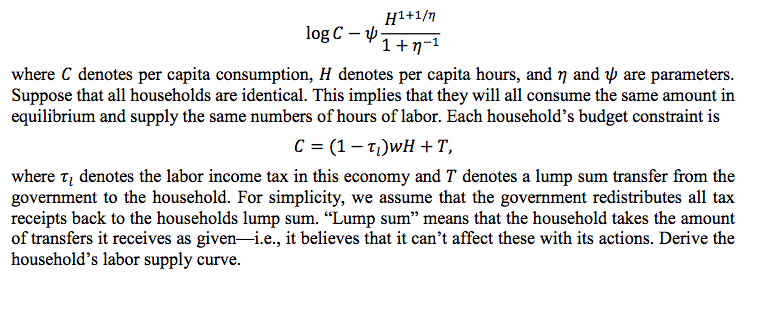
H1+1m logEylerl where C denotes per capita consinnption, H denotes per capita hours, and I] and d: are parameters. Suppose that all households are identical. This implies that they will all consume the same amount in equilibrium and supply the same nmnbers of hours of labor. Each household's budget constraint is C = (1 1rl)wH +T, where r1 denotes the labor income tax in this economy and T denotes a lump sum transfer from the government to the household. For simplicity, we assume that the government redistribute: all tax receipts back to the households lump sum. \"Lump stun\" means that the household takes the amount of transfers it receives as givenLe, it believes that it can't affect these with its actions. Derive the household's labor supply curve
Step by Step Solution
There are 3 Steps involved in it

Get step-by-step solutions from verified subject matter experts
 Study Help