







Question: ans all pls Throughout this question, apply the ionic bonding model to the compound BaO. a) Calculate the equilibrium spacing (r0) between Ba and O
ans all pls
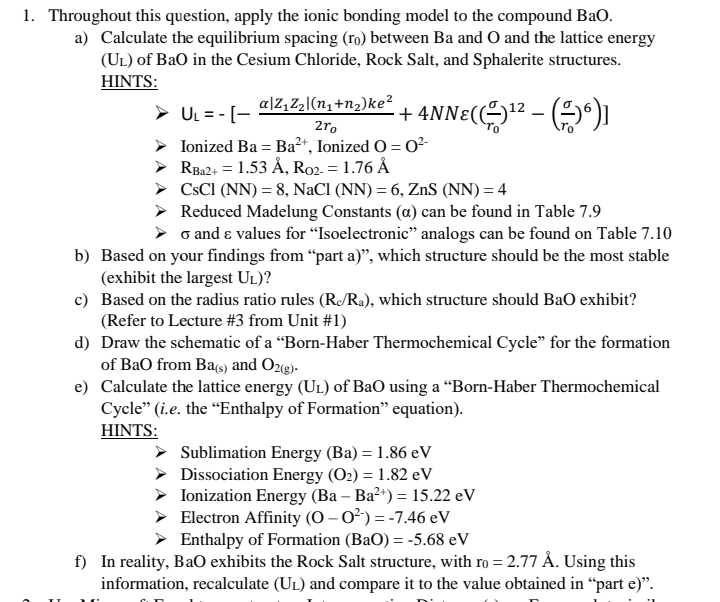
Throughout this question, apply the ionic bonding model to the compound BaO. a) Calculate the equilibrium spacing (r0) between Ba and O and the lattice energy ( UL ) of BaO in the Cesium Chloride, Rock Salt, and Sphalerite structures. HINTS: UL=[2roZ1Z2(n1+n2)ke2+4NN((r0)12(r0)6)]IonizedBa=Ba2+,IonizedO=O2RBa2+=1.53A,RO2=1.76ACsCl(NN)=8,NaCl(NN)=6,ZnS(NN)=4 Reduced Madelung Constants () can be found in Table 7.9 and values for "Isoelectronic" analogs can be found on Table 7.10 b) Based on your findings from "part a)", which structure should be the most stable (exhibit the largest UL )? c) Based on the radius ratio rules (Rc/Ra), which structure should BaO exhibit? (Refer to Lecture \#3 from Unit \#1) d) Draw the schematic of a "Born-Haber Thermochemical Cycle" for the formation of BaO from Ba(s) and O2(g). e) Calculate the lattice energy ( UL) of BaO using a "Born-Haber Thermochemical Cycle" (i.e. the "Enthalpy of Formation" equation). HINTS: Sublimation Energy (Ba)=1.86eV Dissociation Energy (O2)=1.82eV Ionization Energy (BaBa2+)=15.22eV Electron Affinity (OO2)=7.46eV Enthalpy of Formation (BaO)=5.68eV f) In reality, BaO exhibits the Rock Salt structure, with r0=2.77A. Using this information, recalculate (UL) and compare it to the value obtained in "part e)
Step by Step Solution
There are 3 Steps involved in it

Get step-by-step solutions from verified subject matter experts
 Study Help