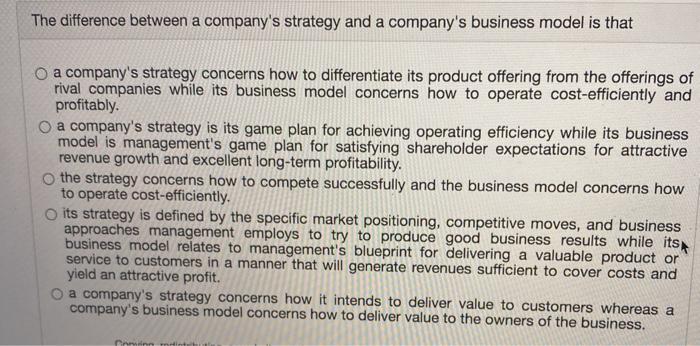
Question: Answer 1-5 please The difference between a company's strategy and a company's business model is that a company's strategy concerns how to differentiate its product

Answer 1-5 please
Answer 1-5 please The difference between a
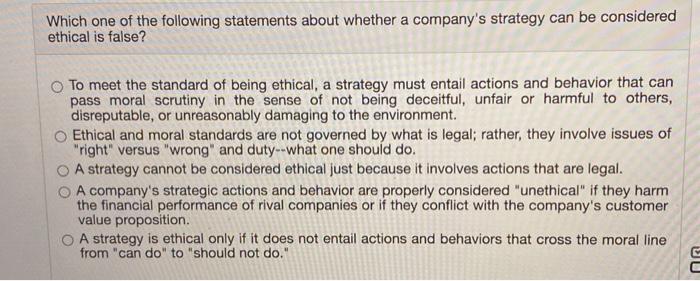
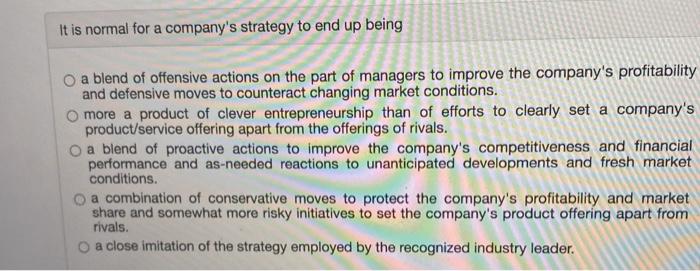
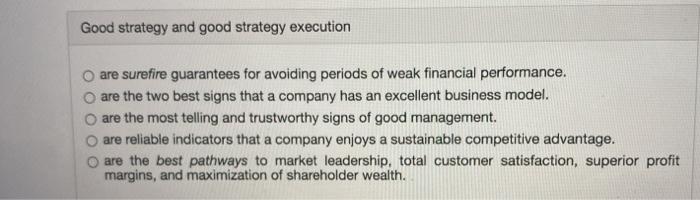
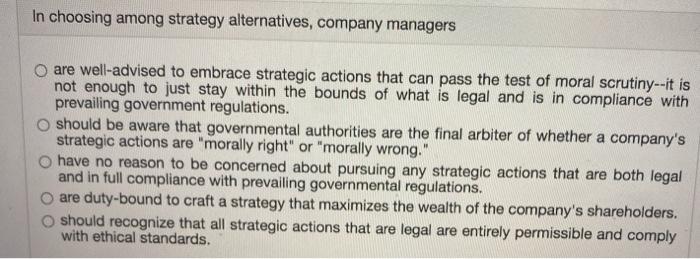
The difference between a company's strategy and a company's business model is that a company's strategy concerns how to differentiate its product offering from the offerings of rival companies while its business model concerns how to operate cost-efficiently and profitably. O a company's strategy is its game plan for achieving operating efficiency while its business model is management's game plan for satisfying shareholder expectations for attractive revenue growth and excellent long-term profitability. o the strategy concerns how to compete successfully and the business model concerns how to operate cost-efficiently. O its strategy is defined by the specific market positioning, competitive moves, and business approaches management employs to try to produce good business results while its business model relates to management's blueprint for delivering a valuable product or service to customers in a manner that will generate revenues sufficient to cover costs and yield an attractive profit. O a company's strategy concerns how it intends to deliver value to customers whereas a company's business model concerns how to deliver value to the owners of the business. Conni Which one of the following statements about whether a company's strategy can be considered ethical is false? To meet the standard of being ethical, a strategy must entail actions and behavior that can pass moral scrutiny in the sense of not being deceitful, unfair or harmful to others, disreputable, or unreasonably damaging to the environment. Ethical and moral standards are not governed by what is legal; rather, they involve issues of "right" versus "wrong" and duty--what one should do. A strategy cannot be considered ethical just because it involves actions that are legal. A company's strategic actions and behavior are properly considered "unethical" if they harm the financial performance of rival companies or if they conflict with the company's customer value proposition. A strategy is ethical only if it does not entail actions and behaviors that cross the moral line from "can do" to "should not do." UU It is normal for a company's strategy to end up being a blend of offensive actions on the part of managers to improve the company's profitability and defensive moves to counteract changing market conditions. more a product of clever entrepreneurship than of efforts to clearly set a company's product/service offering apart from the offerings of rivals. O a blend of proactive actions to improve the company's competitiveness and financial performance and as-needed reactions to unanticipated developments and fresh market conditions. a combination of conservative moves to protect the company's profitability and market share and somewhat more risky initiatives to set the company's product offering apart from rivals. a close imitation of the strategy employed by the recognized industry leader. Good strategy and good strategy execution are surefire guarantees for avoiding periods of weak financial performance. are the two best signs that a company has an excellent business model. are the most telling and trustworthy signs of good management. are reliable indicators that a company enjoys a sustainable competitive advantage. are the best pathways to market leadership, total customer satisfaction, superior profit margins, and maximization of shareholder wealth. In choosing among strategy alternatives, company managers are well-advised to embrace strategic actions that can pass the test of moral scrutiny--it is not enough to just stay within the bounds of what is legal and is in compliance with prevailing government regulations. O should be aware that governmental authorities are the final arbiter of whether a company's strategic actions are "morally right" or "morally wrong." have no reason to be concerned about pursuing any strategic actions that are both legal and in full compliance with prevailing governmental regulations. are duty-bound to craft a strategy that maximizes the wealth of the company's shareholders. should recognize that all strategic actions that are legal are entirely permissible and comply with ethical standards

Step by Step Solution

There are 3 Steps involved in it

1 Expert Approved Answer
Step: 1 Unlock blur-text-image

Question Has Been Solved by an Expert!

Get step-by-step solutions from verified subject matter experts

Step: 2 Unlock
Step: 3 Unlock

Students Have Also Explored These Related General Management Questions!