



Question: Answer ALL and receive a like! Background: Scenario: Questions: For almost ten years. A Canadian university has been dealing with financial difficulties due to significant
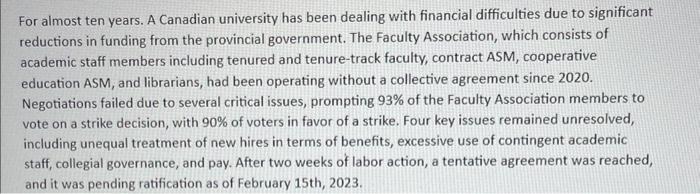
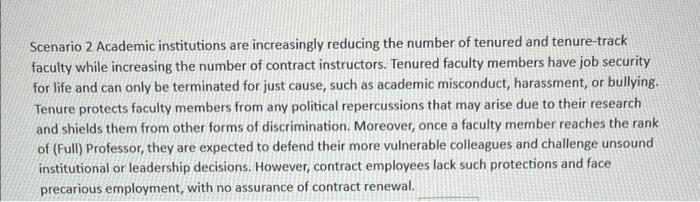
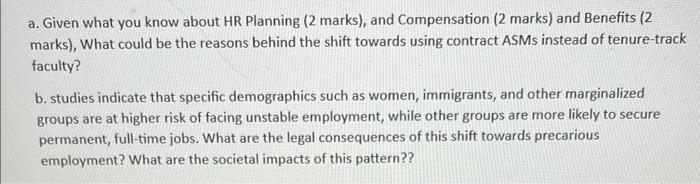
For almost ten years. A Canadian university has been dealing with financial difficulties due to significant reductions in funding from the provincial government. The Faculty Association, which consists of academic staff members including tenured and tenure-track faculty, contract ASM, cooperative education ASM, and librarians, had been operating without a collective agreement since 2020. Negotiations failed due to several critical issues, prompting 93% of the Faculty Association members to vote on a strike decision, with 90% of voters in favor of a strike. Four key issues remained unresolved, including unequal treatment of new hires in terms of benefits, excessive use of contingent academic staff, collegial governance, and pay. After two weeks of labor action, a tentative agreement was reached, and it was pending ratification as of February 15 th, 2023. Scenario 2 Academic institutions are increasingly reducing the number of tenured and tenure-track faculty while increasing the number of contract instructors. Tenured faculty members have job security for life and can only be terminated for just cause, such as academic misconduct, harassment, or bullying. Tenure protects faculty members from any political repercussions that may arise due to their research and shields them from other forms of discrimination. Moreover, once a faculty member reaches the rank of (Full) Professor, they are expected to defend their more vulnerable colleagues and challenge unsound institutional or leadership decisions. However, contract employees lack such protections and face precarious employment, with no assurance of contract renewal. a. Given what you know about HR Planning ( 2 marks), and Compensation ( 2 marks) and Benefits ( 2 ) marks), What could be the reasons behind the shift towards using contract ASMs instead of tenure-track faculty? b. studies indicate that specific demographics such as women, immigrants, and other marginalized groups are at higher risk of facing unstable employment, while other groups are more likely to secure permanent, full-time jobs. What are the legal consequences of this shift towards precarious employment? What are the societal impacts of this pattern
Step by Step Solution
There are 3 Steps involved in it

Get step-by-step solutions from verified subject matter experts