







Question: Answer ALL QUESTIONS using strategies taught in Calculus class in high school Complete the following assignment and submit your work to the dropbox. 1. a)
Answer ALL QUESTIONS using strategies taught in Calculus class in high school
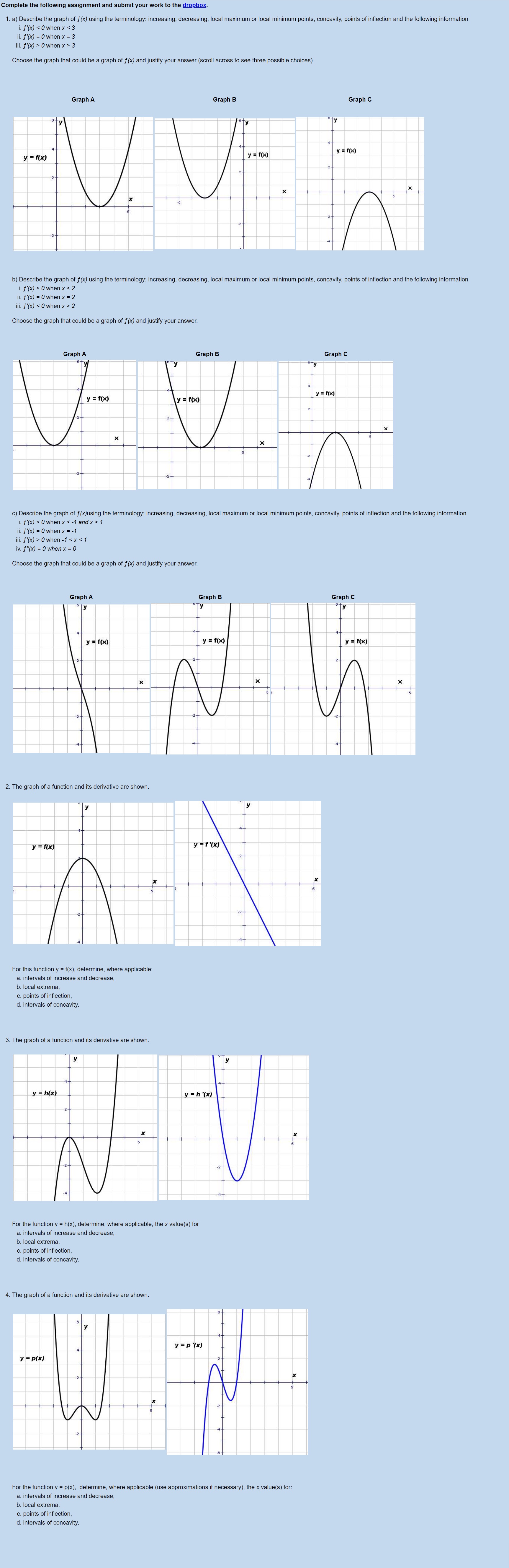
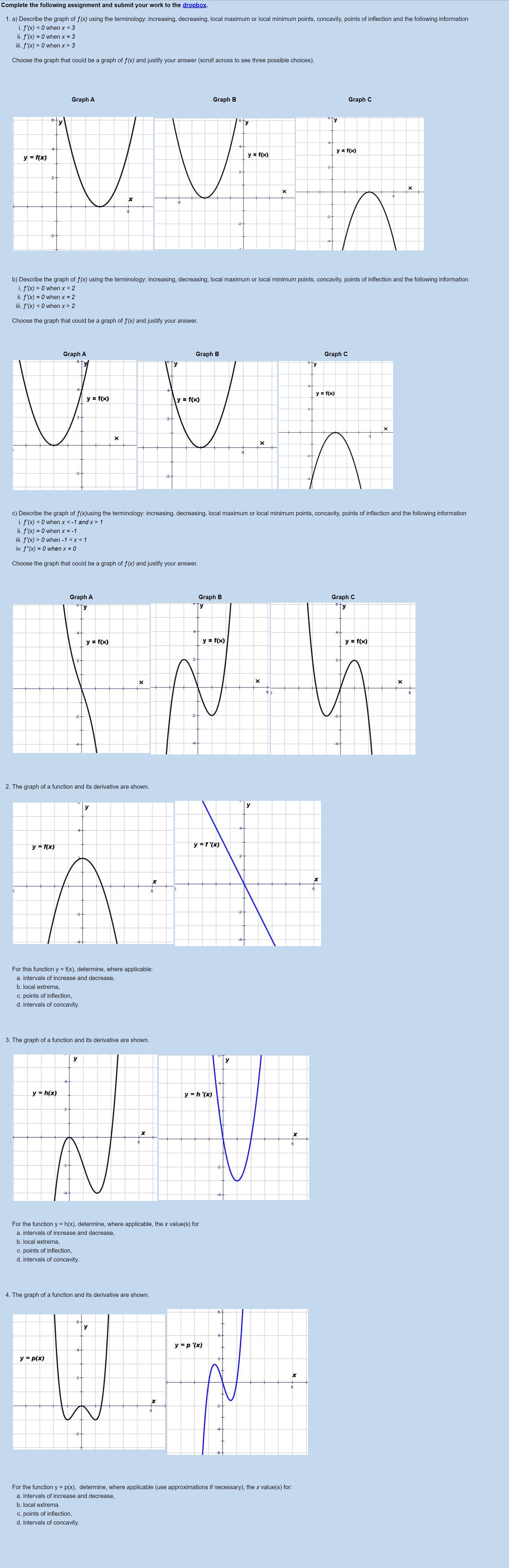
Complete the following assignment and submit your work to the dropbox. 1. a) Describe the graph of f(x) using the terminology: increasing, decreasing, local maximum or local minimum points, concavity, points of inflection and the following information i. f '(x) < 0 when x < 3 ii. f '(x) = 0 when x = 3 iii. f '(x) > 0 when x > 3 Choose the graph that could be a graph of f(x) and justify your answer (scroll across to see three possible choices). Graph A Graph B y f(X) Graph C y = f(X) b) Describe the graph of f(x) using the terminology: increasing, decreasing, local maximum or local minimum points, concavity, points of inflection and the following information i. f '(x) > 0 when x < 2 ii. f '(x) = 0 when x = 2 iii. f '(x) < 0 when x > 2 Choose the graph that could be a graph of f(x) and justify your answer. Graph A Graph B Graph C y = f(x) y f(x) Y f(x) c) Describe the graph of f(x)using the terminology: increasing, decreasing, local maximum or local minimum points, concavity, points of inflection and the following information i. f '(x) < 0 when x < -1 and x > 1 ii. f '(x) = 0 when x = -1 iii. f '(x) > 0 when -1 < x < 1 iv. f "(x) = 0 when x = 0 Choose the graph that could be a graph of f(x) and justify your answer. Graph A 2. The graph of a function and its derivative are shown. For this function y = f(x), determine, where applicable: a. intervals of increase and decrease, b. local extrema, c. points of inflection, d. intervals of concavity. 3. The graph of a function and its derivative are shown. h(x) Graph B Graph C For the function y = h(x), determine, where applicable, the x value(s) for a. intervals of increase and decrease, b. local extrema, c. points of inflection, d. intervals of concavity. 4. The graph of a function and its derivative are shown. For the function y = p(x), determine, where applicable (use approximations if necessary), the x value(s) for: a. intervals of increase and decrease, b. local extrema. c. points of inflection, d. intervals of concavity.
Step by Step Solution
There are 3 Steps involved in it

Get step-by-step solutions from verified subject matter experts
 Study Help