







Question: Answer the number 1. & 2. Math Empowerment A. Identify each sequence as arithmetic, geometric, or neither. If the sequence is arithmetic, write the common
Answer the number 1. & 2.
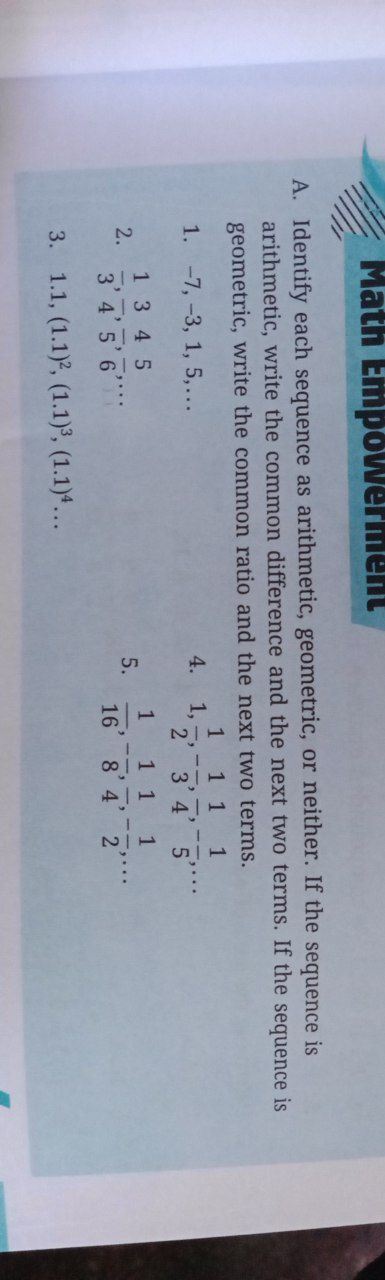
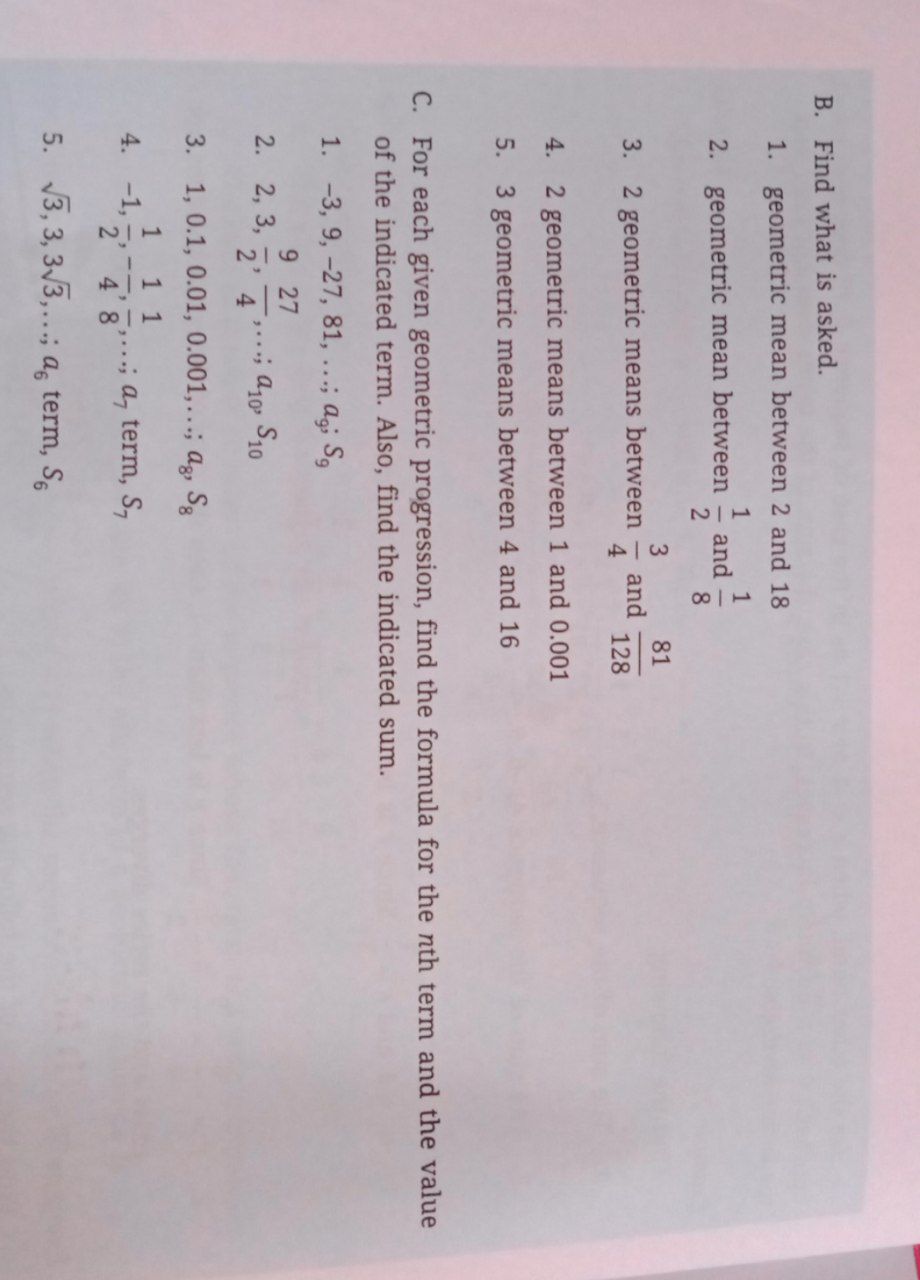
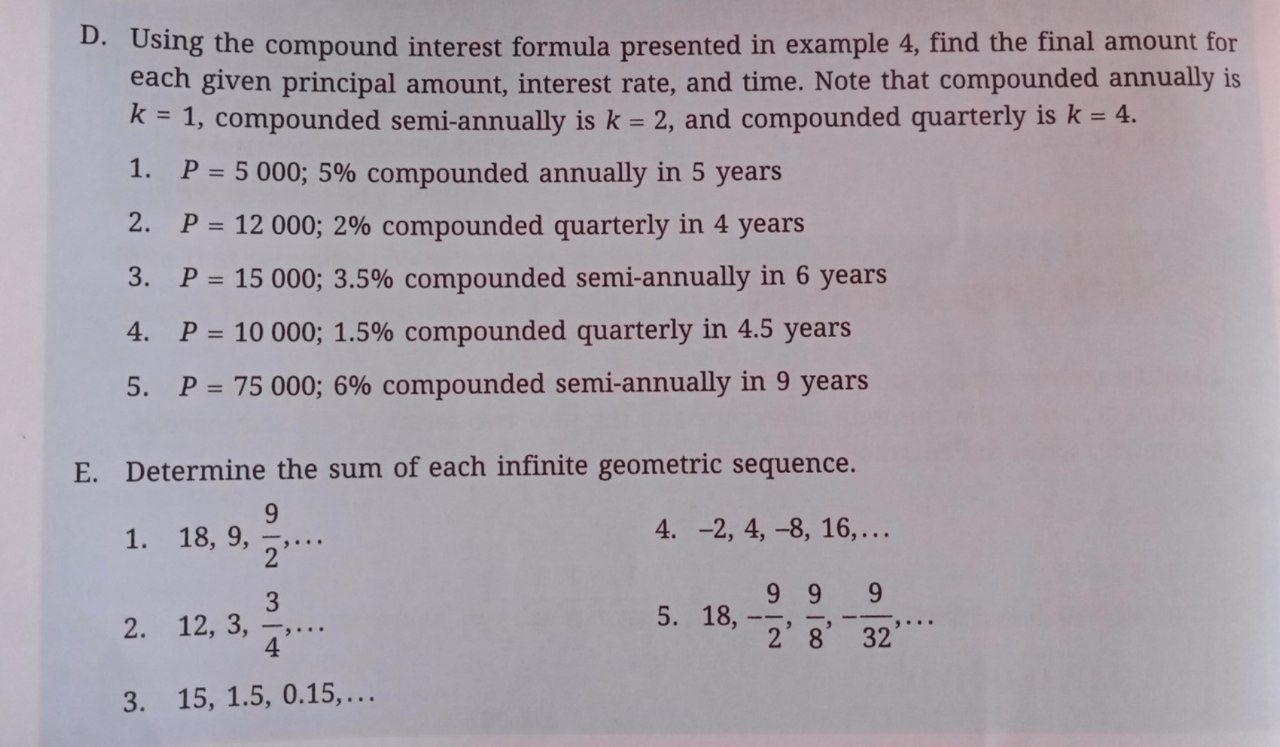
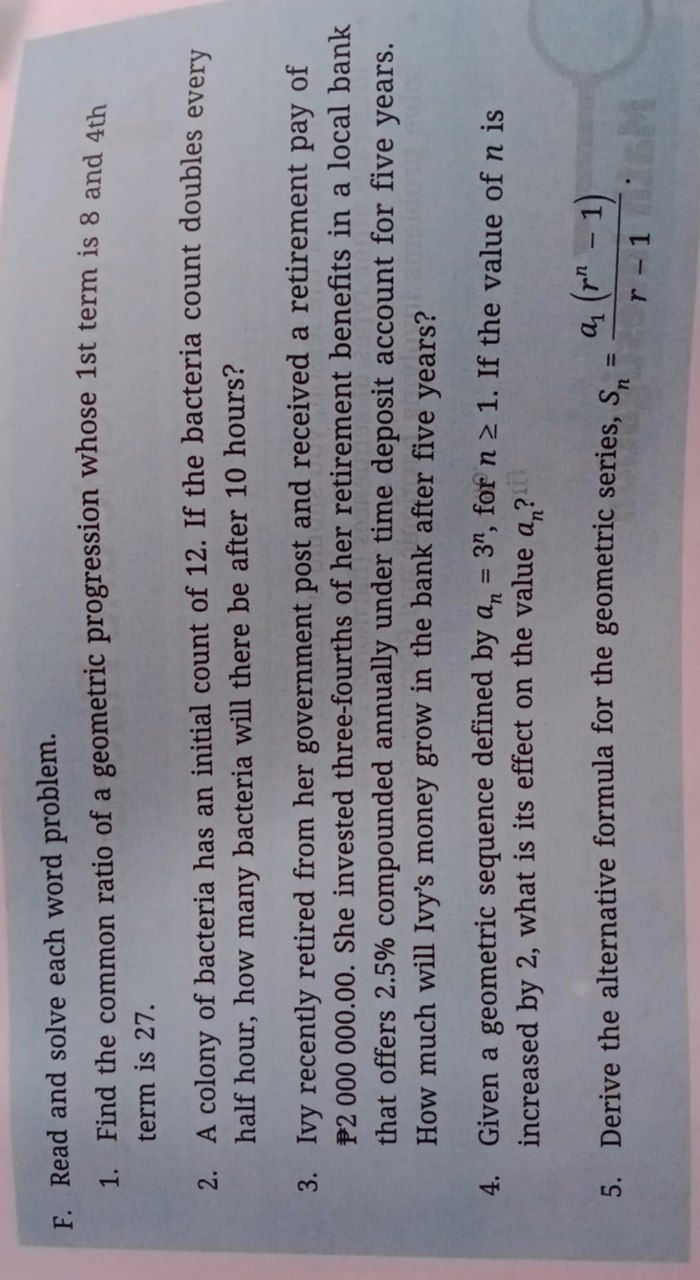
Math Empowerment A. Identify each sequence as arithmetic, geometric, or neither. If the sequence is arithmetic, write the common difference and the next two terms. If the sequence is geometric, write the common ratio and the next two terms. 1. -7, -3, 1, 5,... on in 1345 H H ~ HIN 3 4 5 6 . . ,.. . CO CO + 3. 1.1, (1.1)2, (1.1)3, (1.1)4...B. Find what is asked. 1. geometric mean between 2 and 18 2. geometric mean between - and HIN 100 3. 2 geometric means between - and 128 4. 2 geometric means between 1 and 0.001 5. 3 geometric means between 4 and 16 C. For each given geometric progression, find the formula for the nth term and the value of the indicated term. Also, find the indicated sum. 1. -3, 9, -27, 81, ...; ag; Sg 9 27 2. 2, 3, ?' 7 .'; 10 510 3. 1, 0.1, 0.01, 0.001,...; ag, Sg 2' 4'8 . .. .; a term, S, 5. V3, 3, 3V3,...; as term, S6D. Using the compound interest formula presented in example 4, find the final amount for each given principal amount, interest rate, and time. Note that compounded annually is k = 1, compounded semi-annually is k = 2, and compounded quarterly is k = 4. 1. P = 5 000; 5% compounded annually in 5 years 2. P = 12 000; 2% compounded quarterly in 4 years 3. P = 15 000; 3.5% compounded semi-annually in 6 years 4. P = 10 000; 1.5% compounded quarterly in 4.5 years 5. P = 75 000; 6% compounded semi-annually in 9 years E. Determine the sum of each infinite geometric sequence. 1. 18, 9, , . . . 4. -2, 4, -8, 16,... 2 3 9 9 9 2. 12, 3, . . 5. 18, 4 2' 8' 32 3. 15, 1.5, 0.15,...F. Read and solve each word problem. 1. Find the common ratio of a geometric progression whose ist term is 8 and 4th term is 27. 2. A colony of bacteria has an initial count of 12. If the bacteria count doubles every half hour, how many bacteria will there be after 10 hours? 3. Ivy recently retired from her government post and received a retirement pay of P2 000 000.00. She invested three-fourths of her retirement benefits in a local bank that offers 2.5% compounded annually under time deposit account for five years. How much will Ivy's money grow in the bank after five years? 4. Given a geometric sequence defined by an = 3", for n 2 1. If the value of n is increased by 2, what is its effect on the value a ? 5. Derive the alternative formula for the geometric series, $ = (r - 1) r- 1
Step by Step Solution
There are 3 Steps involved in it

Get step-by-step solutions from verified subject matter experts
 Study Help