







Question: April 2 9 Cache block size B can affect both miss rate and miss latency. Assuming a 1 - CPI machine with an average of
April
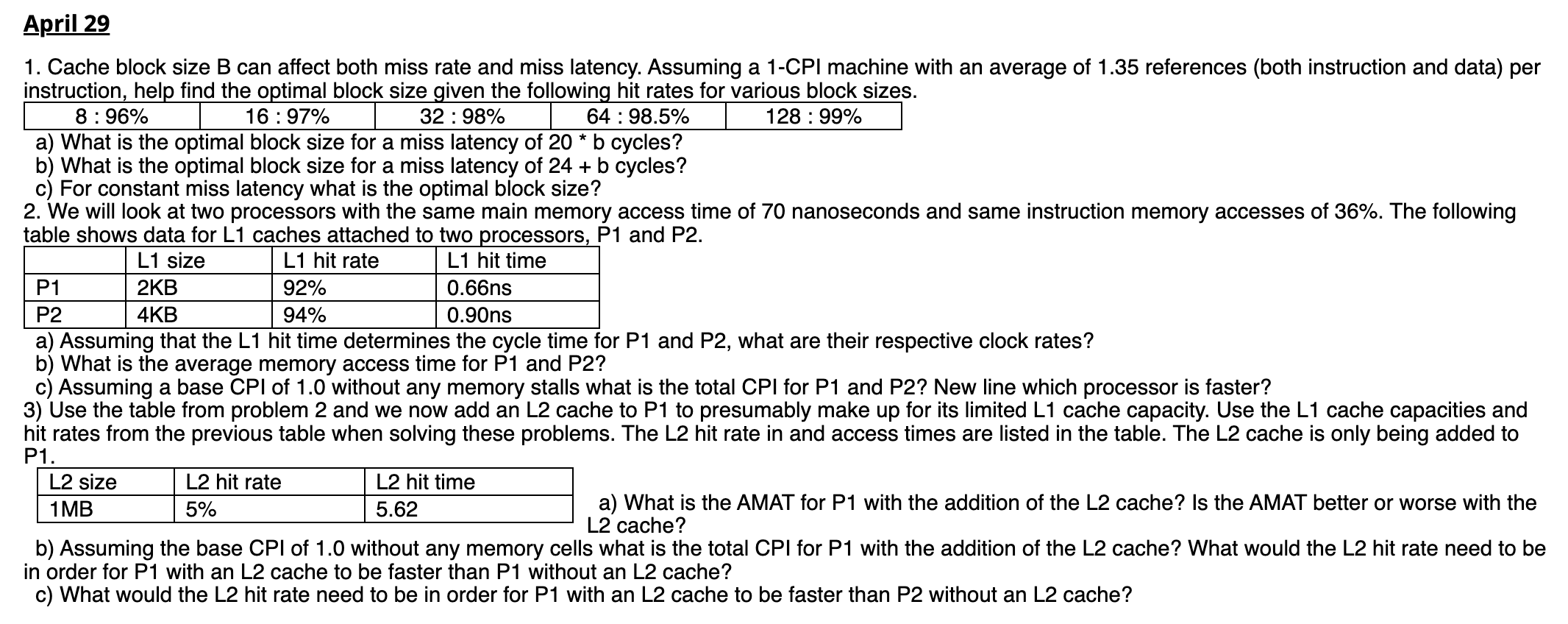
Cache block size B can affect both miss rate and miss latency. Assuming a CPI machine with an average of references both instruction and data per
instruction, help find the optimal block size given the following hit rates for various block sizes.
a What is the optimal block size for a miss latency of b cycles?
b What is the optimal block size for a miss latency of cycles?
c For constant miss latency what is the optimal block size?
We will look at two processors with the same main memory access time of nanoseconds and same instruction memory accesses of The following
table shows data for L caches attached to two processors, P and P
a Assuming that the L hit time determines the cycle time for P and P what are their respective clock rates?
b What is the average memory access time for P and P
c Assuming a base CPI of without any memory stalls what is the total CPI for P and P New line which processor is faster?
Use the table from problem and we now add an L cache to P to presumably make up for its limited L cache capacity. Use the L cache capacities and
hit rates from the previous table when solving these problems. The L hit rate in and access times are listed in the table. The L cache is only being added to
P
a What is the AMAT for with the addition of the L cache? Is the AMAT better or worse with the
L cache?
b Assuming the base CPI of without any memory cells what is the total CPI for P with the addition of the L cache? What would the L hit rate need to be
in order for P with an L cache to be faster than P without an L cache?
c What would the L hit rate need to be in order for P with an L cache to be faster than P without an L cache?
Step by Step Solution
There are 3 Steps involved in it
1 Expert Approved Answer
Step: 1 Unlock

Question Has Been Solved by an Expert!
Get step-by-step solutions from verified subject matter experts
Step: 2 Unlock
Step: 3 Unlock
 Study Help