Question: As discussed in the textbook, which is a fixed-quantity inventory model? a) The ABC model b) P-model c) Cycle counting model d) Economic order quantity
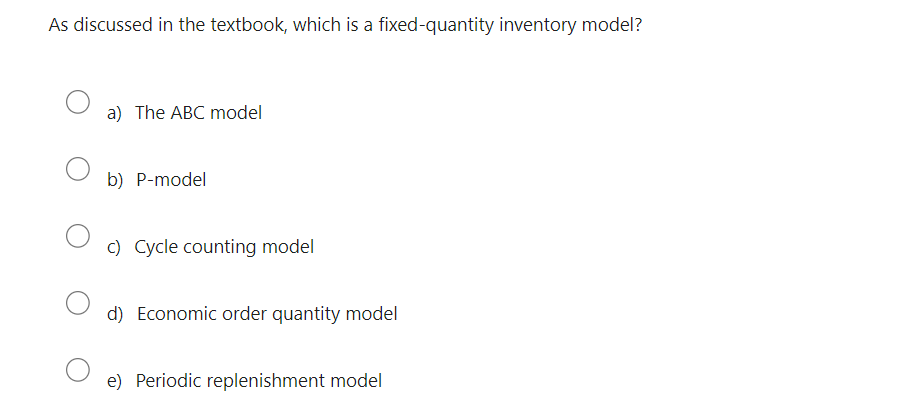
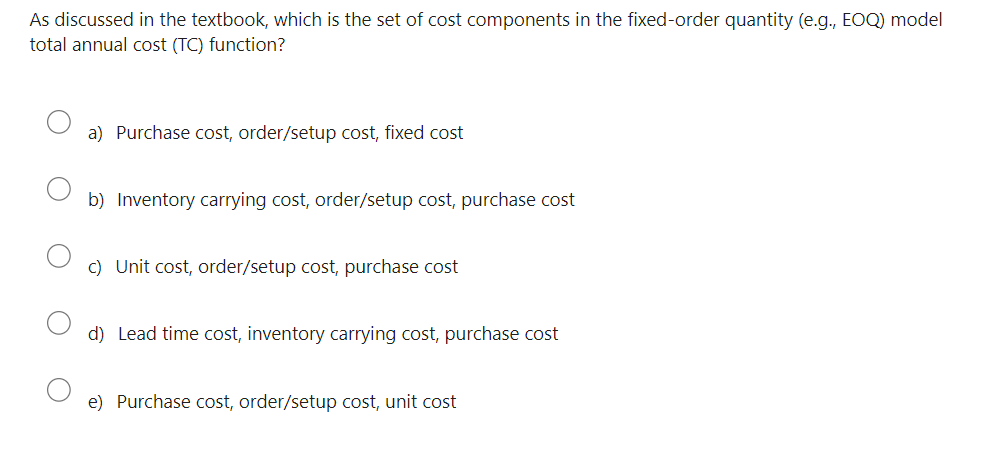
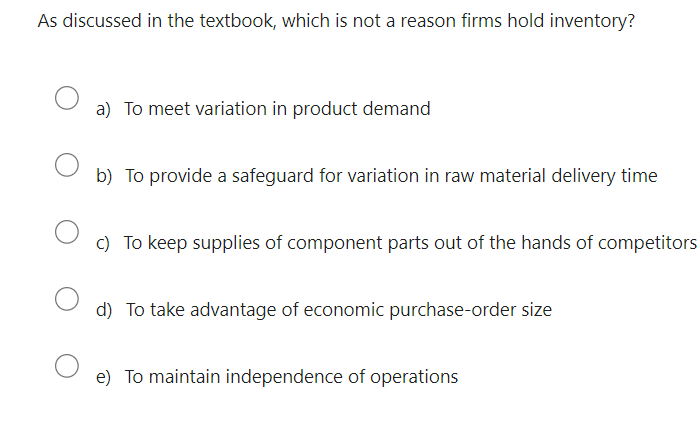
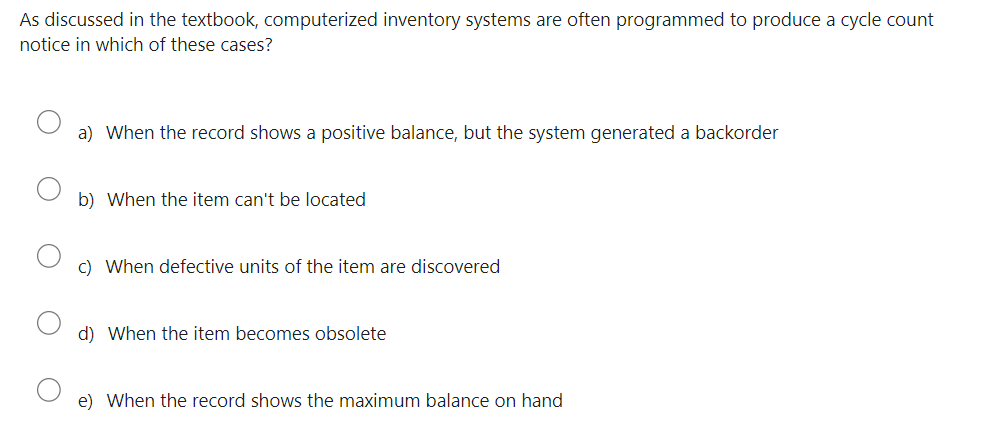
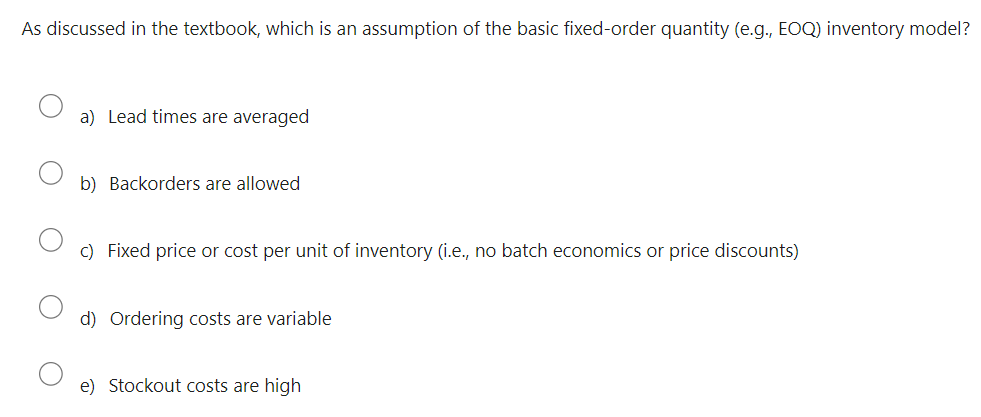
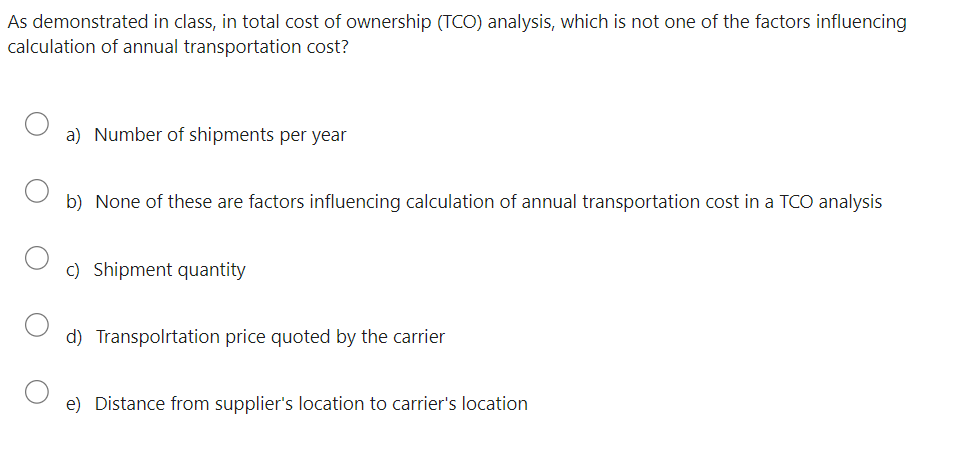
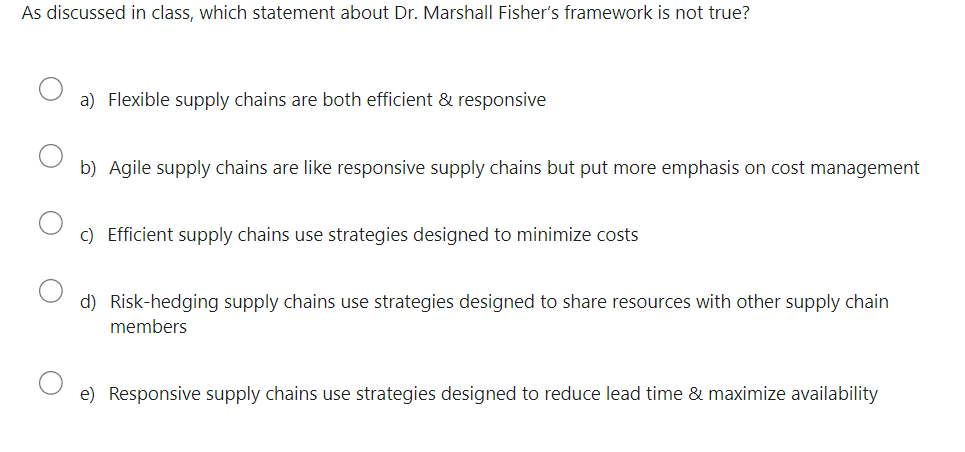
As discussed in the textbook, which is a fixed-quantity inventory model? a) The ABC model b) P-model c) Cycle counting model d) Economic order quantity model e) Periodic replenishment model As discussed in the textbook, which is the set of cost components in the fixed-order quantity (e.g., EOQ) model total annual cost (TC) function? a) Purchase cost, order/setup cost, fixed cost b) Inventory carrying cost, order/setup cost, purchase cost c) Unit cost, order/setup cost, purchase cost d) Lead time cost, inventory carrying cost, purchase cost e) Purchase cost, order/setup cost, unit cost As discussed in the textbook, which is not a reason firms hold inventory? a) To meet variation in product demand b) To provide a safeguard for variation in raw material delivery time c) To keep supplies of component parts out of the hands of competitors d) To take advantage of economic purchase-order size e) To maintain independence of operations As discussed in the textbook, computerized inventory systems are often programmed to produce a cycle count notice in which of these cases? a) When the record shows a positive balance, but the system generated a backorder b) When the item can't be located c) When defective units of the item are discovered d) When the item becomes obsolete e) When the record shows the maximum balance on hand As discussed in the textbook, which is an assumption of the basic fixed-order quantity (e.g., EOQ) inventory model? a) Lead times are averaged b) Backorders are allowed c) Fixed price or cost per unit of inventory (i.e., no batch economics or price discounts) d) Ordering costs are variable e) Stockout costs are high As demonstrated in class, in total cost of ownership (TCO) analysis, which is not one of the factors influencing calculation of annual transportation cost? a) Number of shipments per year b) None of these are factors influencing calculation of annual transportation cost in a TCO analysis c) Shipment quantity d) Transportation price quoted by the carrier e) Distance from supplier's location to carrier's location As discussed in class, which statement about Dr. Marshall Fisher's framework is not true? a) Flexible supply chains are both efficient & responsive b) Agile supply chains are like responsive supply chains but put more emphasis on cost management c) Efficient supply chains use strategies designed to minimize costs d) Risk-hedging supply chains use strategies designed to share resources with other supply chain members e) Responsive supply chains use strategies designed to reduce lead time & maximize availability









 Study Help