







Question: ASSIGNMENT# 3 4. Based on the information in Table 17.2, it is clear that: A. Country A has a comparative advantage in wheat. B.
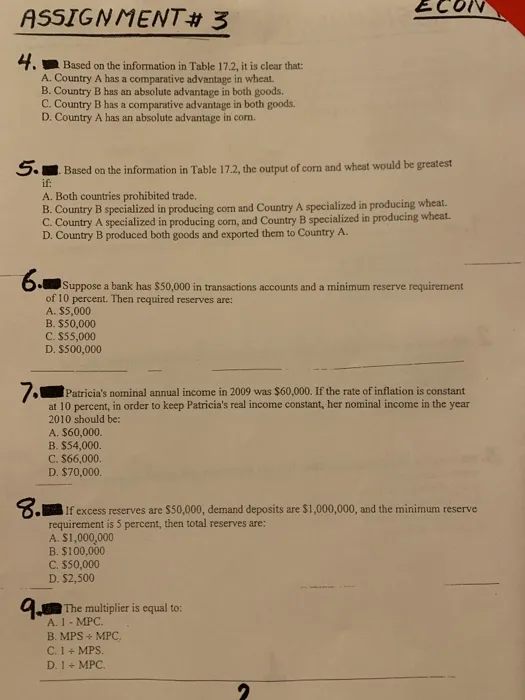
ASSIGNMENT# 3 4. Based on the information in Table 17.2, it is clear that: A. Country A has a comparative advantage in wheat. B. Country B has an absolute advantage in both goods. C. Country B has a comparative advantage in both goods. D. Country A has an absolute advantage in corn. 5. Based on the information in Table 17.2, the output of corn and wheat would be greatest if: A. Both countries prohibited trade. B. Country B specialized in producing com and Country A specialized in producing wheat. C. Country A specialized in producing corn, and Country B specialized in producing wheat. D. Country B produced both goods and exported them to Country A. 6. Suppose a bank has $50,000 in transactions accounts and a minimum reserve requirement of 10 percent. Then required reserves are: A. $5,000 B. $50,000 C. $55,000 D. $500,000 7. Patricia's nominal annual income in 2009 was $60,000. If the rate of inflation is constant at 10 percent, in order to keep Patricia's real income constant, her nominal income in the year 2010 should be: A. $60,000. B. $54,000. C. $66,000. D. $70,000. If excess reserves are $50,000, demand deposits are $1,000,000, and the minimum reserve requirement is 5 percent, then total reserves are: A. $1,000,000 B. $100,000 C. $50,000 D. $2,500 The multiplier is equal to: A. 1 - MPC. B. MPS + MPC. C. 1 + MPS. D. 1 + MPC. 2
Step by Step Solution
There are 3 Steps involved in it
The detailed answer for the above question is provided below 1 C Country B has a comparative advanta... View full answer

Get step-by-step solutions from verified subject matter experts
 Study Help