







Question: ASSIGNMENT IS BASED ON THE BELOW RESEARCH AND HAVE 5 QUESTIONS SURVEY RESEARCH TOPICS APPROPRIATE FOR SURVEY RESEARCH Today, survey research is a frequently used
ASSIGNMENT IS BASED ON THE BELOW RESEARCH AND HAVE 5 QUESTIONS
SURVEY RESEARCH
TOPICS APPROPRIATE FOR SURVEY RESEARCH
- Today, survey research is a frequently used mode of observation in the social sciences.
- In a typical survey, the researcher selects a sample of respondents and administers a standardized questionnaire to them.
- Surveys may be used for descriptive, explanatory, and exploratory purposes.
- They are chiey used in studies that have individual people as the units of analysis. Although this method can be employed for other units of analysis, such as groups or interactions, some individual persons must serve as respondents or informants. Thus, we could undertake a survey in which divorces were the unit of analysis, but we would need to administer the survey questionnaire to the participants in the divorces (or to some other respondents).
- Survey research is probably the best method available to the social researcher who is interested in collecting original data for describing a population too large to observe directly.
- Careful probability sampling provides a group of respondents whose characteristics may be taken to reect those of the larger population, and carefully constructed standardized questionnaires provide data in the same form from all respondents.
- Surveys are also excellent vehicles for measuring attitudes and orientations in a large population.
- The general attitude toward public opinion research is further complicated by scientically unsound surveys that nonetheless capture peoples attention because of the topics they cover and/or their ndings.
- By the same token, political parties and charitable organizations have begun conducting phony surveys.
- Done properly, however, survey research can be a useful tool of social inquiry. Designing useful (and trustworthy) survey research begins with formulating good questions.
GUIDELINES FOR ASKING QUESTIONS
- In social research, variables are often operationalized when researchers ask people questions as a way of getting data for analysis and interpretation.
- Sometimes the questions are asked by an interviewer; sometimes they are written down and given to respondents for completion.
- In other cases, several general guidelines can help researchers frame and ask questions that serve as excellent operationalizations of variables while avoiding pitfalls that can result in useless or even misleading information.
- Surveys include the use of a questionnaire an instrument specically designed to elicit information that will be useful for analysis. Although some of the specic points to follow are more appropriate to structured questionnaires than to the more open-ended questionnaires used in qualitative, in-depth interviewing, the underlying logic is valuable whenever we ask people questions in order to gather data.
CHOOSE APPROPRIATE QUESTION FORMS
- Although the term questionnaire suggests a collection of questions, an examination of a typical questionnaire will probably reveal as many statements as questions. This is not without reason. Often, the researcher is interested in determining the extent to which respondents hold a particular attitude or perspective. If you can summarize the attitude in a fairly brief statement, you can present that statement and ask respondents whether they agree or disagree with it.
- Both questions and statements can be used protably. Using both in a given questionnaire gives you more exibility in the design of items and can make the questionnaire more interesting as well.
OPEN-ENDED AND CLOSED-ENDED QUESTIONS
- In asking questions, researchers have two options. They can ask open-ended questions, in which case the respondent is asked to provide his or her own answers to the questions. For example, the respondent may be asked, What do you feel is the most important issue facing the United States today? and be provided with a space to write in the answer.
- The closed-ended questions, the respondent is asked to select an answer from among a list provided by the researcher. Closed ended questions are very popular in survey research because they provide a greater uniformity of responses and are more easily processed than open-ended ones.
- The chief shortcoming of closed-ended questions lies in the researchers structuring of responses. When the relevant answers to a given question are relatively clear, there should be no problem. In other cases, however, the researchers structuring of responses may overlook some important responses.
- In asking about the most important issue facing the United States, for example, his or her checklist of issues might omit certain issues that respondents would have said were important.
- Open-ended questions: Questions for which the respondent is asked to provide his or her own answers. In-depth, qualitative interviewing relies almost exclusively on open-ended questions.
- Close-ended questions: Survey questions in which the respondent is asked to select an answer from among a list provided by the researcher. Popular in survey research because they provide a greater uniformity of responses and are more easily processed than open-ended questions.
- The construction of closed-ended questions should be guided by two structural requirements.
- First, the response categories provided should beexhaustive: They should include all the possible sponses that might be expected. Often, researchers ensure this by adding a category such as Other(Please specify: ..).
- Second, the answer categories must be mutually exclusive: The respondent should not feel compelled to select more than one. To ensure that your categories are mutually exclusive, carefully consider each combination of categories, asking yourself whether a person could reasonably choose more than one answer. In addition, its useful to add an instruction to the question asking the respondent to select the one best answer, but this technique is not a satisfactory substitute for a carefully constructed set of responses.
MAKE ITEMS CLEAR
- It should go without saying that questionnaire items need to be clear and unambiguous, but the broad proliferation of unclear and ambiguous questions in surveys makes the point worth emphasizing. We can become so deeply involved in the topic under examination that opinions and perspectives are clear to us but not to our respondentsmany of whom have paid little or no attention to the topic. Or, if we have only supercial understanding of the topic, we may fail to specify the intent of a question sufciently.
- The question What do you think about the proposed peace plan? may evoke in the respondent a counter question: Which proposed peace plan? Questionnaire items should be precise so that the respondent knows exactly what the researcher is asking. The possibilities for misunderstanding are endless, and no researcher is immune.
AVOID DOUBLE-BARRELED QUESTIONS
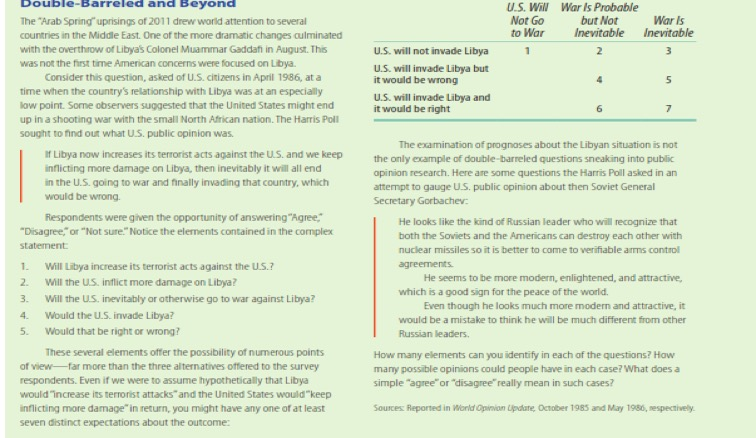
- Frequently, researchers ask respondents for a single answer to a question that actually has multiple parts. These types of queries are often termed double-barreled questions and seem to happen most often when the researcher has personally identied with a complex question.
- As a general rule, whenever the word and appears in a question or questionnaire statement, check whether youre asking a double-barreled question.
- For example ask respondents to agree or disagree with the statement The United States should abandon its space Program and spend the money on domestic programs. Although many people would unequivocally agree with the statement and others would unequivocally disagree, still others would be unable to answer. Some would want to abandon the space program and give the money back to the taxpayers. Others would want to continue the space program but also put more money into domestic programs. These latter respondents could neither agree nor disagree without misleading you.
RESPONDENTS MUST BE COMPETENT
TO ANSWER
- In asking respondents to provide information, you should continually ask yourself whether they can do so reliably. In a study of child rearing, you might ask respondents to report the age at which they rst talked back to their parents. Quite aside from the problem of dening talking back to parents, its doubtful that most respondents would remember with any degree of accuracy.
- As another example, student-government leaders occasionally ask their constituents to indicate how students fees ought to be spent. Typically, respondents are asked to indicate the percentage of available funds that should be devoted to a long list of activities. Without a fairly good knowledge of the nature of those activities and the costs involved in them, the respondents cannot provide meaningful answers. Administrative costs, for example, will receive little support although they may be essential to the programs as a whole.
Your assignment has to be about Survey, this assignment has to include:
3. Which kind of topics are appropriate to conduct survey? (Do a literature research on the databases we provide you below and give 4 topic example about advertising)
U.S. Wil Not Go to War War Is Probable but Not inevitable War is Inevitable Double-Barreled and Beyond The "Arab Spring uprisings of 2011 drew world attention to several countries in the Middle East. One of the more dramatic changes culminated with the overthrow of Libya's Colonel Muammar Gaddafi in August. This was not the first time American concerns were focused on Libya Consider this question, asked of U.S. citizens in April 1986, at a time when the country's relationship with Libya was at an especially low point. Some observers suggested that the United States might end up in a shooting war with the small North African nation. The Harris Poll sought to find out what U.S. public opinion was. U.S. will not invade Libya U.S. will invade Libya but it would be wrong U.S. will invade Libya and it would be right mi If Libya now increases its terrorist acts against the US, and we keep inflicting more damage on Libya, then inevitably it will all end in the U.S. going to war and finally invading that country, which would be wrong The examination of prognoses about the Libyan situation is not the only example of double-barreled questions sneaking into public opinion research. Here are some questions the Harris Poll asked in an attempt to gauge U.S. public opinion about then Soviet General Secretary Gorbacher Respondents were given the opportunity of answering "Agree, "Disagree," or "Not sure." Notice the elements contained in the complex statement He looks like the kind of Russian leader who will recognize that both the Soviets and the Americans can destroy each other with nuclear missiles so it is better to come to verifiable arms control agreements He seems to be more modern, enlightened, and attractive, which is a good sign for the peace of the world. Even though he looks much more modern and attractive, it would be a mistake to think he will be much different from other Russian leaders 1. Will Libya increase its terrorist acts against the U.S.? 2. Will the US. inflict more damage on Libya? 3. Will the US. inevitably or otherwise go to war against Libya? 4. Would the U.S.invade Libya? 5. Would that be right or wrong? These several elements offer the possibility of numerous points of view far more than the three alternatives offered to the survey respondents. Even if we were to assume hypothetically that Libya would increase its terrorist attacks and the United States would"keep inflicting more damage in return, you might have any one of at least seven distinct expectations about the outcome How many elements can you identify in each of the questions? How many possible opinions could people have in each case? What does a simple "agree" or "disagree really mean in such cases? Sources Reported in World Opinion Update October 1985 and May 1986, respectively U.S. Wil Not Go to War War Is Probable but Not inevitable War is Inevitable Double-Barreled and Beyond The "Arab Spring uprisings of 2011 drew world attention to several countries in the Middle East. One of the more dramatic changes culminated with the overthrow of Libya's Colonel Muammar Gaddafi in August. This was not the first time American concerns were focused on Libya Consider this question, asked of U.S. citizens in April 1986, at a time when the country's relationship with Libya was at an especially low point. Some observers suggested that the United States might end up in a shooting war with the small North African nation. The Harris Poll sought to find out what U.S. public opinion was. U.S. will not invade Libya U.S. will invade Libya but it would be wrong U.S. will invade Libya and it would be right mi If Libya now increases its terrorist acts against the US, and we keep inflicting more damage on Libya, then inevitably it will all end in the U.S. going to war and finally invading that country, which would be wrong The examination of prognoses about the Libyan situation is not the only example of double-barreled questions sneaking into public opinion research. Here are some questions the Harris Poll asked in an attempt to gauge U.S. public opinion about then Soviet General Secretary Gorbacher Respondents were given the opportunity of answering "Agree, "Disagree," or "Not sure." Notice the elements contained in the complex statement He looks like the kind of Russian leader who will recognize that both the Soviets and the Americans can destroy each other with nuclear missiles so it is better to come to verifiable arms control agreements He seems to be more modern, enlightened, and attractive, which is a good sign for the peace of the world. Even though he looks much more modern and attractive, it would be a mistake to think he will be much different from other Russian leaders 1. Will Libya increase its terrorist acts against the U.S.? 2. Will the US. inflict more damage on Libya? 3. Will the US. inevitably or otherwise go to war against Libya? 4. Would the U.S.invade Libya? 5. Would that be right or wrong? These several elements offer the possibility of numerous points of view far more than the three alternatives offered to the survey respondents. Even if we were to assume hypothetically that Libya would increase its terrorist attacks and the United States would"keep inflicting more damage in return, you might have any one of at least seven distinct expectations about the outcome How many elements can you identify in each of the questions? How many possible opinions could people have in each case? What does a simple "agree" or "disagree really mean in such cases? Sources Reported in World Opinion Update October 1985 and May 1986, respectivelyStep by Step Solution
There are 3 Steps involved in it
1 Expert Approved Answer
Step: 1 Unlock

Question Has Been Solved by an Expert!
Get step-by-step solutions from verified subject matter experts
Step: 2 Unlock
Step: 3 Unlock
 Study Help