







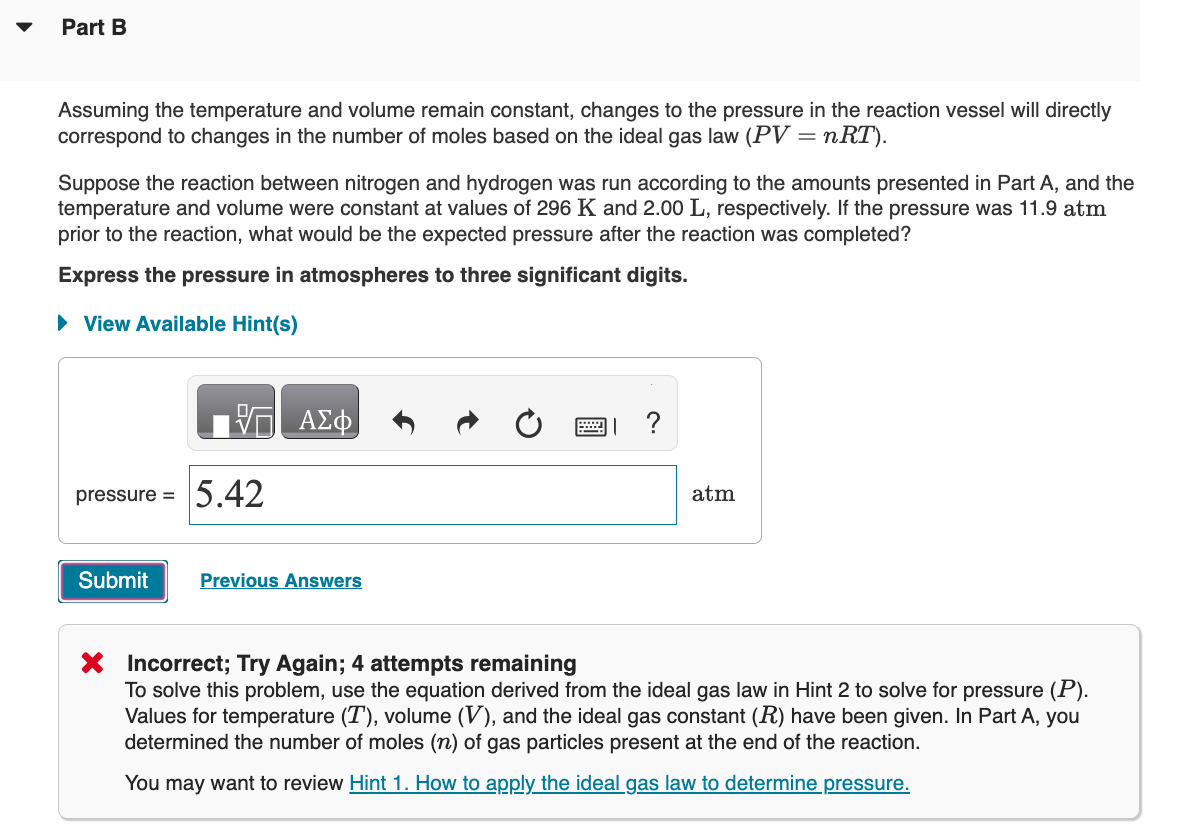
Question: Assuming the temperature and volume remain constant, changes to the pressure in the reaction vessel will directly correspond to changes in the number of moles
Assuming the temperature and volume remain constant, changes to the pressure in the reaction vessel will directly
correspond to changes in the number of moles based on the ideal gas law
Suppose the reaction between nitrogen and hydrogen was run according to the amounts presented in Part A and the
temperature and volume were constant at values of and respectively. If the pressure was atm
prior to the reaction, what would be the expected pressure after the reaction was completed?
Express the pressure in atmospheres to three significant digits.
View Available Hints
pressure
atm
Previous Answers
Incorrect; Try Again; attempts remaining
To solve this problem, use the equation derived from the ideal gas law in Hint to solve for pressure
Values for temperature volume and the ideal gas constant have been given. In Part A you
determined the number of moles of gas particles present at the end of the reaction.
You may want to review Hint How to apply the ideal gas law to determine pressure.
Step by Step Solution
There are 3 Steps involved in it
1 Expert Approved Answer
Step: 1 Unlock

Question Has Been Solved by an Expert!
Get step-by-step solutions from verified subject matter experts
Step: 2 Unlock
Step: 3 Unlock
 Study Help