







Question: B. (16 points) Consider a six-bit representation for IEEE-style floating-point numbers that uses 1 bit for the sign, two bits for the exponent, and three
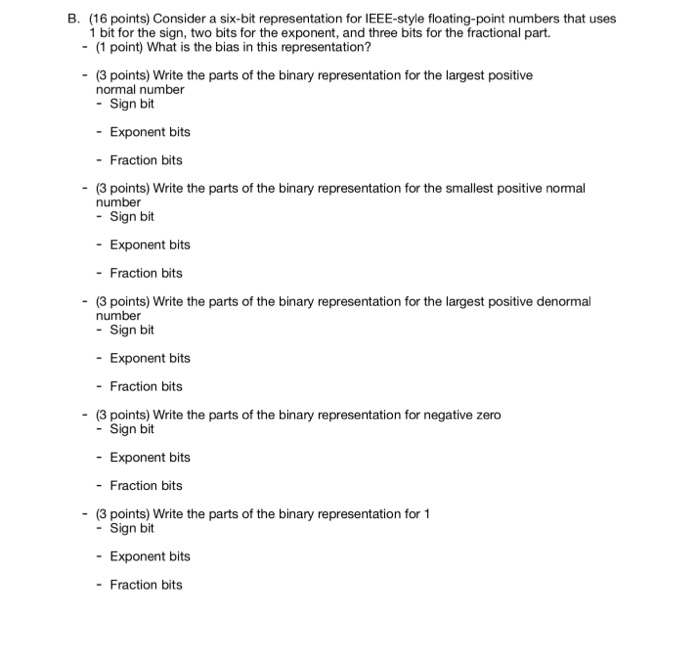
B. (16 points) Consider a six-bit representation for IEEE-style floating-point numbers that uses 1 bit for the sign, two bits for the exponent, and three bits for the fractional part. - (1 point) What is the bias in this representation? (3 points) Write the parts of the binary representation for the largest positive normal number - Sign bit - Exponent bits - Fraction bits (3 points) Write the parts of the binary representation for the smallest positive normal number - Sign bit - Exponent bits - Fraction bits (3 points) Write the parts of the binary representation for the largest positive denormal number - Sign bit - Exponent bits - Fraction bits - (3 points) Write the parts of the binary representation for negative zero - Sign bit - Exponent bits - Fraction bits (3 points) Write the parts of the binary representation for 1 - Sign bit - Exponent bits - Fraction bits
Step by Step Solution
There are 3 Steps involved in it

Get step-by-step solutions from verified subject matter experts
 Study Help