Question: Background When responding to a case study or scenario, the HR practitioner should use a consistent, factbased, problem-solving approach. The development of this skill will
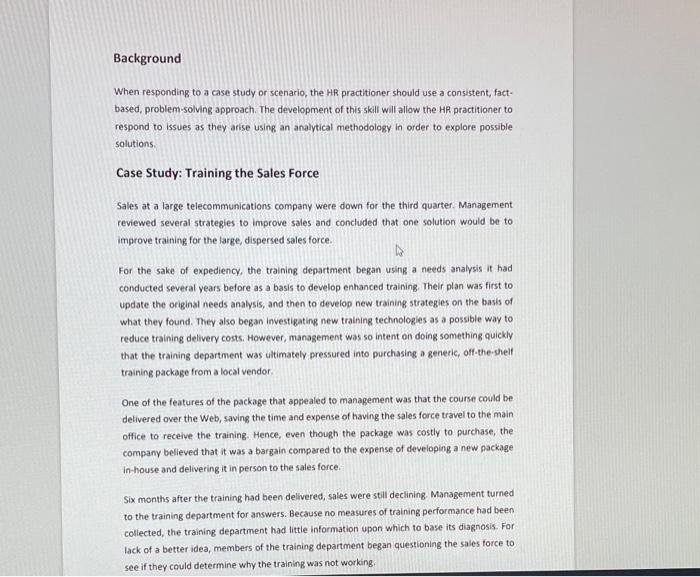
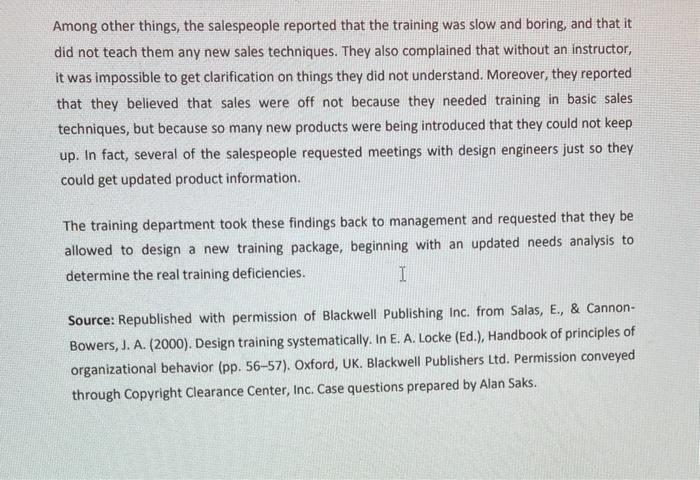
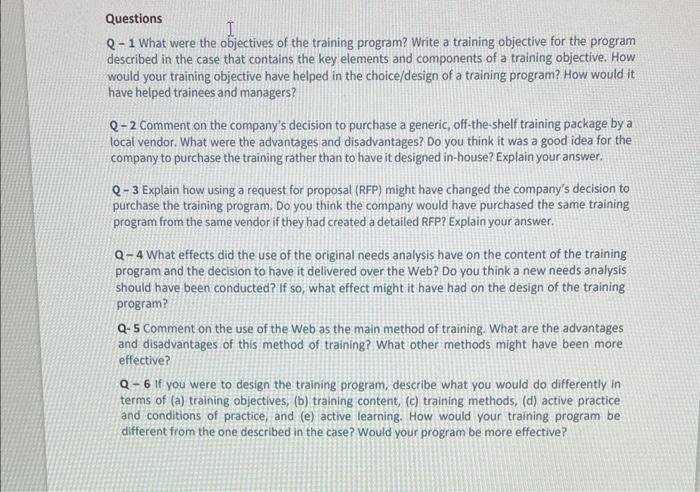
Background When responding to a case study or scenario, the HR practitioner should use a consistent, factbased, problem-solving approach. The development of this skill will allow the HR practitioner to respond to issues as they arise using an analytical methodology in order to explore possible solutions. Case Study: Training the Sales Force Sales at a large telecommunications company were down for the third quarter. Management reviewed several strategies to improve sales and concluded that one solution would be to improve training for the large, dispersed sales force. For the sake of expediency, the training department began using a needs analysis it had conducted several years before as a basis to develop enhanced training. Their plan was first to update the original needs analysis, and then to develop new training strategies on the basis of what they found. They also began investigating new training technologies as a possible way to reduce training delivery costs. However, management was so intent on doing something quickly that the training department was ultimately pressured into purchasing a generic, off-the-shelf training package from a local vendor. One of the features of the package that appealed to management was that the course could be delivered over the Web, saving the time and expense of having the sales force travel to the main office to receive the training. Hence, even though the package was costly to purchase, the company belleved that it was a bargain compared to the expense of developing a new nackage in-house and delivering it in person to the sales force. Six months after the training had been delivered, sales were still declining. Management turned to the training department for answers. Because no measures of training performance had been collected, the training department had little information upon which to base its diagnosis. For lack of a better idea, members of the training department began questioning the sales force to see if they could determine why the training was not working. Among other things, the salespeople reported that the training was slow and boring, and that it did not teach them any new sales techniques. They also complained that without an instructor, it was impossible to get clarification on things they did not understand. Moreover, they reported that they believed that sales were off not because they needed training in basic sales techniques, but because so many new products were being introduced that they could not keep up. In fact, several of the salespeople requested meetings with design engineers just so they could get updated product information. The training department took these findings back to management and requested that they be allowed to design a new training package, beginning with an updated needs analysis to determine the real training deficiencies. Source: Republished with permission of Blackwell Publishing Inc. from Salas, E., \& CannonBowers, J. A. (2000). Design training systematically. In E. A. Locke (Ed.), Handbook of principles of organizational behavior (pp. 56-57). Oxford, UK. Blackwell Publishers Ltd. Permission conveyed through Copyright Clearance Center, Inc. Case questions prepared by Alan Saks. Questions Q - 1 What were the objectives of the training program? Write a training objective for the program described in the case that contains the key elements and components of a training objective. How would your training objective have helped in the choice/design of a training program? How would it have helped trainees and managers? Q - 2 Comment on the company's decision to purchase a generic, off-the-shelf training package by a local vendor. What were the advantages and disadvantages? Do you think it was a good idea for the company to purchase the training rather than to have it designed in-house? Explain your answer. Q - 3 Explain how using a request for proposal (RFP) might have changed the company's decision to purchase the training program. Do you think the company would have purchased the same training program from the same vendor if they had created a detailed RFP? Explain your answer. Q - 4 What effects did the use of the original needs analysis have on the content of the training program and the decision to have it delivered over the Web? Do you think a new needs analysis should have been conducted? If so, what effect might it have had on the design of the training program? Q- 5 Comment on the use of the Web as the main method of training. What are the advantages and disadvantages of this method of training? What other methods might have been more effective? Q - 6 If you were to design the training program, describe what you would do differently in terms of (a) training objectives, (b) training content, (c) training methods, (d) active practice and conditions of practice, and (e) active learning. How would your training program be different from the one described in the case? Would your program be more effective









 Study Help