







Question: TRAINING AND DEVELOPMENT When responding to a case study or scenario, the HR practitioner should use a consistent, factbased, problem-solving approach. The development of this
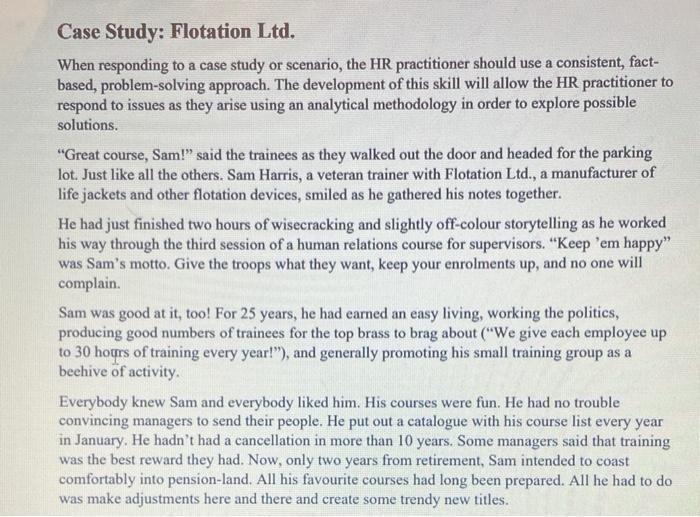
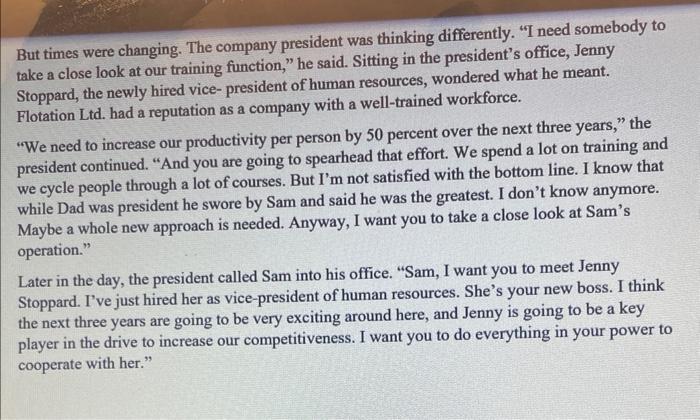
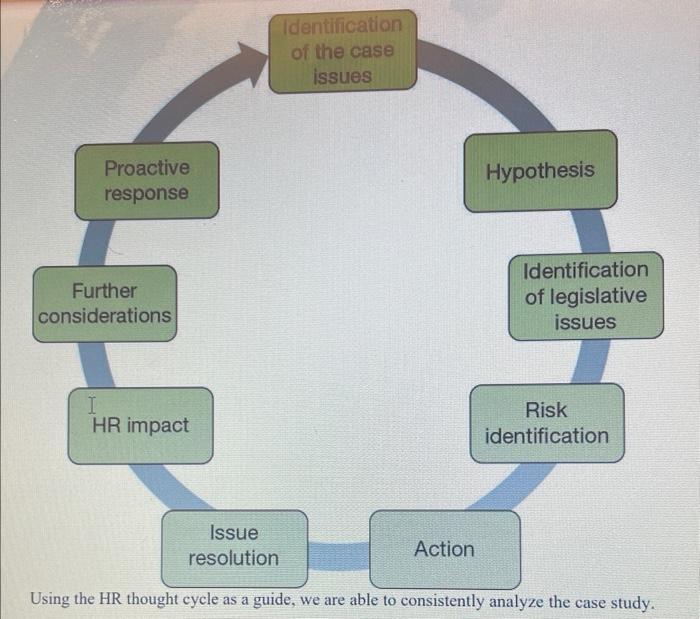
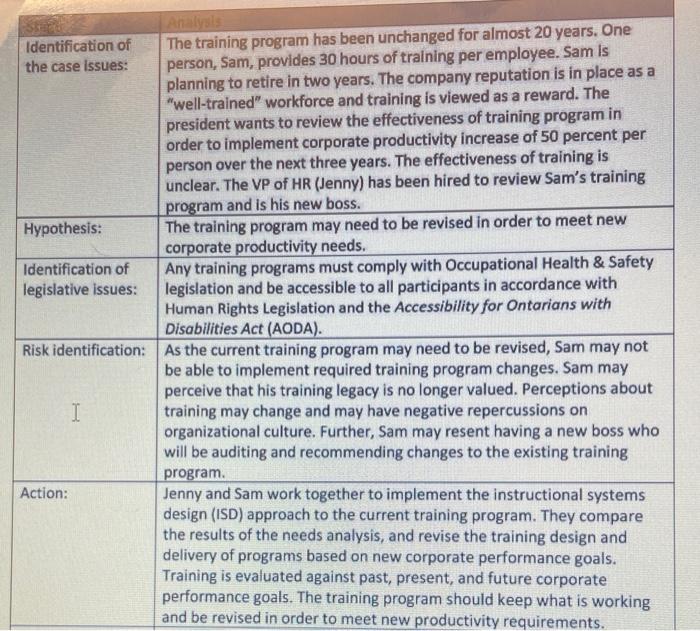
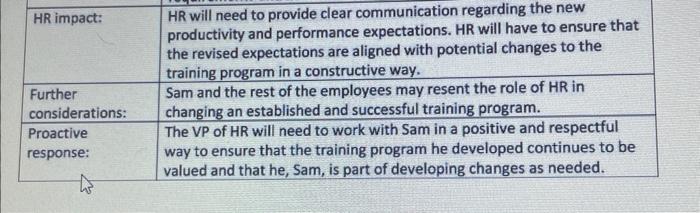
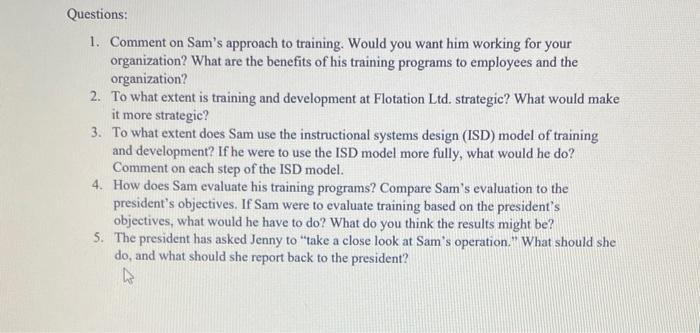
When responding to a case study or scenario, the HR practitioner should use a consistent, factbased, problem-solving approach. The development of this skill will allow the HR practitioner to respond to issues as they arise using an analytical methodology in order to explore possible solutions. "Great course, Sam!" said the trainees as they walked out the door and headed for the parking lot. Just like all the others. Sam Harris, a veteran trainer with Flotation Ltd., a manufacturer of life jackets and other flotation devices, smiled as he gathered his notes together. He had just finished two hours of wisecracking and slightly off-colour storytelling as he worked his way through the third session of a human relations course for supervisors. "Keep 'em happy" was Sam's motto. Give the troops what they want, keep your enrolments up, and no one will complain. Sam was good at it, too! For 25 years, he had earned an easy living, working the politics, producing good numbers of trainees for the top brass to brag about ("We give each employee up to 30 hours of training every year!"), and generally promoting his small training group as a beehive of activity. Everybody knew Sam and everybody liked him. His courses were fun. He had no trouble convincing managers to send their people. He put out a catalogue with his course list every year in January. He hadn't had a cancellation in more than 10 years. Some managers said that training was the best reward they had. Now, only two years from retirement, Sam intended to coast comfortably into pension-land. All his favourite courses had long been prepared. All he had to do was make adjustments here and there and create some trendy new titles. But times were changing. The company president was thinking differently. "I need somebody to take a close look at our training function," he said. Sitting in the president's office, Jenny Stoppard, the newly hired vice- president of human resources, wondered what he meant. Flotation Ltd. had a reputation as a company with a well-trained workforce. "We need to increase our productivity per person by 50 percent over the next three years," the president continued. "And you are going to spearhead that effort. We spend a lot on training and we cycle people through a lot of courses. But I'm not satisfied with the bottom line. I know that while Dad was president he swore by Sam and said he was the greatest. I don't know anymore. Maybe a whole new approach is needed. Anyway, I want you to take a close look at Sam's operation." Later in the day, the president called Sam into his office. "Sam, I want you to meet Jenny Stoppard. I've just hired her as vice-president of human resources. She's your new boss. I think the next three years are going to be very exciting around here, and Jenny is going to be a key player in the drive to increase our competitiveness. I want you to do everything in your power to cooperate with her." Using the HR thought cycle as a guide, we are able to consistently analyze the case study. \begin{tabular}{|l|l|} \hline HR impact: & HRwillneedtoprovideclearcommunicationregardingthenewproductivityandperformanceexpectations.HRwillhavetoensurethattherevisedexpectationsarealignedwithpotentialchangestothetrainingprograminaconstructiveway. \\ \hline Furtherconsiderations: & SamandtherestoftheemployeesmayresenttheroleofHRinchanginganestablishedandsuccessfultrainingprogram. \\ \hline Proactiveresponse: & TheVPofHRwillneedtoworkwithSaminapositiveandrespectfulwaytoensurethatthetrainingprogramhedevelopedcontinuestobevaluedandthathe,Sam,ispartofdevelopingchangesasneeded. \\ \hline \end{tabular} 1. Comment on Sam's approach to training. Would you want him working for your organization? What are the benefits of his training programs to employees and the organization? 2. To what extent is training and development at Flotation Ltd. strategic? What would make it more strategic? 3. To what extent does Sam use the instructional systems design (ISD) model of training and development? If he were to use the ISD model more fully, what would he do? Comment on each step of the ISD model. 4. How does Sam evaluate his training programs? Compare Sam's evaluation to the president's objectives. If Sam were to evaluate training based on the president's objectives, what would he have to do? What do you think the results might be? 5. The president has asked Jenny to "take a close look at Sam's operation." What should she do, and what should she report back to the president
Step by Step Solution
There are 3 Steps involved in it

Get step-by-step solutions from verified subject matter experts
 Study Help