Question: Based on the article, answer the following questions: Do you need additional information areas to evaluate the article findings/conclusions? Summarize the findings/conclusions. Were the findings
Based on the article, answer the following questions:
- Do you need additional information areas to evaluate the article findings/conclusions?
- Summarize the findings/conclusions. Were the findings substantively important?
- What additional questions are suggested by the article's conclusions?
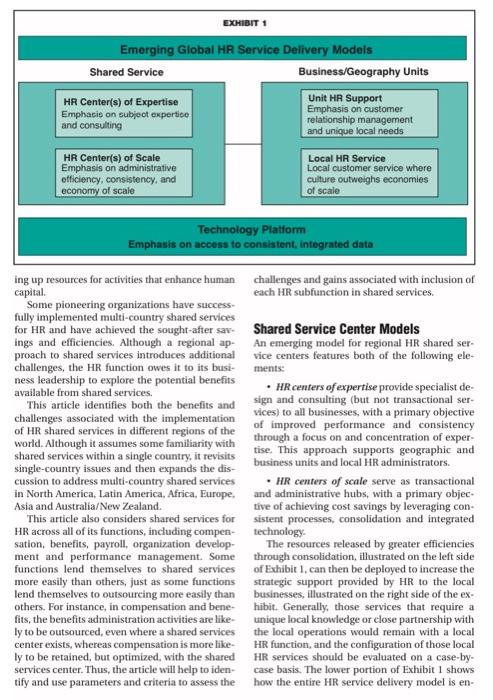
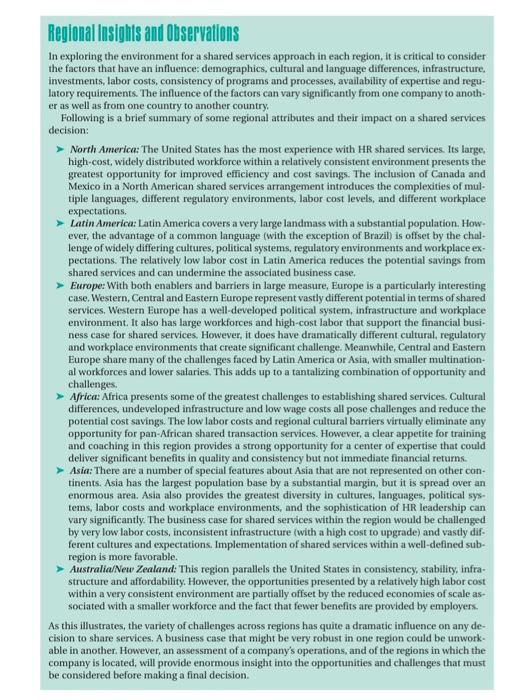
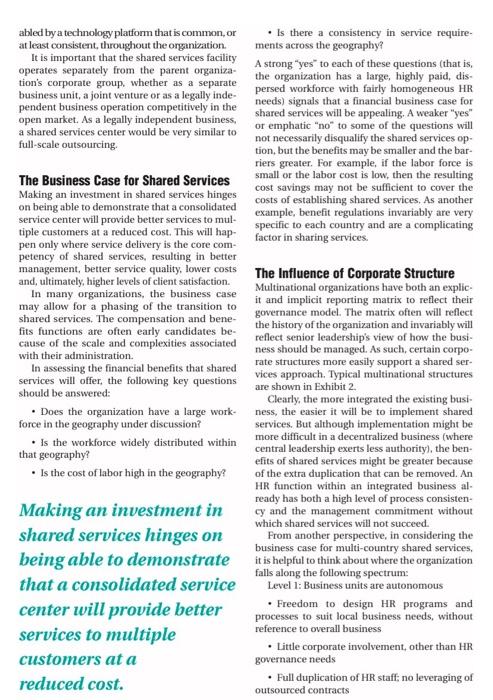
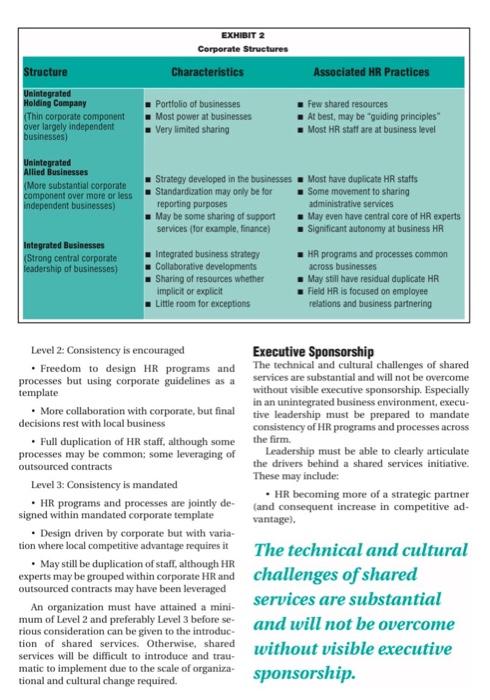
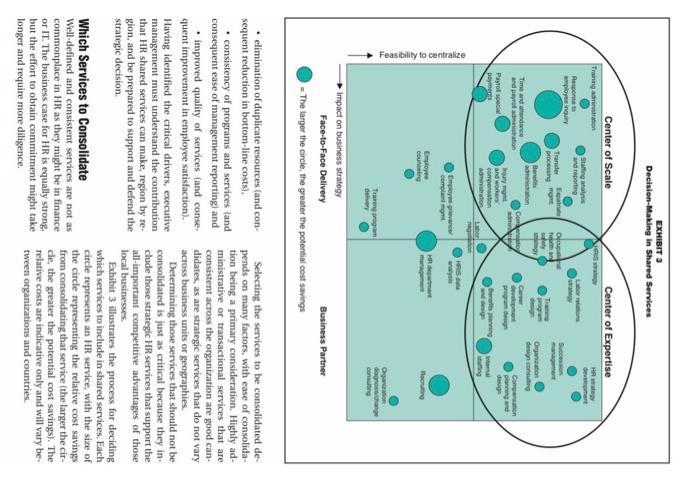
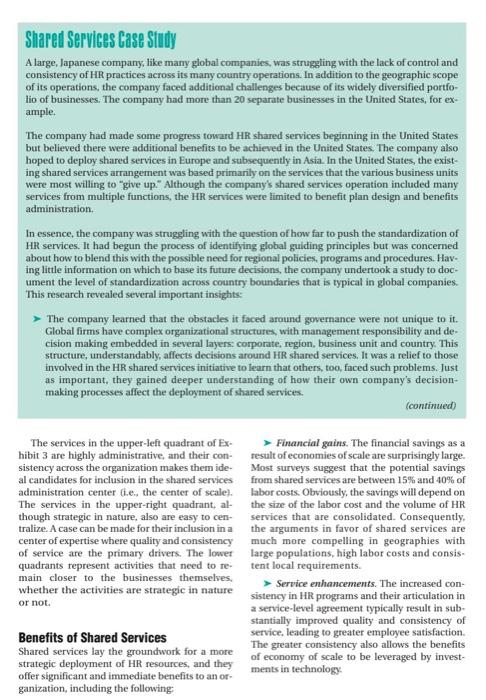
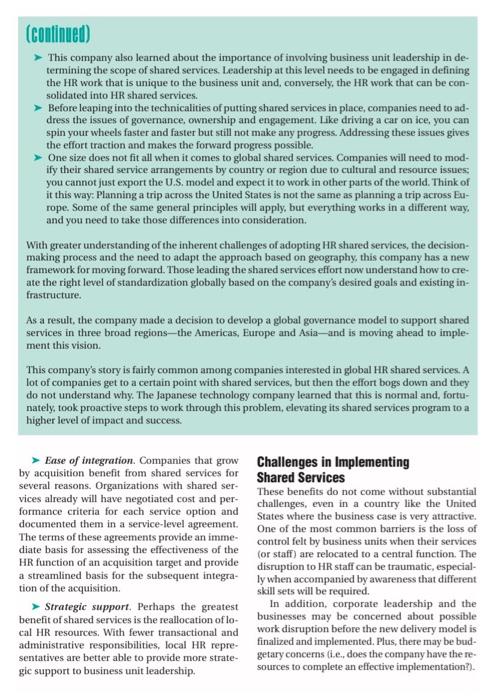
aximizing the return on human One way to dramatically improve the perforcapital investments is uppermost mance of the HR function-particularly for large, in the minds of executives today, geographically dispersed organizations with and in many organizations it is multiple lines of business-is through shared serthe most critical success factor. vices. Consolidating administrative and transac- However, recent surveys reveal tional processing activities within a dedicated adHowever, recent surveys reveal tional processing activities within a dedicated ad- that despite an ever-increasing ministrative facility is not a new concept. rise in HR budgets, the HR func- Regional shared services supporting finance, IT, tion still spends too much time travel and expatriate management exist throughon administrative and transac- out the world. But shared services for HR have tional activities rather than on HR mostly been limited to the larger, uniform counstrategy, which would make a tries, particularly the United States and the Unit- more valued contribution to the ed Kingdom. When done correctly, shared sermore valued contribution to the ed Kingdom. When done correctly, shared ser- business. Clearly, a transforma- vices can deliver significant cost savings and tion in HR is still required. \begin{tabular}{|c|} \hline \multicolumn{1}{|c|}{ Emared Service } \\ \hline HR Center(s) of Expertise Emphacie on cubject expertico and consulting \\ \hline HR Center(s) of Scale Emphasis on administrative efficiency, consistency, and economy of scale \\ \hline \end{tabular} ExHIBrT 1 \begin{tabular}{|l} \hline Technology Piatorm \\ Emphasis on access to consistent, integrated data \\ \hline \end{tabular} Regional Insights and Ousepvallons In exploring the environment for a shared services approach in each region, it is critical to consider the factors that have an influence: demographics, cultural and language differences, infrastructure, investments, labor costs, consistency of programs and processes, availability of expertise and regulatory requirements. The influence of the factors can vary significantly from one company to another as well as from one country to another country. Following is a brief summary of some regional attributes and their impact on a shared services decision: - North America: The United States has the most experience with HR shared services. Its large, high-cost, widely distributed workforce within a relatively consistent environment presents the greatest opportunity for improved efficiency and cost - savings. The inclusion of Canada and Mexico in a North American shared services arrangement introduces the complexities of multiple languages, different regulatory environments, labor cost levels, and different workplace expectations, - Latin America: Latin America covers a very large landmass with a substantial population. However, the advantage of a common language (with the exception of Brazil) is offset by the challenge of widely differing cultures, political systems, regulatory environments and workplace expectations. The relatively low labor cost in Latin America reduces the potential savings from shared services and can undermine the associated business case, > Europe: With both enablers and barriers in large measure, Europe is a particularly interesting case. Western, Central and Eastern Europe represent vastly different potential in terms of shared services. Western Europe has a well-developed political system, infrastructure and workplace environment. It also has large workforces and high-cost labor that support the financial business case for shared services. However, it does have dramatically different cultural, regulatory and workplace environments that create significant challenge. Meanwhile, Central and Eastern Europe share many of the challenges faced by Latin America or Asia, with smaller multinational workforces and lower salaries, This adds up to a tantalizing combination of opportunity and challenges, > Africas Africa presents some of the greatest challenges to establishing shared services. Cultural differences, undeveloped infrastructure and low wage costs all pose challenges and reduce the potential cost savings. The low labor costs and regional cultural barriers virtually eliminate any opportunity for pan-African shared transaction services. However, a clear appetite for training and coaching in this region provides a strong opportunity for a center of expertise that could deliver significant benefits in quality and consistency but not immediate financial returns. - Asia: There are a number of special features about Asia that are not represented on other continents. Asia has the largest population base by a substantial margin, but it is spread over an enormous area. Asia also provides the greatest diversity in cultures, languages, political systems, labor costs and workplace environments, and the sophistication of HR leadership can vary significantly. The business case for shared services within the region would be challenged by very low labor costs, inconsistent infrastructure (with a high cost to upgrade) and vastly different cultures and expectations. Implementation of shared services within a well-defined subregion is more favorable. > Australia/New Zealand: This region parallels the United States in consistency, stability, infrastructure and affordability. However, the opportunities presented by a relatively high labor cost within a very consistent environment are partially offset by the reduced economies of scale associated with a smaller workforce and the fact that fewer benefits are provided by employers. As this illustrates, the variety of challenges across regions has quite a dramatic influence on any decision to share services. A business case that might be very robust in one region could be unworkable in another. However, an assessment of a company's operations, and of the regions in which the company is located, will provide enormous insight into the opportunities and challenges that must be considered before making a final decision. abled by a technology platform that is common, or - Is there a consistency in service requireat least consistent, throughout the organization. ments across the geography? pen only where service delivery is the core competency of shared services, resulting in better Makingan investmentin ready has both a high level of process consisten- cy and the management commitment without which shared services will not succeed. sharedserviceshingesonwhichsharedserviceswillnotsucced.Fromanotherperspective,inconsideringthebusinesscaseformulti-countrysharedservices,itishelpfultothinkaboutwheretheorganizationbeingalletodemalongthefollowingspectrum: center will provide better__ - Freedom to design Hr programs and services to multiple reference to overall business customers at a governance needs - Full duplication of HR staff; no leveraging of Impact on business strategy Face-to-Face Delivery Business Partner - The larger the circle, the greater the potential cost savings Shaped Servicos Case Study A large, lapanese company, like many global companies, was struggling with the lack of control and consistency of HR practices across its many country operations. In addition to the geographic scope of its operations, the company faced additional challenges because of its widely diversified portfolio of businesses. The company had more than 20 separate businesses in the United States, for example. The company had made some progress toward HR shared services beginning in the United States but believed there were additional benefits to be achieved in the United States. The company also hoped to deploy shared services in Europe and subsequently in Asia. In the United States, the existing shared services arrangement was based primarily on the services that the various business units were most willing to "give up." Although the company's shared services operation included mamy services from multiple functions, the HR services were limited to benefit plan design and benefits administration. In essence, the company was struggling with the question of how far to push the standardization of HR services. It had begun the process of identifying global guiding principles but was concerned about how to blend this with the possible need for regional policies, programs and procedures. Having little information on which to base its future decisions, the company undertook a study to document the level of standardization across country botindaries that is typical in global companies. This research revealed several important insights: - The company learned that the obstacles it faced around governance were not unique to it. Global firms have complex organizational structures, with management responsibility and decision making embedded in several layers: corporate, region, business unit and country. This structure, understandably, affects decisions around HR shared services. It was a relief to those involved in the HR shared services initiative to learn that others, too, fnced such problems. Just as important, they gained deeper understanding of how their own company's decisionmaking processes affect the deployment of shared services. (conlinued) This company atso learned about the importance of involving business unit leadership in determining the scope of shared services. Leadership at this level needs to be engaged in defining the HR work that is unique to the business unit and, conversely, the HR work that can be consolidated into HR shared services. - Before leaping into the technicalities of putting shared services in place, companies need to address the issues of governance, ownership and engagement. Iike driving a car on ice, you can spin your wheels faster and faster but still not make any progress. Addressing these issues gives the effort traction and makes the forward progress possible. > One size does not fit all when it comes to global shared services. Companies will need to modify their shared service arrangements by country or region due to cultural and resource issues; you cannot just export the U.S. model and expect it to work in other parts of the world. Think of it this way: Planning a trip across the United States is not the same as planning a trip across Europe. Some of the same general principles will apply, but everything works in a different way, and you need to take those differences into consideration. With greater understanding of the inherent challenges of adopting HR shared services, the decisionmaking process and the need to adapt the approach based on geography, this company has a new framework for moving forward. Those leading the shared services effort now understand how to create the right level of standardization globally based on the company's desired goals and existing infrastructure. As a result, the company made a decision to develop a global governance model to support shared services in three broad regions-the Americas, Europe and Asia-and is moving ahead to implement this vision. This company's story is fairly common among companies interested in global HR shared services, A lot of companies get to a certain point with shared services, but then the effort bogs down and they do not understand why. The lapanese technology company learned that this is normal and, fortunately, took proactive steps to work through this problem, elevating its shared services program to a higher level of impact and success









 Study Help