







Question: based on the study (first picture) a. elaborate on the internal validity, external validity, and construct validity? b. explain the strength and weakness of each?
based on the study (first picture)
Study 2: More Knowledge Leads to Less Liking If participants' intuitions in Study IB are correct, then we should observe a positive-and causal-relationship between amount of knowledge about an individual and liking for that individual. In Study 2, however, we demonstrate that people's intuitions are incorrect and that more information leads to less liking. Trait Generation We created a list of 28 traits, drawn from Asch (1946), Edwards and Weary (1993), and Pavelchak (1989). Pretest participants (N = 121) rated a randomly drawn subset of 10 of these traits (thus each trait was rated approximately 40 times) on a 10-point scale (1= wouldn't like at all, 10= would like very much) for how much they would like someone described with that trait. Means ranged from 2.16 to 9.08, suggesting that the traits encompassed both positive and negative attributes; in addition, the set of traits was rated positively overall (M= 6.91, SD = 2.43), suggesting that results showing greater dislike after participants saw more of the traits were unlikely to be due to an overly negative set of traits. Method Participants (N = 76; 30 men, 44 women, 2 people who did not report gender; age M = 24.1 years, SD = 10.3) completed the survey after being approached on the MIT campus or as part of a class exercise. Participants were told that we had asked other people to list traits that described themselves and that we were randomly drawing from one person's list for them to see. Whereas previous studies have carefully controlled the place- ment and spacing of traits (e.g., Anderson, 1965; Bird, 1987; Hodges, 1974), we used a methodology that allowed us to more closely simulate how information about others is encountered in the real world-randomly and in varying amounts. Participants saw either 4, 6, 8, or 10 traits that had been randomly drawn from the set of 28 and then rated how much they thought they would like the individual described by these traits on a 10-point scale (1= wouldn't like at all, 10 = would like very much). Results As predicted, and in contrast to participants' intuitions in Study IB, we observed a significant negative correlation between the number of traits known and liking. (76)=-.23, p=05. Because traits were selected randomly for each participant, this effect cannot be attributed to systematic biases on trait selection. Holding the average valence of traits and the traits themselves constant. participants simply liked target individuals less when they had more information about them. Ambiguity Breeds Similarity; Familiarity Breeds Dissimilarity What mechanism might underlie positive impressions becoming more negative over time? We propose that initial impressions are overly positive in part because of erroneous perceptions of simi- larity to ambiguous targets. With the acquisition of more informa- tion, ambiguity is resolved and dissimilarity reveals itself, causing a decrease in liking. We place such a heavy role on similarity as our proposed mechanism for two reasons. First, similarity to the self from shared personality traits and values (e.g., Byrne, 1971; Byrne, Clore, & Smeaton, 1986) to trivial factors such as shared birthdays (Miller, Downs, & Prentice, 1998) has been shown repeatedly to be highly diagnostic of liking. Second, as with liking. perceptions of similarity are relatively high early in the acquain- tanceship process, both because people (falsely) assume similarity with others in the absence of other information (e.g., Krueger & Clement, 1997; Levinger & Breedlove, 1966; Rosenbaum, 1986; Ross, Greene, & House, 1977) and because people tend to empha- size or exaggerate their similarities with others when preparing to meet (Rowatt, Cunningham, & Druen, 1998, 1999). For dissimilarity to mediate the negative impact of information acquisition on liking, however, perceptions of dissimilarity must increase or cascade-over time. Previous research has shown that expectancy-disconfirming information is highly diagnostic in forming impressions (Hastie & Kumar, 1979), particularly when negative information follows positive information (Aronson & Linder, 1965; Norton & Goethals, 2004), and that such diagnostic information alters the meaning of subsequently encountered infor- mation (Asch, 1946; Hamilton & Zanna, 1974; Hoyle, 1993; Kelley, 1950; Nisbett & Wilson, 1977). Because individuals ex- pect to find similarity, encountering evidence of dissimilarity is unexpected and therefore impactful; this initial dissimilarity then causes subsequent information to be interpreted as further evi- dence of dissimilarity. In short, we propose the existence of dissimilarity cascades: One instance of dissimilarity causes subse- quent information to be interpreted as further evidence of dissim- ilarity, leading to relatively greater perceptions of dissimilarity over the course of impression formation. Summary ( Critique Accurate and concise summary that follows the detailed guidelines Not plagiarized or inappropriately paraphrased (no direct quotes). Well-written and within the page limit. (On final version: shows significant improvements, addressed feedback) l Follows detailed guidelines Writing demonstrates understanding of validities Correct application of article content to the appropriate validity Correct application of the three rules for causation Addresses one merit + one shortcoming validity-One MUST be INTERNAL (On final version: shows significant improvements, addressed feedback) Follows detailed guidelines Compare & contrast strengths & weakness of validities in the two studies. Builds a case for which study is the "better more valid" one. Discusses prioritization of validities. Argument (
a. elaborate on the internal validity, external validity, and construct validity?
b. explain the strength and weakness of each?
c. the variables and how they were operationalized? 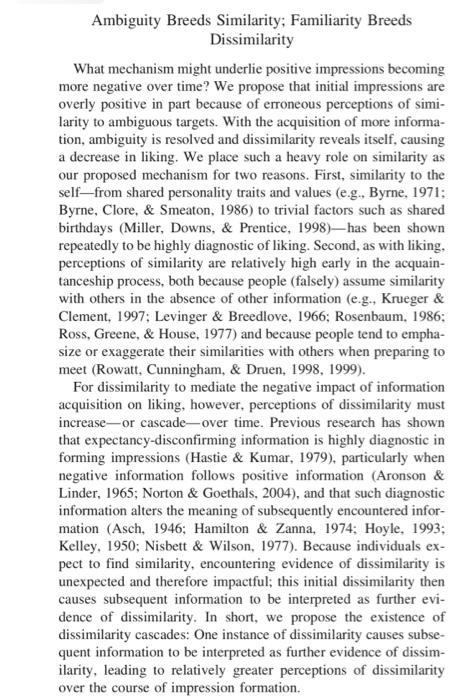
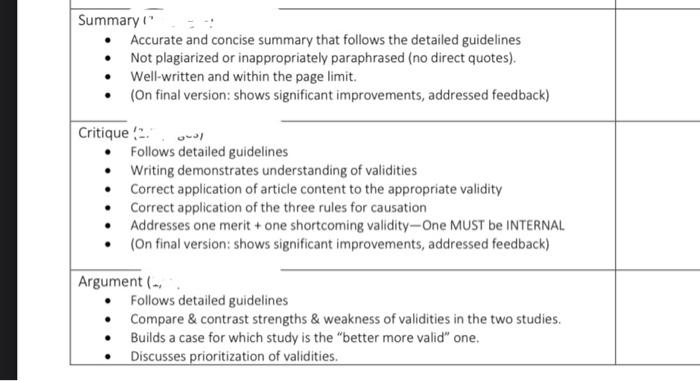
please write complete sentences
second image is the background research 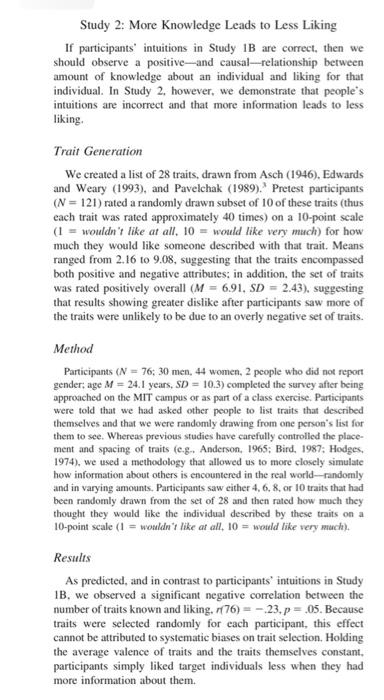
Step by Step Solution
There are 3 Steps involved in it
1 Expert Approved Answer
Step: 1 Unlock

Question Has Been Solved by an Expert!
Get step-by-step solutions from verified subject matter experts
Step: 2 Unlock
Step: 3 Unlock
 Study Help